Electrolysis vs. Laser Hair Removal: The Complete Comparison
By Aida Khazieva·Electrolysis·15 min read·Real Skin Beauty, Irvine CA·Updated July 27, 2026
The question comes up in almost every consultation I do at my studio in Irvine, CA: should I do laser first, or go straight to electrolysis? After 20 years treating hair removal clients across Orange County, I have given this answer hundreds of times. The short version is that these are fundamentally different methods with different clinical outcomes, different candidate requirements, and a very different definition of what the word "permanent" actually means. Here is the full picture, without the marketing version.
Quick answer: Electrolysis is the only FDA-recognized method of permanent hair removal and works on every hair color and skin tone. Laser is cleared for permanent hair reduction: it thins dark hair on lighter skin, but regrowth often occurs, especially with PCOS, and it does not work on blonde, white, gray or red hair.
How Each Method Destroys Hair Follicles
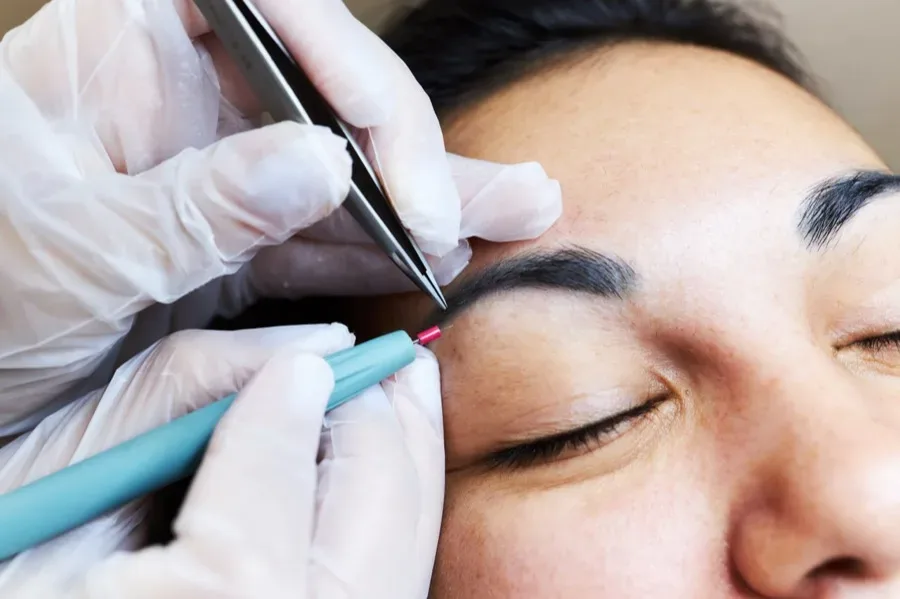
Electrolysis inserts a fine metal probe, roughly the same diameter as a hair shaft, directly into the follicle opening alongside the hair. An electrical current is then delivered through the probe into the follicle tissue. That current destroys the two structures responsible for hair production: the dermal papilla, which is the blood supply and growth command center at the base of the follicle, and the follicle bulge, where stem cells capable of regenerating the follicle reside. Destroying both means that follicle cannot ever produce another hair. The result is permanent in the literal sense.
Three modalities deliver that current. Galvanic electrolysis uses direct current to create sodium hydroxide through a chemical reaction within the follicle tissue, which destroys the papilla chemically. Thermolysis, also called short-wave or high-frequency electrolysis, uses alternating current that generates heat directly in the follicle, coagulating the cellular tissue thermally. Blend electrolysis combines both currents simultaneously: the heat accelerates and intensifies the chemical reaction from the galvanic current, which makes it particularly effective on coarse, deep, or curved follicles that resist single-modality treatment. I choose the modality based on hair coarseness, follicle depth, and the individual client's skin response. The right modality matters, and a practitioner who uses only one approach for every client and every hair type is not optimizing outcomes.
Laser takes an entirely different approach. Laser energy targets melanin, the pigment that gives hair its color. The melanin in the hair shaft absorbs the light energy and converts it to heat. That heat radiates outward and downward along the shaft toward the follicle, with the goal of damaging or destroying the papilla through thermal injury.
The word to notice in that sentence is "damaging." Laser can injure follicle tissue across a wide spectrum, from temporary growth disruption to significant long-term reduction. But unless the papilla is fully destroyed, the follicle retains some capacity to recover and resume hair production, particularly when ongoing hormonal signals continue to stimulate it. This is precisely why the FDA classifies laser as permanent hair reduction rather than permanent hair removal. The distinction is not semantic. It describes real biological outcomes in real patients that I see walking through my door every month after years of laser treatments. The American Academy of Dermatology confirms this distinction, noting that electrolysis can permanently remove hair with no maintenance treatments needed, while laser results are not fully permanent on all areas.
Which Hair Colors and Skin Tones Each Method Can Treat
Laser targeting depends on a specific physical requirement: adequate melanin contrast between the hair and surrounding skin. The laser needs a chromophore, a pigmented target in the hair, to absorb the light and generate sufficient heat. Without that contrast, the treatment either fails to reach the follicle adequately or creates burn risk in surrounding tissue.
This creates two significant groups for whom laser is not a viable primary option:
Clients with light hair: Blonde, red, white, gray, and strawberry-blonde hair contain little to no eumelanin, the specific pigment that laser targets. The chromophore is simply not there in adequate concentration. No current laser technology reliably overcomes this limitation. I regularly see marketing for certain laser devices claiming efficacy on light hair, and I consistently find these claims unsupported by clinical evidence when I follow up with clients who tried them. If you have light facial hair and want permanent removal, electrolysis is your only real option.
Clients with darker skin: Fitzpatrick skin types V and VI present a different problem. The melanin in the epidermis competes with the melanin in the hair. Laser energy intended for the hair follicle gets partially absorbed by the skin, creating real risk of burns and post-inflammatory hyperpigmentation. Nd:YAG lasers at 1064nm wavelength were designed specifically to reduce this risk by using a wavelength less absorbed by epidermal melanin, but efficacy is reduced compared to lighter-skinned clients, and the risk profile remains higher even with the most appropriate device. For darker-skinned clients treating facial areas where hyperpigmentation is particularly visible, electrolysis eliminates this risk entirely.
Hair Color and Laser Efficacy
Laser energy targets melanin. Black and dark brown hair absorbs laser energy most effectively. Light brown hair responds moderately. Blonde, red, gray, and white hair have insufficient melanin for laser to target. Electrolysis achieves the same permanent result on every hair color because it uses electrical current, not light energy.
Electrolysis has no such restrictions. The electrical current destroys follicle tissue through a physical and chemical mechanism that has nothing to do with hair color or skin tone. White hair on dark skin responds to electrolysis identically to dark hair on light skin. This is not a marginal advantage for the subset of clients it applies to. For a meaningful number of people seeking hair removal, electrolysis is the only method that actually works on their specific combination of hair color and skin tone.
I treat clients in Irvine and across Orange County who span every skin tone and hair color. Fitzpatrick I through VI, hair ranging from nearly black to white. Electrolysis is the only method that works for all of them without modification.
Two different tools: a fine electrolysis probe treats single follicles, a laser handpiece treats an area of skin with light.
The FDA Approval Difference: Reduction vs. Removal
The FDA language here is precise and worth stating clearly. Laser and intense pulsed light devices are cleared for "permanent hair reduction," defined as a long-term stable reduction in the number of hairs regrowing after a treatment course. Electrolysis devices are cleared for "permanent hair removal," defined as the permanent destruction of the hair follicle.
Reduction. Removal. These describe different outcomes.
Clients often assume that FDA-cleared means permanently effective regardless of which device or method is used. The difference between these two designations is more specific than most people realize. Both methods are approved for their respective defined outcomes. Laser is approved and effective at reducing hair. Electrolysis is approved and effective at removing hair permanently, where "permanently" means that a properly treated follicle cannot produce another hair.
The FDA Distinction That Matters
The FDA classifies laser and IPL as "permanent hair reduction" devices. It classifies electrolysis as "permanent hair removal." This distinction reflects actual biological outcomes: a damaged follicle can recover; a destroyed one cannot. The American Electrology Association recognizes electrolysis as the only method achieving permanent hair removal as medically defined.
The clinical implication: laser-treated hair can and does return. In clients without active hormonal factors, a well-executed laser course can achieve a reduction that remains stable for several years. But long-term follow-up data consistently shows meaningful regrowth for many clients over 3 to 5 year periods, particularly when hormonal changes occur with age, pregnancy, menopause, or thyroid shifts. For many clients this means returning to maintenance sessions indefinitely.
For clients in Orange County who completed laser courses years ago and are now seeing gradual regrowth, this is not a treatment failure in the clinical sense. It is the expected behavior of a method that was never designed to produce permanent removal. Understanding this upfront changes the financial and time calculations involved in choosing between methods.
Pain and Comfort: A Realistic Comparison
Neither method is painless, and any claim otherwise is oversimplified. What is accurate is that both have become substantially more comfortable with improved technology and technique, and that individual experience varies considerably by treatment area, baseline sensitivity, and provider skill.
Laser: Each laser pulse treats a relatively large area of skin simultaneously. Most clients describe the sensation as a rubber band snap against the skin, sometimes combined with brief heat. Modern systems integrate cooling mechanisms including cryogen spray, contact cooling plates, or cold air streams that substantially reduce the burn sensation. Larger body areas treated with modern cooled systems are generally well-tolerated. Upper lip, bikini, and underarm tend to be more sensitive regardless of cooling.
Electrolysis: The sensation happens one hair at a time. Each probe insertion creates a brief heat or sting lasting a fraction of a second. Between insertions there is no discomfort at all. Because the experience is divided into these very brief individual moments rather than a broad snap across a skin area, many clients find the psychological experience more manageable, even if an individual insertion is more intense than a single laser pulse.
Pain varies substantially by treatment area. Based on consistent client feedback over 20 years:
Most sensitive for electrolysis: Upper lip, bikini area, labia, inner thigh
Generally well-tolerated: Legs, arms, back, chest, forehead
Variable by individual: Neck, sideburns, hairline
For clients who are sensitive, topical anesthetic applied 45 to 60 minutes before the session makes a meaningful difference. EMLA cream or a compounded lidocaine preparation work well for most areas. I always recommend this for upper lip treatment and for anyone who has expressed concern about discomfort during the consultation. The goal is a treatment experience that is manageable enough that clients follow through on their full treatment plan, because skipping sessions due to discomfort extends your overall timeline significantly.
One thing I notice consistently: as electrolysis treatment progresses over multiple sessions, the experience becomes easier. The hairs being treated become progressively finer and sparser with each session, which means less current intensity is required per follicle, which directly reduces the sensation. Clients in their later sessions regularly tell me it feels much easier than their first appointment. That trajectory is an intrinsic part of the process.
Electrolysis can be used close to the eye area, where laser is not suitable.
Cost Comparison: Per Session vs. Lifetime Value
Per-session price comparisons between laser and electrolysis are fundamentally misleading without the full context of total investment over time. The honest question is what you spend to achieve your actual goal, and those goals differ.
Orange County laser pricing:
Per session, facial area: $150 to $400 at a reputable provider
Initial course: 6 to 12 sessions, totaling $900 to $4,800
Annual maintenance sessions: $100 to $300 per session, typically 1 to 2 per year
10-year total for a facial area: $2,000 to $7,000 or more, with no guaranteed permanence
Electrolysis pricing (Irvine and Orange County):
Per session: $70 to $150 depending on session length
Sessions needed: More individual sessions than laser, but with a finite endpoint
Maintenance after completion: None. Treated follicles do not return.
Total investment: Front-loaded in time but no ongoing expense once complete
The True Cost Question
Comparing laser and electrolysis by session price alone misses the point. Laser has no defined endpoint for most clients, meaning you are committing to indefinite maintenance. Electrolysis has a real, permanent finish line. When calculating total investment over 10 years, the difference between an ongoing maintenance expense and a one-time complete treatment is often more significant than the per-session price comparison suggests.
For some clients, a combination approach makes the most financial sense. Using laser to reduce overall density quickly across a large area of dark hair on light skin, then using electrolysis to permanently treat remaining hairs, shortens the total electrolysis treatment time. This can reduce total cost for eligible clients while still achieving permanent clearance.
For clients with light hair, dark skin, or hormonal conditions, money spent on laser often does not deliver the expected reduction. In those cases, the entire laser investment would have been more effectively applied to electrolysis from the start. I discuss actual total cost projections, not just per-session pricing, at every free consultation at my Real Skin Beauty studio. The number that informs a good decision is total investment to clearance, not the cost of a single appointment.
Electrolysis vs. Laser for PCOS and Hormonal Hair
PCOS creates a fundamentally different treatment landscape, and it is one I have spent over 20 years working through with clients across Orange County. The standard hair removal comparison shifts significantly when active hormonal stimulation is part of the picture.
The mechanism: PCOS causes elevated androgen hormones, primarily testosterone and its derivative dihydrotestosterone (DHT). These androgens continuously stimulate follicles that would otherwise remain dormant, activating new hair growth in areas classically associated with male hair patterns: chin, upper lip, neck, jaw, sideburns, chest, abdomen, and upper thighs.
The laser problem with PCOS: Even when a full laser course effectively reduces the follicles that were active during treatment, the underlying hormonal environment does not change. New follicles, previously dormant and therefore invisible and untreatable during the laser course, activate afterward as androgen stimulation continues. Within 6 to 18 months of completing a laser course, many PCOS clients watch new hair emerge in areas they thought were cleared. This is not a treatment failure in the technical sense. The laser did exactly what it was cleared to do: reduce active follicles at the time of treatment. But active hormonal stimulation continued generating new growth.
I see this scenario regularly at my Irvine studio. Clients arrive having spent several thousand dollars on laser treatment for their chin and upper lip. They achieved clearing for a year or two, then watched new growth emerge, assumed the laser had stopped working, and came to me as a next step. The laser worked exactly as it was supposed to. The hormonal condition created a pool of new follicles that laser could not preemptively treat.
Electrolysis and PCOS: The same limitation applies in principle. Electrolysis cannot preemptively treat a dormant follicle that has not yet activated and become visible. But each follicle that is properly treated with electrolysis is permanently destroyed, regardless of what the hormonal environment does afterward. Previously treated follicles never return. This is the critical distinction: laser reduces active follicles without permanently disabling them. Electrolysis permanently disables each treated follicle while new follicles activate and become treatable in subsequent sessions.
The treatment approach for PCOS clients involves working systematically through the population of hormonally active follicles as they appear over time. Medical management of PCOS through an endocrinologist or gynecologist, including medications such as spironolactone or metformin, can reduce the rate of new follicle activation and significantly shorten the overall treatment timeline. For more on my specific approach to hormonal hair growth, see the PCOS electrolysis page or visit the FAQ for common PCOS treatment questions.
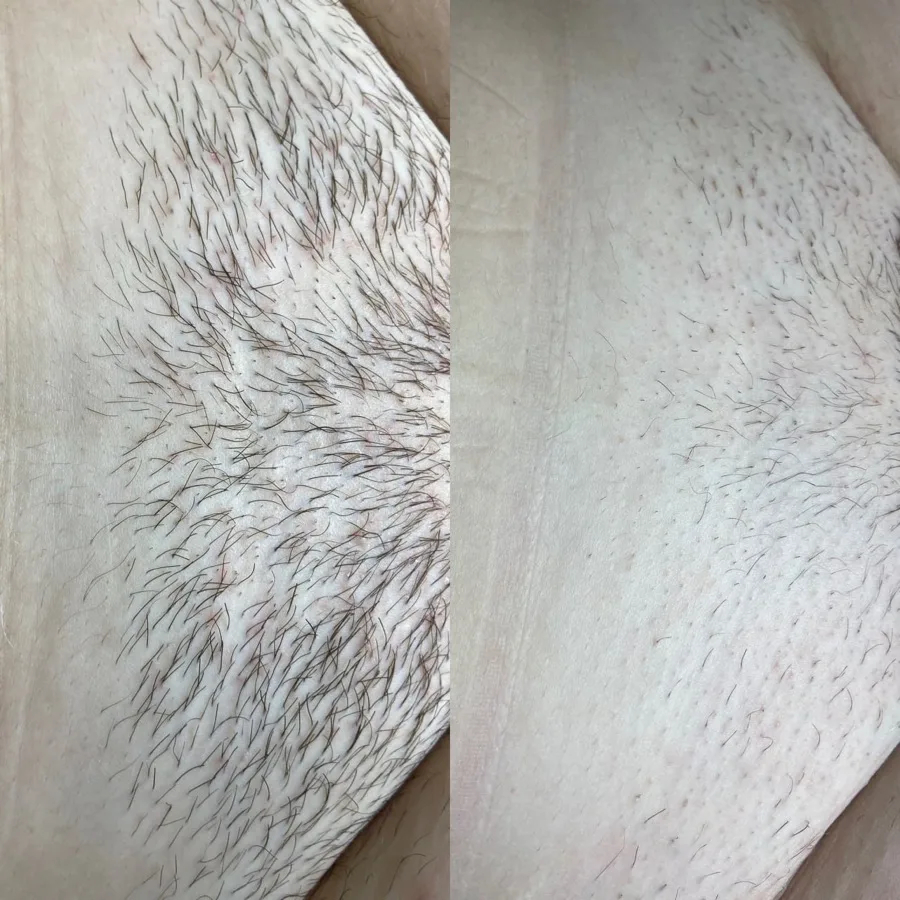
Body hair before and after electrolysis at Real Skin Beauty. Individual results vary.
Treatment Areas: What Each Method Can and Cannot Do
Where laser has genuine advantages:
Large body areas with dark hair: Full legs, full back, chest, and abdomen are areas where treating hairs individually with electrolysis would require a very large number of total treatment hours. On a client with coarse dark hair on light skin, laser can dramatically reduce density across these large areas in a reasonable course of sessions.
Speed per session: A full-leg laser session takes 45 to 90 minutes. Achieving comparable density reduction via electrolysis alone on the same area could take 50 to 100 or more total hours of treatment. For clients who are good laser candidates, this speed advantage is real and significant.
Density reduction before electrolysis: Laser can function as a thinning step that meaningfully shortens the total electrolysis treatment time on eligible areas, making it a useful first step in a planned combination approach.
Where electrolysis is the necessary choice:
Facial hair on darker skin (Fitzpatrick IV through VI), where laser carries real risk of burns and hyperpigmentation
Any client with primarily light, gray, white, or red hair that laser cannot target
PCOS and active hormonal hair growth where permanent destruction of each follicle is the only path to lasting clearance
Bikini and Brazilian on clients with darker skin, where the risk of hyperpigmentation and burns is elevated
Where a planned combination strategy makes sense: Clients with large areas of primarily dark hair on light-to-medium skin can benefit from laser to reduce overall density, followed by electrolysis to permanently treat remaining lighter or resistant hairs. I help plan combination timelines at consultations, including the appropriate waiting period between the last laser session and starting electrolysis in the same area. Typically 4 to 6 weeks of waiting is appropriate to allow the skin to settle and for any treated hairs to shed fully before beginning electrolysis work in the same area.
Which Is Right for You?
After 20 years of this work, here is how I guide the decision in practice.
Choose electrolysis directly if:
Your hair is light, white, gray, red, or blonde in the treatment area
Your skin is Fitzpatrick type IV, V, or VI
You have PCOS, elevated androgens, or any other active hormonal hair stimulation
You want genuinely permanent results, not long-term reduction with ongoing maintenance
You are treating a precision area where follicle-by-follicle control is necessary
You have already completed laser treatment and are seeing regrowth
Consider laser as a starting step if:
You have coarse, dark hair on light-to-medium skin
You are treating a large body area and want to reduce density before committing to electrolysis for permanence
You understand that laser provides reduction rather than removal and are comfortable with ongoing maintenance sessions
A significant density reduction, rather than full permanent clearance, is sufficient for your goal in a specific area
Consider using both in sequence if:
You are treating a large area with mostly dark hair but significant lighter or finer resistant hairs
You want to shorten your electrolysis treatment time and have a realistic timeline for a two-phase approach
Your skin tone and hair color make you a good laser candidate for the bulk reduction phase
If you are uncertain which description fits your situation, the most useful thing I can do is see you directly, assess your hair type, skin tone, hormonal history, and treatment goals, and give you a specific recommendation. At Real Skin Beauty in Irvine, CA, every new client starts with a free consultation where we work through exactly this decision. You can read more about the electrolysis services I offer or find answers to common questions on the FAQ page. For a deeper look at what permanent actually means, read Is Electrolysis Really Permanent? What the Science Actually Says.
Frequently Asked Questions
+ Can laser hair removal ever be truly permanent?
Laser is FDA-cleared for permanent hair reduction, not permanent hair removal. It significantly reduces hair density in most eligible clients, but regrowth occurs over time for many people, particularly when hormonal changes are involved. Long-term studies show meaningful regrowth over 3 to 5 year periods in a significant portion of clients. Electrolysis is the only hair removal method cleared by the FDA for permanent hair removal, which means a properly treated follicle cannot produce another hair.
+ Does laser work on light, white, gray or red hair?
No. Laser requires melanin in the hair to absorb the light energy and generate enough heat to damage the follicle. Blonde, white, gray and red hair contain insufficient melanin for laser to target effectively. No current laser technology reliably overcomes this limitation regardless of what device marketing claims. Electrolysis works on all hair colors without exception because the mechanism is electrical, not light-based.
+ Is electrolysis more painful than laser?
Pain varies by treatment area and individual sensitivity, and the sensations are genuinely different rather than one being universally more painful than the other. Electrolysis feels like a brief heat flash lasting a fraction of a second per individual hair. Laser can feel like a rubber band snap across a broader skin area. Many clients who have experienced both describe a preference for electrolysis because the sensation is brief and localized rather than a larger surface snap. Topical numbing cream applied before electrolysis makes a significant difference for sensitive areas.
+ How many laser sessions vs. electrolysis sessions will I need?
Laser typically requires 6 to 12 initial sessions for the primary treatment course, plus annual maintenance sessions indefinitely for most clients as hair gradually returns. Electrolysis requires more individual sessions because each follicle is treated one at a time, but there is a real permanent endpoint: once all follicles in an area have been treated during their active growth phase, no maintenance is needed. The total session count for electrolysis varies by area, hair density, and hormonal factors, and I provide realistic estimates at your free consultation.
+ Can I do laser and electrolysis at the same time?
Yes, and many clients use them strategically together. A common approach is to use laser first to reduce overall hair density on a large area with dark hair, then use electrolysis to permanently clear the remaining hairs, particularly lighter-colored or resistant ones that laser could not target. The two methods do not interfere with each other as long as you allow an appropriate waiting period of 4 to 6 weeks between a laser session and starting electrolysis in the same area. I help plan combination approaches at your free consultation.
Licensed electrologist and cosmetologist with 20+ years of experience. Aida sees clients at Real Skin Beauty, 18021 Sky Park Circle, Suite N, Irvine, CA 92614.
Book a free consultation with Aida Khazieva at Real Skin Beauty in Irvine, CA. She will assess your specific hair type, skin tone, and treatment goals and give you a clear recommendation tailored to your situation.
This article is for informational purposes and reflects Aida Khazieva's clinical experience. It does not replace a personalized medical consultation. Individual results vary.
Questions? Aida Answers Them All.
Visit our FAQ or book a free consultation to discuss your specific skin and hair concerns.