PCOS and Facial Hair: Your Complete Guide to Permanent Removal
By Aida Khazieva·PCOS & Hormonal Hair·16 min read·Real Skin Beauty, Irvine CA·Updated July 27, 2026
Most PCOS clients who walk into my studio in Irvine have spent years looking for a solution that works. They have waxed. They have threaded. Some have completed six or eight laser sessions at a clinic that promised excellent results. They keep coming back because the hair keeps coming back. This is not a failure of their effort or their patience. It is a result of being given the wrong tool for the wrong biological situation. In my 20 plus years of practice in electrolysis and hair removal, PCOS-related facial hair has been one of my most concentrated areas of expertise, and this guide covers what actually works and why.
Quick answer: Electrolysis permanently removes PCOS facial hair because it destroys each treated follicle regardless of hormone levels. PCOS can activate new follicles during treatment, so you will often need more sessions than someone without PCOS. Medical management such as metformin or spironolactone can reduce new growth and works well alongside electrolysis.
What PCOS Does to Your Hair Follicles
Polycystic ovary syndrome is primarily an endocrine condition, and its effect on hair growth begins at the hormonal level. PCOS causes elevated androgens, the class of hormones that includes testosterone, dihydrotestosterone (DHT), androstenedione, and DHEA-S. These are often called "male hormones," but that label is misleading. All women produce androgens, and they serve important physiological functions. In PCOS, androgen levels exceed the normal female range, or androgen sensitivity at the receptor level is elevated, or both.
Hair follicles contain androgen receptors. When androgens bind to these receptors, they trigger a biological response that depends on the follicle's location. On the scalp, this response causes follicular miniaturization: thick terminal hairs are converted over time into progressively finer hairs, eventually barely visible vellus hairs. This is why women with PCOS often experience both scalp thinning and facial hair thickening simultaneously. The same hormone acts on the same receptor type, but with opposite results depending on the site.
In androgen-sensitive areas of the face and body, the reverse process occurs. Fine, colorless vellus follicles transform into coarse, pigmented terminal follicles. The follicle deepens, its dermal papilla enlarges and becomes more vascularized, and it begins producing hair structurally identical to male beard hair. The chin, jaw, upper lip, neck, chest, abdomen, and inner thighs are the areas most commonly affected. Which zones are involved, and how severely, depends on the density of androgen receptors in that tissue and on individual receptor sensitivity.
One detail that changes how I approach PCOS cases clinically: androgen levels in a blood test do not tell the complete story of follicle behavior. Two clients with identical androgen readings can have dramatically different amounts of facial hair, because the follicles themselves vary in receptor sensitivity. This is why bloodwork alone does not give me everything I need to plan a realistic treatment timeline, and why a thorough clinical assessment matters as much as any lab result.
The most important thing to understand about PCOS and follicles, for the purpose of hair removal, is this: the hormonal environment that activates existing follicles can also recruit dormant ones. Follicles that have never produced visible hair can begin active production if androgen levels remain elevated over time. This ongoing recruitment is what distinguishes PCOS hair removal from treating a fixed, stable population of follicles. The total number of follicles requiring attention can increase during the treatment period, which is one reason PCOS timelines are longer than those for clients without hormonal drivers. Understanding this from the start means you can plan realistically rather than being blindsided midway through.
Key Clinical Point
Follicle behavior in PCOS is driven by receptor sensitivity, not androgen levels alone. Two clients with the same bloodwork can present very differently. A thorough clinical assessment gives a more accurate picture than lab values in isolation.
Why Most Hair Removal Methods Fail PCOS Clients
The methods most widely used for managing facial hair, including shaving, tweezing, threading, waxing, and depilatory creams, all share one fundamental property: they affect the hair itself but leave the follicle entirely intact. For PCOS clients, this is the critical limitation.
Shaving cuts the hair shaft at the skin surface. The follicle continues its growth cycle completely undisturbed. The hair regrows, and because it has been cut bluntly rather than tapering naturally to a point, the new growth feels stubbly and appears darker than it actually is. The visual impression of "making it worse" is real, even though the follicle biology has not changed. For many of my clients, daily shaving has become a morning ritual consuming 10 to 20 minutes and carrying significant emotional weight.
Tweezing and threading remove the hair shaft from the follicle through traction. The hair is pulled out from the root. The follicle rests briefly, then regenerates. Over years, repeated traction distorts the follicle channel, creating curved or kinked follicle tracts. I can treat these follicles with electrolysis, but they require more precise probe insertion, which adds time. If you have been tweezing for a decade, I account for this in your treatment plan.
Here is a summary of what each common method actually does at the follicle level:
Shaving: cuts at the skin surface, follicle fully intact, regrowth in 1 to 3 days
Tweezing: removes hair by traction, follicle rests then regenerates, distorts follicle geometry over time
Threading: same mechanism as tweezing, same limitations
Waxing: removes hair at the root, follicle rests then regenerates, can cause ingrown hairs in coarser PCOS hair
Depilatory creams: dissolve the hair shaft chemically at or near the skin surface, zero effect on the follicle
At-home IPL devices: may reduce some dark hairs but cannot address the full PCOS hair profile at home energy levels
Waxing presents the same fundamental issue as tweezing at scale. The follicle is not damaged; it simply rests and produces a new hair. Many PCOS clients wax every few weeks for years, which manages the appearance of hair but does not move toward a resolution. The financial cost compounds significantly: a $50 wax appointment every three weeks adds up to over $850 per year, indefinitely.
Depilatory creams dissolve the keratin protein of the hair shaft chemically at or slightly below the skin surface. The follicle continues functioning normally. These creams frequently cause contact irritation on sensitive facial skin, and regular use can compromise the skin barrier over time. For coarser PCOS chin hair, they often do not achieve a clean result and require reapplication within days.
All of these approaches have something in common: they address the visible hair, not the structure that produces it. For PCOS clients managing an ongoing androgenic stimulus, addressing only the visible hair will never achieve a lasting result.
The Core Distinction
Every method that targets only the visible hair leaves the follicle intact and able to produce more hair. For PCOS clients, permanent improvement requires treating the follicle itself, not the hair it creates.
Why Laser Particularly Disappoints PCOS Clients
I want to be precise about laser hair removal because it is more effective than the surface methods described above, and I do not want to dismiss it unfairly. Laser works by delivering light energy that is selectively absorbed by melanin pigment inside the hair shaft. That absorbed light converts to heat, which travels down the shaft to the follicle and damages the follicle's ability to produce hair. For a specific client profile (dark hair, light skin, stable hormone levels), laser can achieve excellent long-term reduction.
PCOS clients frequently fall outside that profile in ways that matter clinically.
First, PCOS hair is often a mixture. On the same chin or jaw, you may find coarse dark hairs alongside fine lighter hairs, and in clients approaching perimenopause or with naturally fair coloring, white and gray hairs in the same zone. Laser can damage the dark hairs substantially. It cannot address lighter or unpigmented hairs because there is no melanin to absorb the laser energy. The result is an area that appears improved from a distance but still has residual hairs that are frustrating at close range.
Second, the FDA classifies laser as achieving "permanent hair reduction," not permanent hair removal. This is not a technicality. It reflects the reality that laser damages follicles to varying degrees, and some damaged follicles recover their ability to produce hair over time. For clients with stable hormone levels, the reduction is often dramatic enough to be functionally satisfying for years. For PCOS clients with continuing androgen exposure, partially recovered follicles are more likely to be reactivated.
Third, laser sessions for PCOS clients often begin well. The first two or three sessions produce noticeable reduction. Then results plateau. More sessions produce diminishing returns. By the time many clients from across Orange County arrive at my studio, several have spent $1,500 to $3,000 on laser treatments and carry a mix of disappointment and confusion.
This pattern is not always the fault of the laser technology or the clinic. In many cases, clients simply were not given a clear explanation of why laser may not be the right primary tool for their specific hormonal picture. A thorough pre-treatment consultation should include an honest conversation about this. My recommendation for most PCOS clients is to use electrolysis as the primary treatment and, where appropriate, use laser selectively on areas with predominantly dark hair to reduce initial density before targeting residual hair with electrolysis.
This combined approach can be cost-effective and efficient. But it requires a provider who is honest about what each modality can and cannot achieve for your specific case, rather than promoting one method universally.
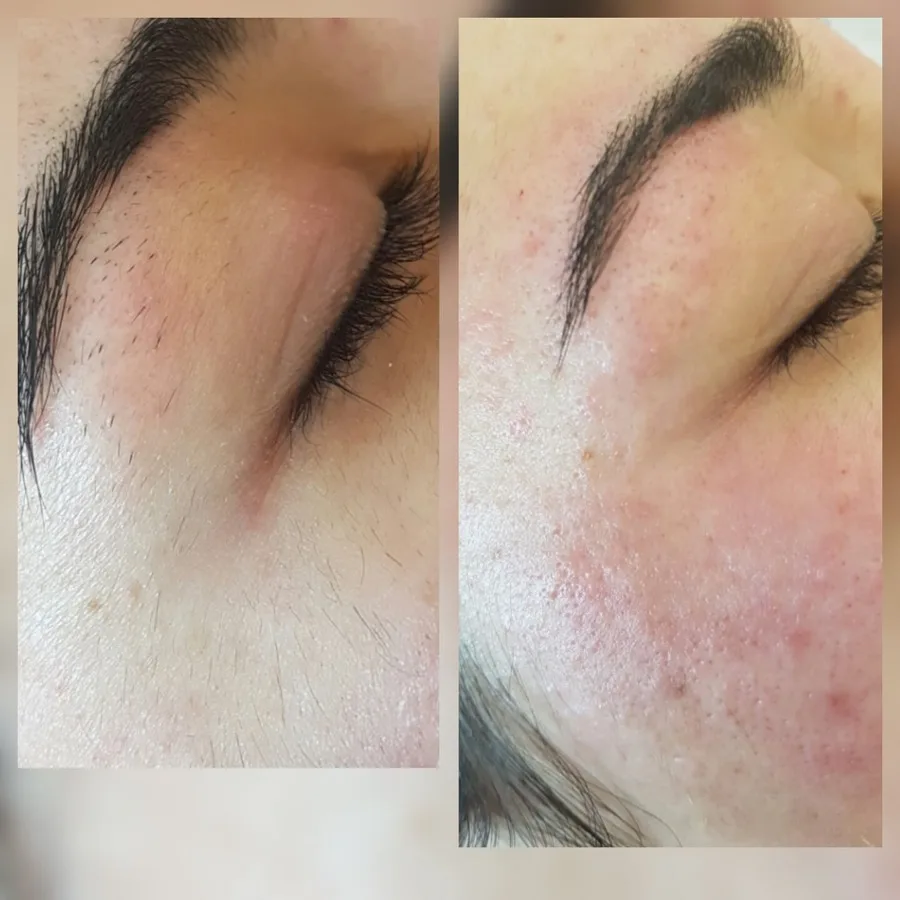
Cheek area before and after electrolysis. Individual results vary.
The Case for Electrolysis with PCOS
Electrolysis is the only hair removal method that the FDA recognizes as permanent, a distinction also confirmed by the American Academy of Dermatology. The word permanent here carries a specific meaning I want to be precise about, because it matters for PCOS clients in particular.
When electrolysis properly treats a follicle, the dermal papilla at the base of that follicle is deactivated. The dermal papilla is the cluster of specialized cells that generates new hair shaft cells. Once properly deactivated, the papilla cannot regenerate a hair. This is not a reduction in function. It is the permanent cessation of function in that specific follicle. That follicle will never produce hair again.
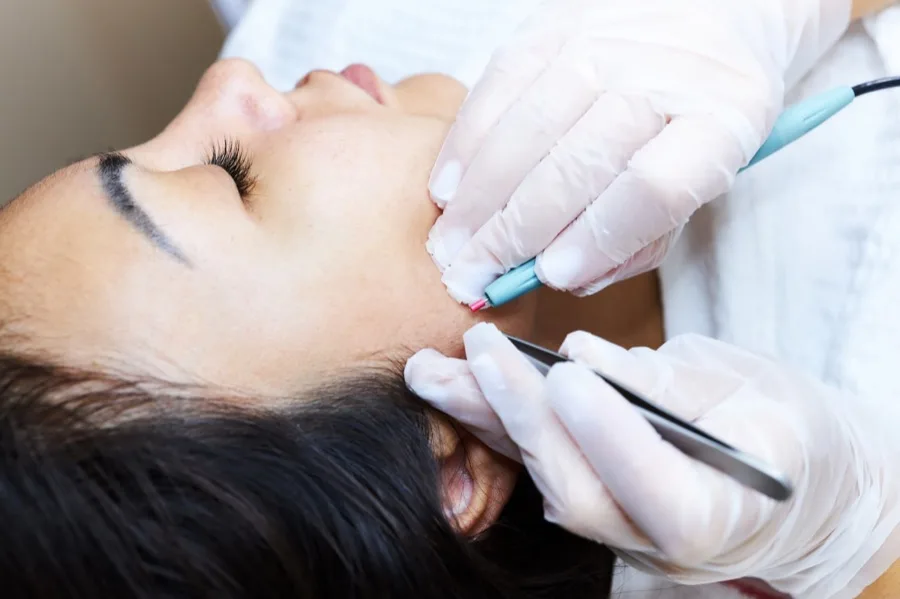
The technique works by inserting an ultra-fine metal probe into the follicle alongside the existing hair shaft, reaching the follicle's base. A precisely calibrated electrical current is then delivered. Three modalities exist:
Galvanic electrolysis: direct current produces a sodium hydroxide reaction at the follicle base, destroying the papilla chemically
Thermolysis: high-frequency alternating current generates localized heat that coagulates the papilla tissue
Blend method: combines galvanic and thermolysis simultaneously for more thorough deactivation
I use the blend method for most PCOS cases. PCOS follicles are often coarser, deeper, and more vascularized than follicles in non-hormonal clients, and the blend achieves more complete deactivation in these deeper structures. The combination of chemical and thermal action is particularly effective in the well-developed follicles that characterize active androgenic hair growth.
Critically, none of this process depends on hair color. The electrical current damages the papilla through heat and chemistry, not through melanin absorption. Electrolysis treats dark hairs, light hairs, gray hairs, and white hairs with equal effectiveness. For PCOS clients with any mix of hair types in the same treatment zone, this is a profound practical advantage.
Once treated, a follicle remains permanently deactivated regardless of the hormonal environment afterward. If PCOS continues producing elevated androgens, those androgens can only stimulate follicles that have not yet been treated. They cannot reverse a properly completed electrolysis treatment. This is the fundamental reason electrolysis works for PCOS where other methods only manage the condition.
To learn more about the electrolysis process itself, visit the electrolysis service page. For specific information about how I approach PCOS cases, the PCOS electrolysis page covers the details of treatment planning, expected timelines, and what the first sessions look like.
FDA Recognition
Electrolysis is the only method the FDA recognizes for permanent hair removal. This distinction applies regardless of hair color, skin type, or hormonal status. Every properly treated follicle is permanently gone.
Working With Your Endocrinologist During Electrolysis Treatment
When a new PCOS client books a consultation with me, one of my first questions is whether they are currently working with an endocrinologist or gynecologist to manage their PCOS medically. The answer shapes how I approach their treatment timeline.
I am not a physician, and I do not prescribe or advise on medical treatment for PCOS. But over 20 years of working with PCOS clients in Irvine and throughout Orange County, I have developed a practical understanding of how hormonal management affects electrolysis outcomes. Medical management that reduces circulating androgen levels or blocks androgen receptor activity can meaningfully reduce the rate at which new follicles are activated during your electrolysis course, potentially shortening the overall treatment period.
The most commonly prescribed medications that affect hair growth in PCOS include:
Spironolactone: an anti-androgen that blocks androgen receptors in peripheral tissue, including hair follicles. At doses typically prescribed for PCOS (50 to 200 mg daily), it can significantly reduce new coarse hair production. Clients stable on spironolactone often accumulate electrolysis results faster because fewer new follicles are being recruited.
Metformin: addresses insulin resistance, which is a core metabolic feature of many PCOS cases. Insulin resistance drives higher circulating insulin, which stimulates ovarian androgen production. By improving insulin sensitivity, metformin indirectly reduces androgen output. Its effect on hair is slower than spironolactone but addresses a root mechanism.
Combined oral contraceptives: reduce ovarian androgen production and increase sex hormone binding globulin (SHBG), which binds free testosterone and reduces its availability to follicles. The specific progestin in the formulation matters; drospirenone and norgestimate have more favorable androgenic profiles for PCOS clients.
Inositol supplements: used by some integrative practitioners to improve insulin sensitivity and reduce androgens in PCOS. Evidence is growing, though results vary by individual.
I always ask about your current medications and supplements at the first appointment because they help me give you a more accurate timeline estimate. A client on stable spironolactone who has had controlled androgen levels for six months is in a meaningfully different situation from a newly diagnosed client who has not yet started any hormonal management. Both can make excellent progress with electrolysis. The timelines will differ, and I want to set those expectations honestly.
The reverse is also worth knowing: if a client is receiving regular electrolysis but we keep seeing significant new follicle activation despite treatment, that is clinical information worth sharing with their prescribing physician. Persistent new hair growth despite treatment can indicate that current hormonal management is not adequately controlling androgen levels. This has implications well beyond hair removal, and sharing the observation with their medical team is something I actively encourage.
Realistic Timeline for PCOS Electrolysis
Timeline is the conversation I have most carefully with PCOS clients, because it is the one most likely to create either unrealistic expectations or unnecessary discouragement. I am committed to accuracy over optimism in this discussion, always.
Hair grows in cycles. At any given moment, approximately 20 to 30 percent of follicles in a given area are in anagen, the active growth phase, where the follicle is fully invested and most responsive to electrolysis. The remaining follicles are in catagen (a brief transitional phase) or telogen (resting), where the hair shaft is not connected to the papilla in the same way. Treating a telogen follicle is technically possible but less definitively permanent than treating an anagen follicle, because the probe's access to the papilla is less direct.
This cycling means that completely clearing an area requires treating it across multiple rounds, not just once. A given follicle cycles through one complete growth cycle every 8 to 16 weeks depending on the body area. Multiple treatment rounds are required to catch each follicle during its anagen phase.
For PCOS clients treating the chin and upper lip, the most common starting zone in my practice, realistic timelines look like this:
Controlled PCOS with hormonal management in place: 12 to 18 months of regular weekly or biweekly sessions to achieve clearance, with sessions shifting to monthly maintenance in the final phase
Active PCOS with significant androgenic activity or no current medical management: 18 to 30 months is common, with gradual and visible reduction throughout
Long history of tweezing or waxing: follicle distortion adds some time to individual sessions but does not change the overall achievable outcome
I want to be honest about what "clearance" means in the PCOS context. It means that the visible, established hair population you currently have is permanently gone. It does not guarantee that zero new hairs will ever appear, particularly if hormonal management remains incomplete. But the trajectory is unambiguously downward over time, and most clients see meaningful, visible improvement within the first 4 to 6 months of consistent treatment. The progress is cumulative and real. Every session permanently removes follicles, and those follicles are gone permanently.
Session length is typically 30 to 60 minutes. Frequency in early treatment is weekly to biweekly. As density decreases, sessions shift to every three or four weeks, then monthly. The session frequency reduction is itself a measure of progress, and clients notice it and appreciate it.
Hormonal hair on the chin and jawline is treated hair by hair, with sessions spaced to catch each growth cycle.
Managing Active Hormonal Fluctuation During Treatment
PCOS is not a static condition. The hormonal environment can shift with stress, illness, weight change, dietary changes, and medication adjustments. These shifts can affect what you observe during treatment, and knowing how to interpret them keeps you from drawing incorrect conclusions about progress.
The menstrual cycle matters for clients who have one. For PCOS clients with irregular or semi-regular cycles, the hormonal environment is not uniform across the month. The luteal phase, the approximately two weeks between ovulation and menstruation, involves elevated progesterone, and in some PCOS clients this is associated with a mild androgen spike. Many of my clients notice that facial hair grows more actively during the week before their period. This is a real and documented phenomenon, not imagination. If this applies to you, it is worth noting and worth discussing at your appointments.
Stress deserves specific attention. Chronic stress elevates cortisol, which in PCOS can worsen androgen levels through adrenal pathways. Cortisol signals the adrenal glands to increase androgen output, and in someone with PCOS who already has elevated androgens, this additional load can be measurable in hair behavior. I see this pattern regularly: a client making consistent progress experiences a period of significant life stress, and they notice more facial hair activity than usual. This is understandable and does not mean treatment is not working. It means the hormonal environment has temporarily shifted.
Weight changes affect PCOS hormone levels in both directions. Significant weight gain often worsens insulin resistance and raises androgens. Even modest weight loss, 5 to 10 percent of body weight in clients carrying excess weight, can improve insulin sensitivity enough to reduce androgen production measurably. I mention this not as a directive but as context: if you experience significant weight change during treatment, it may affect your hair growth pattern and your treatment trajectory.
The practical recommendation I give every PCOS client: keep sessions regular throughout the year. Do not skip summer months because facial hair feels less urgent when you are in full-coverage clothing. Do not interpret a period of increased new hair growth as treatment failure. It is almost always a signal with an identifiable cause, and consistent treatment through these fluctuations, rather than pausing during them, is what builds toward a lasting result.
The Emotional Impact of PCOS Facial Hair
I include this section because the emotional reality of living with PCOS facial hair is something my clients rarely have space to discuss in any medical setting. I want to name it directly.
Most of my clients have been managing visible facial hair for years before they come to see me. Some started shaving as teenagers. Some have maintained a threading appointment every three weeks for a decade or longer. Some have told no one in their personal lives about the hair, managing it entirely in secret before anyone in their household is awake. The social weight this carries is real and significant.
Our culture associates female facial hair with something that should not exist and must be hidden. The energy that goes into managing both the hair and the secret of the hair over years is considerable. I have had clients describe their daily routine in terms of time budget: 15 minutes every morning, 365 days a year, for 12 years. That is over 1,000 hours spent on something they deeply wish did not exist. More than the time is the emotional frame: for many clients, the very first thing they do every day is attend to something they find distressing. This shapes how the day begins.
PCOS as a diagnosis carries its own emotional complexity: fertility concerns, weight, acne, fatigue, mood, menstrual irregularity. Facial hair is one visible, addressable component of that larger picture. Addressing it effectively can have an effect on overall wellbeing that goes well beyond aesthetics. Clients who complete their electrolysis course describe changes in how they feel in photographs, in intimate relationships, in how they approach mornings. These are not small things.
I try to make the consultation at Real Skin Beauty a different kind of conversation from the start. You do not need to minimize your concerns or justify why the hair bothers you. The fact that it does bother you is enough, and it is exactly why you are here. You can visit our FAQ page before your appointment to see how I approach common questions, and what to expect from the process.
The Consultation at Real Skin Beauty
The first appointment is a 30-minute private conversation, free of charge. There is no obligation to begin treatment. Many clients say it is the first time they have spoken openly about their hair with anyone. That is fine. That is what it is for.
What Your First PCOS Consultation Covers
The consultation is 30 minutes and free. I want to walk through exactly what it covers because clients who know what to expect come more prepared and we use the time more effectively.
We begin with medical history. I ask when you were diagnosed with PCOS, what symptoms you experience, and what medical treatment you are receiving. I ask about all medications and supplements, not just PCOS-related ones, because a number of common medications affect hair growth or skin sensitivity. If you have recent bloodwork showing androgen levels, that context is useful, but it is not required.
I ask about your hair removal history in detail. How long have you been managing visible facial hair? What methods have you used? Have you had laser treatments, and did they help? Are you currently tweezing, threading, or waxing? This history shapes both my technique and my timeline planning. Years of tweezing can alter follicle geometry, and knowing this upfront means I can account for it from the first session.
We then do a visual assessment of the areas you want to treat. I look at hair density, coarseness, distribution, and skin condition. I note any areas of skin irritation, ingrown hairs, hyperpigmentation from previous methods, or active PCOS-related acne. This assessment directly informs my treatment approach and timeline estimate.
Based on history and assessment, I give you a realistic timeline estimate and a proposed treatment schedule. I aim to be accurate rather than optimistic. If your situation suggests an 18 to 24 month course, I will tell you that directly. Clients who start with accurate expectations complete treatment. Clients who are surprised by longer timelines often give up partway through, which means they spend time and money without reaching the outcome they came for.
We discuss session frequency and duration, and figure out what fits your schedule. Many of my clients drive from throughout Orange County, from Newport Beach, Costa Mesa, and Mission Viejo to Irvine, and we find a schedule that maintains treatment momentum without being impossible to sustain.
We also have a direct financial conversation. I give you a total cost estimate based on the timeline and session frequency we have discussed. For PCOS clients who have been managing hair with ongoing waxing or threading costs for years, the lifetime economics of electrolysis often look very different from what they assumed going in.
If you want to try a brief sample treatment during the consultation, many clients choose to do that. You leave with a clear sense of what the treatment feels like, what to expect in terms of sensation and skin response, and whether the approach feels right for you.
Can electrolysis permanently remove PCOS facial hair? +
Yes. Electrolysis destroys individual follicles regardless of the hormonal environment. Even if PCOS continues to stimulate new follicles, previously treated ones will not regrow hair. This is the key distinction from laser, which depends on pigment and cannot guarantee permanent results under ongoing androgenic stimulation.
Will I need more sessions than someone without PCOS? +
Often yes. Active hormonal imbalance can trigger dormant follicles during your treatment period, which means the total number of follicles requiring treatment can increase over time. I account for this in your timeline estimate and re-evaluate regularly throughout treatment so your expectations stay accurate as we progress.
Should I manage my PCOS medically before starting electrolysis? +
It helps but is not required. Medications like metformin or spironolactone can reduce new follicle activation, potentially shortening your overall treatment timeline. That said, you do not need to wait for perfect hormonal control before starting. Electrolysis and medical management work very effectively in parallel, and starting sooner generally means fewer total sessions.
How many PCOS clients has Aida treated? +
PCOS and hormonal hair removal is my deepest area of specialization. The majority of clients I see at Real Skin Beauty have some hormonal component driving their hair growth, whether diagnosed PCOS, perimenopause, or another endocrine factor. My 20 plus years of practice in Irvine is especially concentrated in this area, and I have guided hundreds of clients through complete treatment courses.
Is PCOS electrolysis covered by insurance? +
Typically no. Electrolysis is classified as cosmetic in most insurance plans, even when the underlying cause is a documented medical condition like PCOS. Some plans with medical necessity provisions for PCOS complications may partially reimburse in specific circumstances. Contact your insurer directly to verify your plan benefits, as coverage rules vary significantly by provider and plan type.
Licensed electrologist and cosmetologist with 20+ years of experience. Aida sees clients at Real Skin Beauty, 18021 Sky Park Circle, Suite N, Irvine, CA 92614.
Book a free consultation with Aida Khazieva at Real Skin Beauty in Irvine, CA. Get an honest timeline, a clear treatment plan, and answers to all your PCOS hair removal questions.
This article is for informational purposes and reflects Aida Khazieva's clinical experience. It does not replace a personalized medical consultation. Individual results vary.