Why Am I Growing Facial Hair? The Real Causes Explained
By Aida Khazieva·PCOS & Hormonal Hair·13 min read·Real Skin Beauty, Irvine CA·Updated July 27, 2026
Clients who come to me with facial hair concerns almost always arrive with the same question first: why is this happening? Before we can build a treatment plan, we need to understand what is driving the growth. In 20 plus years of practice in Irvine and throughout Orange County, I have worked with every cause: PCOS, menopause, medications, genetics, adrenal conditions, and cases where no clear cause is ever found. This guide walks through each one so you can understand where your situation fits and what that means for your options.
Quick answer: Some fine facial hair is normal for every woman. Coarse, dark hair on the chin, upper lip or neck usually reflects androgen activity. PCOS is the most common cause in women under 40, and menopause, medications and genetics also contribute. Sudden or progressing growth is worth discussing with your doctor before choosing hair removal.
Hirsutism: The Medical Term You Should Know
Hirsutism is the clinical term for coarse, dark, terminal hair growth in androgen-sensitive areas of a woman's body. Androgen-sensitive areas are the zones where male-pattern hair typically appears: the chin, jaw, upper lip, neck, chest, abdomen, lower back, and inner thighs. When coarse hair grows in these zones in a woman, it is almost always driven by androgens, either elevated circulating androgens or elevated androgen receptor sensitivity in those tissues.
Hirsutism is distinct from a related condition called hypertrichosis, which involves generalized fine hair growth across the body and is driven by different mechanisms (certain medications, metabolic conditions, or genetic factors). The distinction matters because the treatments differ. If you have coarse dark hairs specifically on your chin, jaw, or upper lip, you are most likely dealing with androgen-driven hirsutism, not generalized hypertrichosis.
Clinically, hirsutism is assessed using the Ferriman-Gallwey (FG) scale, which scores hair density across nine body areas on a scale of 0 to 4 in each zone. A total score above 8 in Caucasian women, with adjustments for ethnicity, is considered clinical hirsutism warranting investigation. Scores above 15 suggest significant androgen excess. The scale is a useful communication tool with your doctor if you are seeking an evaluation.
One thing I always clarify for clients: some degree of fine facial hair is completely normal for all women. Fine, light, vellus hairs on the upper lip and cheeks are not hirsutism. They are a normal feature of female skin. Hirsutism refers specifically to coarse, pigmented, terminal hairs in androgen-sensitive locations, the type that would be immediately recognizable as beard-type hair on close inspection. Knowing this distinction helps you have a more precise conversation with your doctor and helps you understand whether the treatment approach should be primarily medical, primarily electrolysis, or both.
The word hirsutism sometimes feels clinical and detached from the lived experience of managing this kind of hair growth. I use it here because naming the condition accurately is the first step toward addressing it accurately. Hirsutism is a recognized medical finding with known causes, measurable markers, and effective treatments. It is not a cosmetic vanity. It is a physiological condition that deserves proper evaluation and care.
PCOS: The Most Common Cause of Female Facial Hair
Polycystic ovary syndrome is the most common cause of hirsutism in women under 40, accounting for approximately 70 to 80 percent of cases with an identifiable hormonal driver. It affects 6 to 12 percent of women of reproductive age, and one of the most significant clinical features of PCOS is that it is frequently undiagnosed. Studies suggest that up to 70 percent of women with PCOS have not received a formal diagnosis. The average delay from first symptoms to diagnosis is over two years, and many women have visible facial hair for years before connecting it to a systemic condition.
PCOS is diagnosed using the Rotterdam criteria, which require at least two of the following three features:
Irregular or absent ovulation (which typically presents as irregular periods, infrequent periods, or periods that have stopped)
Clinical signs or biochemical evidence of hyperandrogenism (which includes hirsutism, acne, or elevated androgens on a blood test)
Polycystic morphology of the ovaries on ultrasound (multiple small follicles arranged around the periphery of the ovary)
Not all three are required. A woman can have PCOS with regular periods and no visible ovarian cysts on ultrasound, as long as she has evidence of both ovulatory dysfunction and hyperandrogenism in some form. This is why PCOS is sometimes missed: the presentation varies significantly between individuals.
The facial hair component of PCOS is driven by excess androgens, primarily testosterone and its more potent form, dihydrotestosterone (DHT). These hormones bind to androgen receptors in hair follicles of the chin, jaw, upper lip, and neck, triggering those follicles to shift from producing fine vellus hairs to producing coarse terminal hairs. Once a follicle has undergone this transformation, the hair it produces does not revert to vellus without direct follicle treatment.
Other symptoms that often accompany PCOS facial hair, and that can help point toward a PCOS diagnosis, include: irregular or infrequent menstrual periods, acne (particularly on the chin and jaw), scalp hair thinning at the crown, difficulty managing weight, darkened patches of skin in body folds (acanthosis nigricans), and fatigue. Not every PCOS client has all of these. Some have only one or two. But if you have coarse facial hair and recognize any of these additional features, a PCOS evaluation is warranted.
PCOS and Diagnosis Delays
Studies suggest up to 70 percent of women with PCOS have not received a formal diagnosis. If you have unexplained coarse facial hair, particularly with irregular periods or acne, asking your doctor specifically for a PCOS evaluation (including blood androgens, LH, FSH, and a pelvic ultrasound) is a reasonable first step.
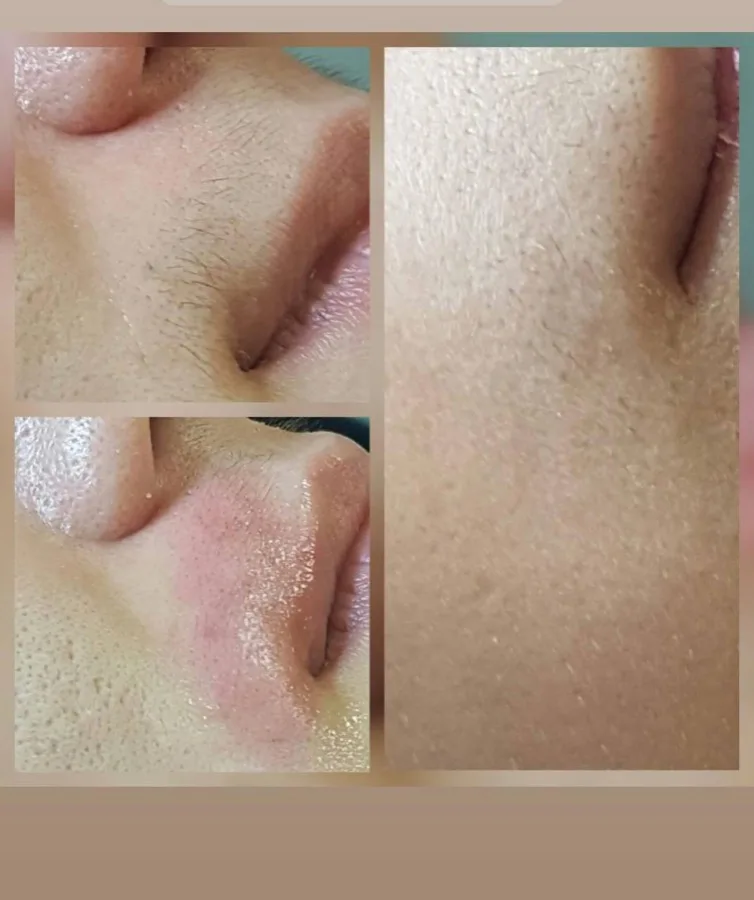
Lower face before and after electrolysis. Individual results vary.
Menopause and the Estrogen-Androgen Shift
Menopause is the second most common hormonal cause of new facial hair growth in women, and it is one of the causes that surprises people most. Many of my clients who develop chin or jaw hair in their 40s and 50s say the same thing: "I never had this before. Where did it come from?" The answer lies in a hormonal ratio shift rather than an absolute increase in androgens.
All women produce both estrogen and androgens throughout their lives. In the reproductive years, estrogen is the dominant sex hormone, and its presence effectively modulates the androgenic effect on androgen-sensitive tissues. As menopause approaches, estrogen production by the ovaries declines significantly. Androgen levels (particularly from the adrenal glands) do not decline at the same rate. The result is a relative androgenic dominance: not necessarily more androgens than before, but a higher ratio of androgens to estrogen. Androgen-sensitive follicles on the chin and jaw, previously held in check by estrogen's moderating presence, respond to this new ratio by activating.
This process begins during perimenopause, the transitional phase that can start in the mid-40s, sometimes earlier. It is why some women notice their first chin hairs several years before their periods stop entirely. The average age of menopause in the United States is 51, but perimenopause typically begins four to six years earlier, and the hormonal shifts that drive chin hair can be measurable well before the full transition.
The characteristics of menopausal chin hair differ in one important way from PCOS facial hair: menopausal clients frequently have a mix of dark and gray or white hairs in the same area. This matters significantly for treatment choices. Laser hair removal targets pigment (melanin) in the hair shaft. Gray and white hairs have no melanin, so laser cannot address them. Electrolysis treats all hair colors equally, making it the more complete solution for the mixed pigmentation that is common in post-menopausal chin and jaw hair.
Hormone replacement therapy (HRT) can slow new chin hair activation by partially restoring estrogen balance. However, HRT will not remove the established hairs that are already present. Electrolysis is still required to permanently remove visible hairs, even for clients who are on HRT. The combination of HRT and electrolysis is often the most efficient path for menopausal clients: HRT slows new follicle activation while electrolysis systematically removes the existing hair population.
Medications That Cause Unwanted Hair Growth
Several categories of medications are known to cause or worsen facial and body hair growth in women. When I take a new client's medication history at consultation, this is one of the things I am specifically looking for. If a medication is the primary driver of hair growth, understanding that upfront helps set realistic treatment expectations, because electrolysis will remove the hairs that exist now, but if the medication is still being taken, new hairs may continue to appear during treatment.
The medications most commonly associated with increased hair growth fall into two categories: androgenic medications (which directly stimulate follicles) and medications that cause hypertrichosis through other mechanisms.
Medications with androgenic effects that can cause or worsen coarse facial hair include:
Anabolic steroids: including testosterone prescribed for low libido or energy, as well as performance-enhancing steroids. Direct androgen supplementation produces the same follicular response as endogenous androgen excess.
DHEA supplements: increasingly popular as an energy and anti-aging supplement. DHEA is a direct androgen precursor. Regular supplementation raises circulating androgen levels and can cause or worsen hirsutism.
Some progestins in hormonal contraceptives: older formulations containing levonorgestrel or norethindrone at higher doses have mild androgenic activity. Newer formulations with drospirenone, norgestimate, or desogestrel are designed to minimize this effect.
Corticosteroids: long-term high-dose use stimulates adrenal androgen production indirectly and can cause mild hirsutism as a side effect.
Medications that cause generalized hair growth (hypertrichosis) through non-androgenic mechanisms include:
Minoxidil: used topically for hair loss and systemically for blood pressure, causes fine hair growth in unexpected locations as a recognized side effect
Phenytoin: seizure medication associated with hypertrichosis in a subset of users
Cyclosporine: immunosuppressant used in transplant patients and autoimmune conditions
If you suspect a medication may be contributing to your facial hair, do not stop it without discussing with your prescribing physician first. In many cases, an alternative formulation exists with fewer androgenic effects. I ask about medications at every consultation precisely because this conversation shapes the treatment plan.
Adrenal Conditions and Thyroid Disorders
Beyond PCOS and menopause, a smaller but clinically important group of women develop hirsutism because of adrenal gland conditions or thyroid disorders. These conditions require medical evaluation and management, and knowing about them is important both for treatment planning and for overall health.
The adrenal glands produce approximately 50 percent of a woman's circulating androgens, making them a significant hormonal source independent of the ovaries. Conditions that cause excess adrenal androgen production can cause hirsutism indistinguishable in appearance from PCOS-related hair growth.
Adrenal conditions associated with hirsutism include:
Non-classical congenital adrenal hyperplasia (CAH): an inherited deficiency of 21-hydroxylase enzyme, which causes the adrenal glands to overproduce androgens. Non-classical (late-onset) CAH is often called "the great mimic of PCOS" because its presentation is nearly identical. It is estimated to affect 1 to 2 percent of women presenting with hirsutism, and it is identified through a specific blood test (17-hydroxyprogesterone) not included in standard PCOS panels. It is worth asking your doctor about if initial PCOS workup is inconclusive.
Cushing's syndrome: excess cortisol production, most commonly from a pituitary or adrenal tumor. Hirsutism is one symptom among many, alongside central weight gain, stretch marks, a rounded face, easy bruising, and elevated blood pressure. Facial hair that appears alongside these features warrants prompt medical evaluation.
Adrenal tumors (adenomas or carcinomas): rare but can produce significant androgen excess. The hallmark of tumor-driven hirsutism is rapid onset: coarse hair developing over weeks to months rather than gradually over years. Very rapid onset of hirsutism is a red flag that should be evaluated quickly.
Thyroid disorders do not directly cause androgen-driven hirsutism, but they interact with hair growth in important ways. Hypothyroidism (underactive thyroid) can cause dry, coarse hair, slower hair growth cycles, and changes in hair texture. It can also coexist with PCOS, which is not rare, complicating both diagnosis and treatment. Thyroid status is a routine part of any workup for unexplained hair changes.
When Rapid Onset Is a Red Flag
Coarse facial hair that developed quickly, over weeks or a few months rather than gradually over years, warrants prompt medical evaluation. Adrenal tumors can produce this pattern. Do not assume rapid-onset hirsutism is just PCOS or menopause without a workup.
Genetics and Ethnicity as Contributing Factors
Genetics plays a significant role in hirsutism, and this role is often underestimated in clinical discussions. Two women can have identical androgen blood levels and experience completely different amounts of facial hair, because the sensitivity of their androgen receptors is genetically determined. Women with more sensitive androgen receptors in facial follicles develop coarser hair in response to the same hormonal stimulus that would produce minimal hair in a woman with less sensitive receptors.
This receptor sensitivity is largely inherited. If your mother, grandmother, or sisters have or had significant facial hair, your baseline risk is higher. Family history is one of the first things I ask about at consultation because it gives me a useful framework for understanding what I am likely to see clinically and how to plan a realistic timeline.
Ethnicity affects baseline androgen receptor sensitivity in ways that are documented and clinically important. Women of South Asian, Middle Eastern, and Mediterranean descent tend to have higher baseline androgenic hair sensitivity compared to East Asian or Northern European women. This is reflected in the Ferriman-Gallwey scale, which uses ethnicity-adjusted cutoff scores to define clinical hirsutism. A score of 8 that is considered clinically significant for a Caucasian woman may be within normal variation for a South Asian woman, whose baseline follicle sensitivity is higher. Conversely, a score of 4 might be clinically notable for an East Asian woman. The scale must be applied with this context in mind.
What genetics does not mean is inevitability of severe hirsutism. Genetics sets the sensitivity of the follicle to androgenic stimulation. But circulating androgen levels still drive the actual behavior. A woman with high receptor sensitivity and normal androgen levels may have modest hirsutism that responds very well to electrolysis. A woman with lower receptor sensitivity but significantly elevated androgens may have more significant hirsutism. The interaction between these two factors, receptor sensitivity and androgen levels, determines the individual clinical picture.
From a treatment standpoint, genetic factors make no difference to electrolysis efficacy. The follicle is destroyed through electrical current, not through modulation of androgen signaling. Whether a follicle was recruited by elevated androgens or by high receptor sensitivity, properly treating it with electrolysis removes it permanently. Genetics explains why the hair grew. It does not protect it from permanent removal.
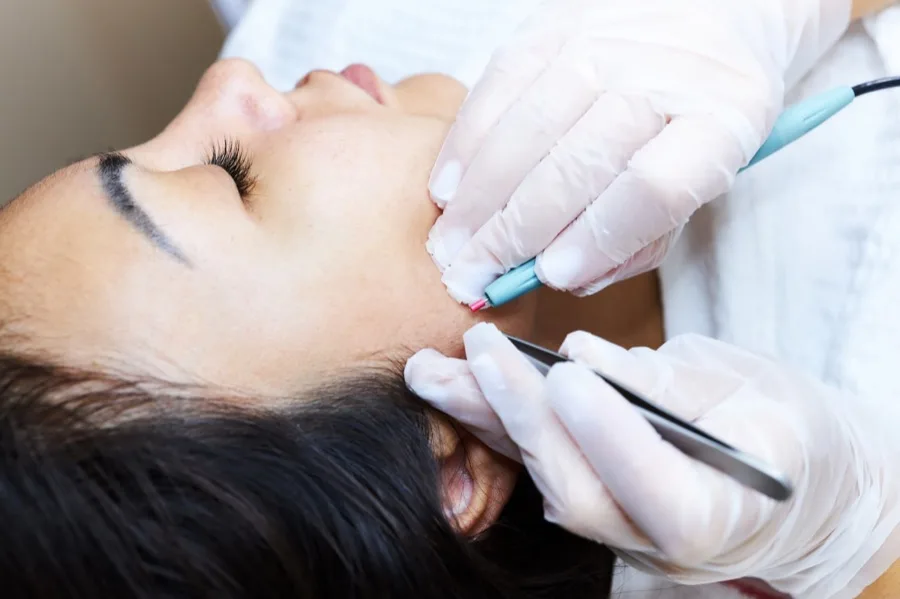
Once the cause is understood, the existing hair can be removed permanently with electrolysis.
Idiopathic Hirsutism: When No Clear Cause Is Found
Idiopathic hirsutism is the clinical label for cases in which a woman has clinically significant coarse facial or body hair but normal androgen levels on comprehensive testing, normal ovulatory function, and no other identifiable underlying condition. It affects approximately 20 percent of women who present with hirsutism.
The most widely accepted explanation for idiopathic hirsutism is elevated peripheral androgen receptor sensitivity or increased local 5-alpha reductase activity in the skin. 5-alpha reductase is an enzyme that converts testosterone into dihydrotestosterone (DHT) directly in the skin tissue. Women with higher local 5-alpha reductase activity in facial skin can have significant follicle activation even with normal blood testosterone levels, because more DHT is being produced at the follicle site than the blood measurement would predict.
The clinical implication is that bloodwork alone cannot fully characterize every case of hirsutism. Normal androgens do not rule out a real, physiological cause for excessive hair growth. I see clients regularly who have been told by a physician "your bloodwork is normal, there is nothing wrong," and who feel dismissed. Their experience of hair growth is real. The cause is real. It is simply operating at a level of tissue sensitivity that standard blood testing does not capture.
Treatment options for idiopathic hirsutism include:
Spironolactone: even in women with normal androgen levels, blocking androgen receptor activity can reduce new hair production. It is commonly prescribed for idiopathic hirsutism.
Eflornithine cream: a topical treatment that slows hair regrowth by inhibiting an enzyme required for cell division in hair follicles. It does not remove hair but can slow regrowth between sessions.
Electrolysis: works identically for idiopathic hirsutism as for any other cause. The follicle is destroyed regardless of why it was activated. Because new follicle activation in idiopathic cases is typically less aggressive than in active PCOS, treatment timelines are often somewhat more predictable.
If you have been told that your labs are normal and you still have significant facial hair, this is not a reason to give up on understanding your situation or on treating it. Idiopathic hirsutism is a legitimate diagnosis, not a dismissal. And electrolysis addresses it just as effectively as any other cause.
When to See a Doctor and When to Start Treatment
One of the most common questions I hear from clients across Orange County and Irvine is whether they need a full medical evaluation before starting hair removal treatment. The short answer: it depends on your specific presentation. Here is how I think about it.
Seek prompt medical evaluation if any of the following apply:
Rapid onset of coarse facial hair: appearing over weeks or a few months rather than gradually over years. This pattern warrants adrenal tumor workup.
Signs of virilization accompanying the hair growth: voice deepening, clitoral enlargement, male-pattern scalp hair loss, or significant muscular changes. These suggest severe androgen excess.
Cushing's signs: central weight gain, purple or red stretch marks, a rounded face, easy bruising, or persistent high blood pressure alongside new facial hair.
Irregular periods combined with significant new facial hair, particularly if both symptoms appeared together or in close proximity. This is a classic PCOS presentation that warrants diagnosis.
Schedule a routine (non-urgent) medical evaluation if:
You have gradual onset of coarse chin or jaw hair and have never been evaluated for PCOS or hormonal causes
You have other features that suggest PCOS (acne, irregular periods, scalp thinning, difficulty with weight)
Facial hair began in your 40s alongside other perimenopause symptoms and you have not discussed it with your doctor
You want to understand the cause before committing to a treatment plan
You can start electrolysis treatment immediately without a prior diagnosis if:
Onset is gradual and you have no red flag features suggesting an urgent underlying condition
You want to begin removing existing hair while pursuing a diagnosis in parallel
You have a known diagnosis (PCOS, menopause) and are ready to address the hair
You Do Not Need to Wait for a Perfect Diagnosis
Electrolysis removes the hair that exists now, permanently, regardless of what caused it. If you have red flag features, seek medical evaluation first. If you have gradual-onset hirsutism without red flags, you can start treatment while the diagnostic process runs in parallel. Waiting for a perfect hormonal workup before starting electrolysis is rarely necessary.
The best approach for most clients is to pursue both tracks simultaneously: get a medical evaluation to understand the cause and explore hormonal management, and start electrolysis to permanently remove existing hairs. Medical management can slow new follicle activation. Electrolysis removes what is already there. Neither approach substitutes for the other, but together they produce results that neither achieves alone.
If you are ready to start or simply want to discuss your specific situation with someone who has worked with every cause of female facial hair growth, book a free consultation at Real Skin Beauty. You can also review common questions on the FAQ page, and if you are interested in addressing PCOS-related skin concerns beyond hair, our facial treatments include options for hormonal acne and skin health.
Frequently Asked Questions
Is growing facial hair as a woman normal? +
Some degree of fine facial hair is completely normal for all women. Noticeable coarse or dark facial hair on the chin, upper lip, or neck is a different matter. This type of hair, called terminal hair, indicates androgen activity in those follicles and is worth discussing with your doctor, particularly if it appeared suddenly or is progressively worsening.
What is the most common cause of facial hair in women under 40? +
Polycystic ovary syndrome (PCOS) is the most common cause, accounting for roughly 70 to 80 percent of hirsutism cases with an identifiable hormonal driver. It affects 6 to 12 percent of reproductive-age women and is frequently undiagnosed. PCOS causes elevated androgens that stimulate coarse hair growth on the chin, jaw, upper lip, and neck.
Can stress cause facial hair in women? +
Chronic stress elevates cortisol, which can increase adrenal androgen production. Stress alone rarely causes significant hirsutism from scratch, but it can worsen an underlying hormonal condition that was previously subclinical. If you have noticed more facial hair growth during prolonged stressful periods, this is a physiologically plausible connection, not imagination.
Do I need to treat the underlying cause before removing facial hair? +
Not necessarily. You can begin electrolysis immediately to permanently remove existing hairs. Simultaneously diagnosing and addressing an underlying hormonal cause (such as PCOS or medications) can reduce new follicle activation over time. The two approaches work very effectively in parallel. Starting both sooner generally produces better outcomes than waiting for perfect hormonal control before beginning hair removal.
Will facial hair go away on its own? +
In most cases, no. Hormonally-driven facial hair tends to progress without treatment, not resolve. The follicles that are already producing coarse hair become more established over time, and in active conditions like PCOS, new follicles continue to be recruited. Acting sooner rather than later generally means fewer total sessions to achieve the same degree of clearance.
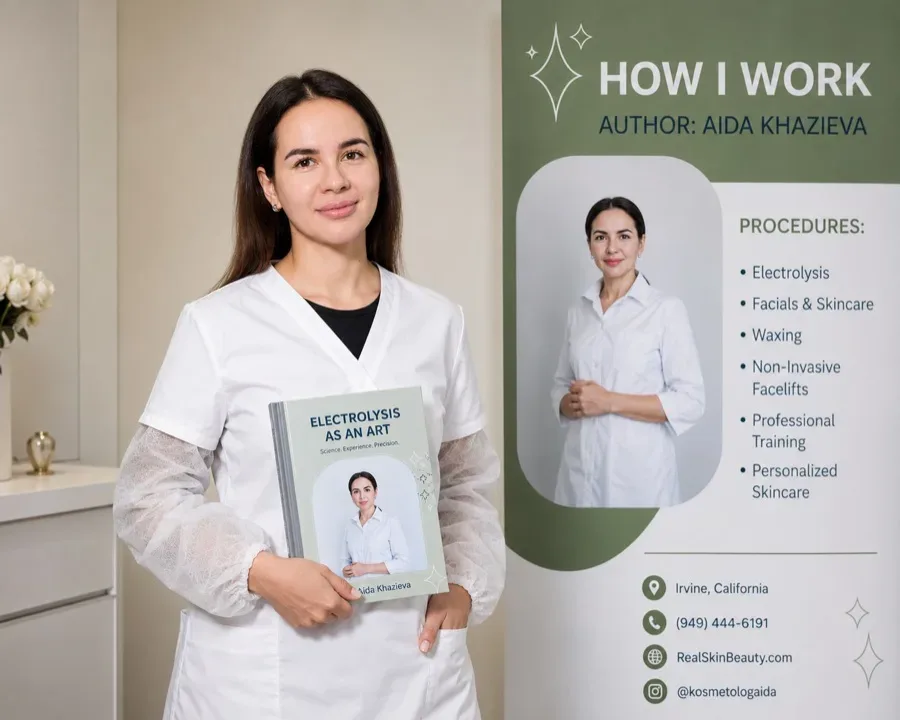
Licensed electrologist and cosmetologist with 20+ years of experience. Aida sees clients at Real Skin Beauty, 18021 Sky Park Circle, Suite N, Irvine, CA 92614.
Book a free consultation with Aida Khazieva at Real Skin Beauty in Irvine, CA. Get clarity on your specific situation, a realistic treatment timeline, and answers to all your questions.
This article is for informational purposes and reflects Aida Khazieva's clinical experience. It does not replace a personalized medical consultation. Individual results vary.