Electrolysis for Chin Hair: The Only Permanent Solution
By Aida Khazieva·Electrolysis·13 min read·Real Skin Beauty, Irvine CA·Updated July 27, 2026
Chin hair is the most common concern I treat at my studio in Irvine, CA, and it is also the one where clients have almost always already tried everything else first. Threading for years, waxing monthly, laser courses, epilators. They arrive at electrolysis having spent significant time and money without permanent results. Here is why chin hair is clinically different from most other body hair, why those other methods keep failing, and what permanently solves the problem.
Quick answer: Electrolysis is the only method that permanently destroys coarse chin follicles. Waxing and threading remove only the hair shaft, and laser struggles with light hair, dark skin and hormonal growth. Most non-hormonal chin cases see significant clearing in 8 to 15 sessions, while PCOS or active hormonal imbalance often needs 15 to 25 or more.
Why Chin Hair Is Different From Body Hair
Chin hair is not simply hair that happens to grow on the chin. It has specific characteristics that make it more resistant to removal than hair in most other locations, and understanding those characteristics explains why so many removal methods fail at it specifically.
It is terminal hair in a sensitive androgen-responsive zone. Terminal hair is fully developed, thick, pigmented hair, as opposed to the fine vellus hair that covers most of the face. Terminal follicles are deeper, more robust, and more heavily vascularized than vellus follicles. They are also more responsive to androgen hormones, which is why the chin, along with the upper lip and jaw, tends to be where hormonally influenced hair growth appears first and most aggressively in women.
Chin follicles are often curved or distorted. Unlike the relatively straight follicles on the legs or arms, chin follicles are frequently angled, curved, or bent, particularly in clients who have been waxing or threading for years. These curved follicles require more precise probe placement during electrolysis and are one reason why chin treatment benefits particularly from an experienced practitioner.
The hair density in a small area is often higher than clients realize. A client who describes having "just a few hairs" on their chin often has 80 to 200 individual follicles in that zone when I examine it carefully. The perception of few hairs comes from regular removal making only the most recently grown hairs visible. The full follicle population is much larger than what appears on any given day.
Chin hair has a relatively short but productive anagen cycle. The active growth phase for facial hair runs approximately 1 to 4 months, compared to 2 to 7 years for scalp hair. This means follicles cycle through the treatable anagen phase more frequently than scalp follicles, which has implications for both scheduling and the pace of treatment progress.
Many chin hairs are driven by hormonal signals, not just genetics. A significant portion of women who seek chin hair treatment have an underlying hormonal component: PCOS, perimenopause-related androgen shifts, or a post-pregnancy hormonal recalibration. These are not rare edge cases. In my experience across Orange County, the majority of clients seeking chin electrolysis have at least some hormonal contribution to their chin hair growth. Knowing whether yours is hormonally driven matters for setting accurate timeline expectations.
Why Waxing and Threading Make Chin Hair Worse Over Time
I hear this observation from clients frequently: "My chin hair used to be fine and light. After years of waxing, it became thick and dark." They assume the removal method caused the hair to grow back thicker. The mechanism is more specific than that, and understanding it explains why these methods actively work against permanent results.
Neither waxing nor threading removes the follicle. Both methods remove only the hair shaft, pulling it from the follicle channel while leaving the papilla, bulge, and all germinal tissue completely intact. The follicle is undamaged. It will produce another hair on its normal schedule as if nothing happened.
Trauma-induced stimulation: Repeatedly pulling hair from a follicle creates localized trauma and increases blood flow to the follicle area. Increased vascularization can enhance the follicle's nutrient supply, which in some cases produces a more robust, coarser hair on regrowth. This is not a universal effect, but it is a real phenomenon that practitioners observe regularly. Fine vellus hairs treated repeatedly with waxing can, over time, become terminal follicles.
Follicle distortion: Each wax or threading pull exerts force on the follicle wall and its surrounding tissue. Over hundreds of treatments across years, this repeated pulling distorts the follicle channel, causing it to grow at an abnormal angle. Distorted follicles are more prone to ingrown hairs and make electrolysis probe insertion less precise because the natural channel that the probe follows has been altered.
Ingrown hair formation: Follicle distortion from repeated waxing causes a significant portion of hairs to regrow sideways, curled back on themselves, or buried under the surface of the skin. These ingrown hairs become raised, sometimes inflamed papules that are difficult to manage and can cause permanent pigmentation changes in the skin. I release and treat ingrown hairs regularly as part of chin electrolysis for clients who have had years of waxing history.
The electrolysis problem with waxing history: If you have been waxing before starting electrolysis, I need the hair shaft to be present in the follicle to use it as a guide for probe insertion. Waxing removes the hair shaft entirely and the follicle takes weeks to regrow a visible hair. During your electrolysis treatment period, you must stop waxing and threading completely. Shaving or trimming is the only acceptable in-between-session method because it cuts the hair at the surface without disturbing the follicle or removing the shaft that the probe tracks.
Why Waxing and Threading Are Not a Bridge Solution
Waxing and threading remove the hair shaft from the follicle, leaving the papilla intact. The follicle regrows the hair exactly as before. More significantly, repeated waxing over years distorts follicle direction, stimulates blood flow to the follicle, and increases the chance of ingrown hair formation. These effects make electrolysis treatment more complex rather than simpler when waxing has been the primary removal method.
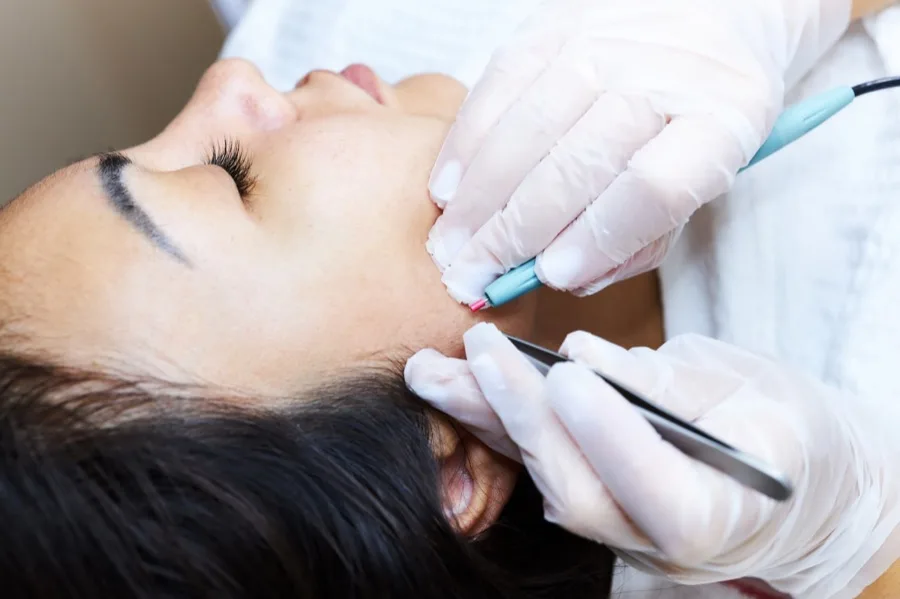
Chin electrolysis in progress at Real Skin Beauty in Irvine, CA.
Why Laser Fails on So Many Chin Hair Cases
Laser hair removal and the chin are a problematic combination for several reasons that I see play out clinically with great regularity. Clients who have had laser treatment for chin hair before coming to see me typically describe one of a few specific outcomes: minimal results from the start, good initial results followed by regrowth over 6 to 18 months, or burns and pigmentation changes that complicated subsequent treatment.
Chin hair color is often not laser-compatible. Laser requires melanin in the hair shaft to absorb the light energy and generate the heat that damages the follicle. Chin hair, particularly in women, is frequently lighter or finer than hair in other areas, especially in clients of European descent where chin hair often appears as light brown or dark blonde even when scalp hair is darker. This lighter chin hair has insufficient melanin for laser to target effectively. Clients are often told laser cannot treat their chin hair and leave confused, because the issue is the hair color, not their skin tone.
Darker skin and chin laser: a serious risk equation. For clients of South Asian, Middle Eastern, East Asian, African, or Latin American heritage with medium to dark skin tones, laser on the chin and jaw area carries real risk of post-inflammatory hyperpigmentation. The melanin in the skin competes with the melanin in the hair, and the result of an inadequately calibrated treatment can be dark spots that persist for months to years. This is not a hypothetical. I see the resulting pigmentation regularly in clients who come to me after laser complications.
PCOS-driven chin hair is a category where laser consistently underperforms. Even when a client appears to be an ideal laser candidate, dark hair on light skin, active PCOS creating ongoing androgen stimulation means that new follicles activate during and after the laser treatment period. Laser reduces the follicles active at the time of each treatment. New follicles that were dormant during the laser course become active afterward. The result is a cycle of temporary clearing followed by regrowth that frustrates clients and eventually leads them to electrolysis.
Gray and white chin hairs: Many clients in perimenopause and menopause notice that their existing chin hair is transitioning from pigmented to gray or white while also increasing in density. Gray and white hairs have no melanin at all. Laser is completely ineffective on them. Electrolysis treats white chin hairs identically to any other hair color because the mechanism is electrical, not light-based.
The combination of these factors means that chin hair is the area where laser's limitations cluster most densely. It is the body zone where I most consistently see clients who have tried and failed with laser and who are now genuinely well-served by moving to electrolysis. For more on this comparison, see Electrolysis vs. Laser Hair Removal: The Complete Comparison.
How Electrolysis Permanently Treats Each Chin Follicle
The mechanism is straightforward and clinically clean. A fine probe, precisely the right diameter for the follicle being treated, is inserted alongside the hair shaft into the follicle channel. The probe travels to the base of the follicle where the dermal papilla and germinal bulge tissue reside. An electrical current is then delivered for a calibrated fraction of a second.
That current destroys the two structures that allow a follicle to produce hair. The dermal papilla is the blood supply and growth control center at the follicle base. The follicular bulge contains the stem cells that can regenerate the follicle. Destroying both means the follicle loses its ability to produce another hair permanently. Not temporarily. Permanently.
For chin treatment specifically, I use blend electrolysis in most cases. The coarse, deep follicles characteristic of chin hair respond better to blend's combination of thermal and chemical follicle destruction than to thermolysis alone. Blend is more effective on resistant follicles and produces lower surface trauma relative to thermolysis at equivalent efficacy levels, which matters for an area where post-treatment redness is visible.
Several features make chin electrolysis particularly well-suited to this area:
No melanin requirement: white, gray, blonde, or red chin hairs are treated identically to dark ones
No skin tone restriction: the electrical current targets follicle tissue, not skin pigment
Precision at the follicle level: each hair is treated individually, allowing navigation around curved and distorted follicles that are common after years of waxing
Ingrown hair treatment: I can release and treat ingrown chin hairs that are buried beneath the skin surface, which no other method handles effectively
Genuine permanence: a properly treated chin follicle does not produce another hair, regardless of what the hormonal environment does afterward
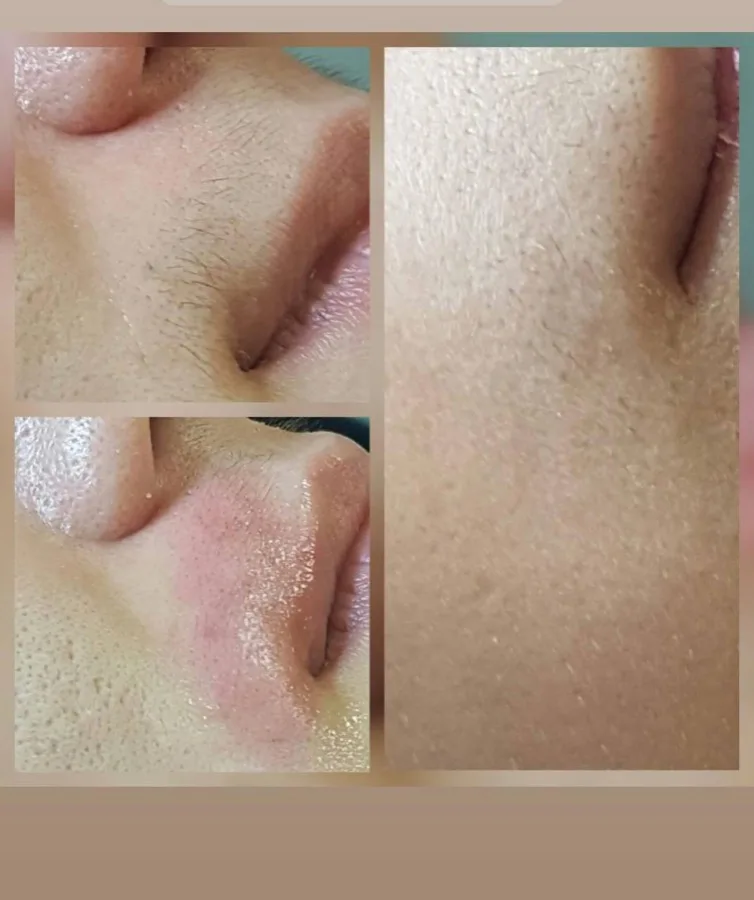
One thing I want clients to understand about chin electrolysis specifically: the area is small enough that progress is visible relatively quickly. Even after 4 to 6 sessions, clients often notice that the areas where hair was densest have cleared meaningfully. The whole-chin population takes more sessions to fully clear, but early evidence of progress in specific spots is both visible and motivating.
Lower face before and after a course of electrolysis. Individual results vary.
Hormonal vs. Non-Hormonal Chin Hair: Does the Cause Change Treatment?
The cause of your chin hair matters less for the electrolysis technique itself and more for setting an accurate treatment timeline and managing expectations around new growth during treatment.
Non-hormonal chin hair: Some chin hair is primarily genetic and not driven by elevated androgens. Women in this category have chin hair because their individual follicle programming produces it, not because of an active hormonal signal stimulating new follicle development. For these clients, the follicle population in the chin area is relatively fixed. Electrolysis systematically works through that population over multiple sessions until all follicles have been treated during their active phase. Once complete, clearance is stable and permanent. These clients reach the end of treatment on the lower end of the session range, typically 8 to 15 sessions over 12 to 18 months.
Hormonally driven chin hair (PCOS, perimenopause, medication-related): For clients with PCOS, androgen-secreting conditions, or perimenopausal hormonal shifts, the chin follicle pool is not fixed during treatment. Androgens continuously activate dormant follicles throughout the treatment period. This means that as electrolysis clears the follicles that were active at the start of treatment, new follicles emerge from the previously dormant population and become visible as new chin hairs.
This is not a failure of the electrolysis treatment. Every follicle that has been properly treated is permanently gone. But new follicles are entering the active pool from the side. The timeline for these clients extends accordingly.
Medical Management Alongside Electrolysis
For clients with PCOS-driven chin hair, working with an endocrinologist or gynecologist on hormonal management can significantly shorten the total electrolysis treatment timeline. Medications like spironolactone reduce androgen receptor activity, limiting the rate at which new dormant follicles activate. Fewer newly activated follicles during treatment means a smaller total follicle pool to work through and a shorter path to permanent clearance.
Perimenopause presents a specific variation. As estrogen decreases and the androgen-to-estrogen ratio shifts, follicles on the chin and jaw that were previously quiescent become active. Many women first notice chin hair in their mid to late 40s for exactly this reason. The good news: the androgen shift associated with perimenopause is finite. Once a client passes through perimenopause and hormone levels stabilize at their new post-menopausal baseline, the rate of new follicle activation typically decreases substantially. Electrolysis treatment that starts during perimenopause may feel like a moving target, but it does reach an endpoint.
For clients with PCOS, I always recommend a visit to the PCOS electrolysis page for a more detailed discussion of the hormonal dimension of treatment and what a realistic timeline looks like specific to that condition.
What a Chin Electrolysis Session Actually Looks Like
First-time clients often arrive with a mental image of electrolysis that is either very clinical and intimidating or vague and undefined. The reality is a straightforward, quiet procedure that most people adapt to quickly. Here is what actually happens during a typical chin electrolysis session at my Irvine, CA studio.
You lie in a reclined treatment chair under good lighting. I examine the chin area first, noting the current distribution of visible hairs, any ingrown hairs, and areas that have cleared since the last session. For first-time clients, I explain the probe insertion and sensation before starting, and do a brief test insertion so you know what the feeling is before we begin in earnest.
The session proceeds hair by hair across the treatment area. For each hair, I:
Insert the fine probe alongside the hair shaft, following the natural follicle direction
Deliver the electrical current for the calibrated duration (fractions of a second for thermolysis, longer for galvanic/blend)
Remove the treated hair, which should slide out with zero resistance
Move to the adjacent follicle
The pace varies by hair density and treatment area condition. Early in treatment, a 30-minute chin session might cover 100 to 200 hairs. Later in treatment, when density has decreased, the same 30 minutes may treat fewer but more resistant individual follicles.
Session length for chin treatment only (not combined with upper lip or jaw) runs 15 to 45 minutes per appointment in most cases. For clients with high density or who are also treating adjacent areas, sessions can run 60 minutes or more. I do not rush the work to fit an artificial time slot. The probe needs to enter each follicle accurately, and accuracy requires appropriate pacing.
For ingrown chin hairs, the process involves a small additional step. I use a fine probe or extraction tool to gently release the ingrown hair from under the skin, then insert the electrolysis probe into the released follicle and treat it in the normal way. The ingrown hair is treated and the follicle permanently disabled. Future hairs cannot grow from that follicle to become ingrown again.
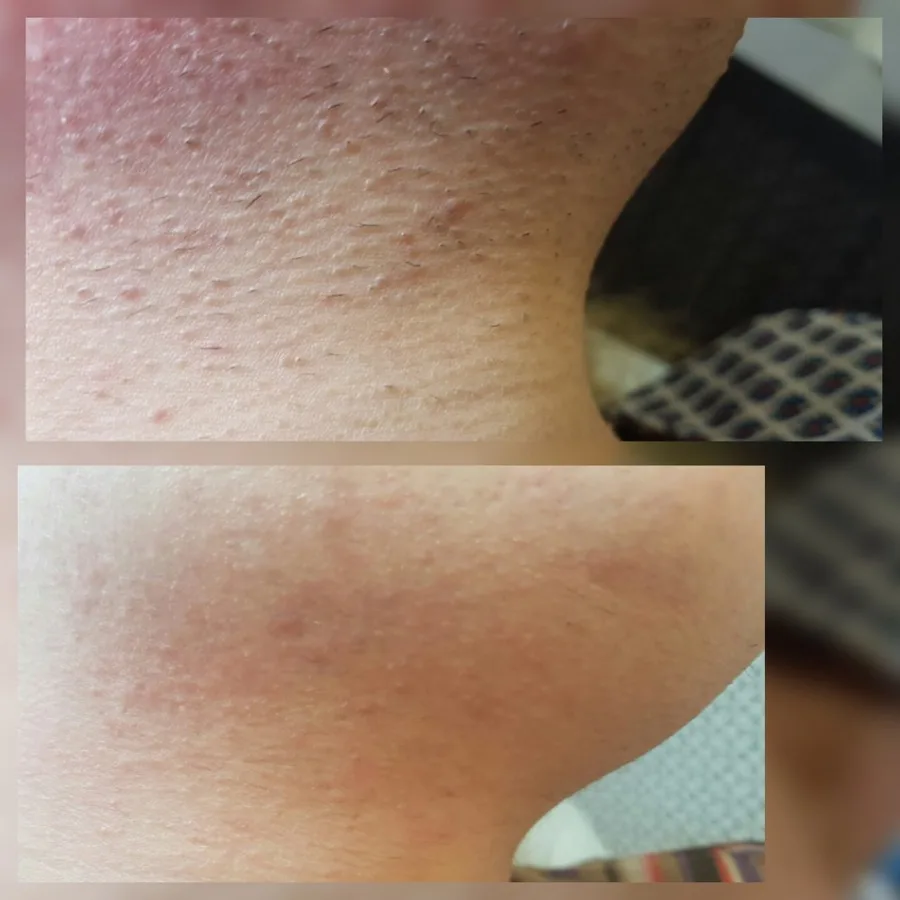
After the session, the chin area shows some redness and possibly minor swelling. Individual follicle sites may appear as tiny red dots. This is normal and expected. Most clients see significant improvement in the appearance within 24 hours and full resolution within 72 hours.
Chin and neck are often treated together, since the growth pattern rarely stops at the jawline.
Timeline: When Will My Chin Finally Be Clear?
This is the question I am asked in almost every first consultation, and I give honest answers rather than optimistic ones, because an accurate expectation leads to consistent scheduling and completion, while an underestimate leads to discouragement when the predicted timeline passes and there is still work to do.
Non-hormonal chin hair: Clients without active hormonal factors typically see significant, visible clearing within 6 to 10 sessions and reach full clearance in 8 to 15 sessions over a 12 to 18 month period. These are clients with genetic chin hair but without PCOS, without the perimenopausal hormonal shift, and without medications known to stimulate hair growth. Within this range, the variation depends primarily on hair density and scheduling consistency.
Hormonal chin hair (PCOS, perimenopause): Clients with active hormonal factors typically require 15 to 30 or more sessions and an 18 to 36 month treatment period. The extended timeline is not because electrolysis is failing on the hairs it treats. It is because new follicles continue activating during the treatment period, requiring ongoing work. The permanent clearance milestone is real for these clients too. It just arrives later.
What does clearance actually mean in practice? I define it as two to three consecutive appointments at the appropriate interval where I examine the chin area and find no new active hairs to treat. Not "hair has reduced significantly," but "there are no more follicles cycling through their active phase in this area." When we reach that milestone, the chin is permanently clear and no further sessions are needed.
The milestones clients notice along the way:
After sessions 1 to 4: Individual areas within the treatment zone begin to show clearing. Clients notice they are not tweezing or shaving certain spots as frequently.
After sessions 5 to 10: Overall density reduction is clearly visible. Sessions are getting shorter. Many clients have stopped daily management of the area and are managing every few days at most.
After sessions 10 to 20 (hormonal cases): Density continues decreasing despite periodic appearance of new hairs. The trend is clearly downward even when new follicles are activating.
Final sessions: Very sparse, increasingly fine hairs. Sessions are brief. The interval between appointments has stretched naturally because there is little to treat at each visit.
Caring for Your Chin Between and After Sessions
What you do between sessions affects your skin's appearance throughout treatment and the ease of subsequent sessions. The most important rules are straightforward and consistent.
Between sessions: do not tweeze or wax. This is the most critical rule for chin hair specifically. Tweezing removes the hair shaft from the follicle, leaving no guide for probe insertion at your next appointment. It also distorts the follicle direction. Waxing has the same effect at scale. Trim with scissors or shave with a clean razor. Both leave the hair shaft in place so I can treat the follicle effectively at your next appointment.
After each session:
Apply witch hazel or aloe vera gel to the treated area. Both are cooling, antibacterial, and soothing without being heavy or pore-clogging.
Avoid makeup on the chin for 24 hours. Mineral powder is the exception if coverage is needed immediately.
Do not pick at or scratch any scabs or papules. They resolve on their own within 24 to 72 hours.
Apply broad-spectrum sunscreen daily during treatment. Post-treatment skin is more susceptible to hyperpigmentation, and sun exposure without protection can cause darkening at treated follicle sites.
Keep the area clean but avoid harsh cleansers, exfoliants, or active ingredients for 72 hours post-session.
Scheduling for social situations: Most clients with professional or social obligations schedule their chin sessions on Thursday or Friday afternoons. Any redness or minor papules visible immediately after treatment typically resolve enough by Monday that the treated area looks clear. If you have an important event, schedule your session at least 5 to 7 days before it, not immediately before.
Sun protection during the full treatment period: For clients treating the chin year-round in the California sun, daily SPF 30 or higher on the face throughout your entire treatment period is not optional. Treated skin is vulnerable to post-inflammatory hyperpigmentation. A tan or UV exposure during the treatment period works against the clean, even result you are working toward. For detailed aftercare instructions, visit the Electrolysis Aftercare guide. For a consultation to discuss your specific chin hair situation, book your free appointment at my Irvine studio.
Frequently Asked Questions
+ Why does my chin hair keep growing back thicker after waxing?
Waxing removes only the hair shaft from the follicle, leaving the papilla and all germinal cells completely intact. The follicle produces another hair on its natural schedule as if nothing happened. Over many repeated waxing treatments, the repeated trauma and pulling stimulates blood flow to the follicle area and distorts the follicle channel. Some follicles respond to this repeated stimulation by producing a coarser hair on regrowth. Neither waxing nor threading damages the follicle in any way that reduces future growth.
+ Why did laser not work on my chin hair?
Several reasons commonly apply. Light or fine chin hair lacks sufficient melanin for laser energy to target, so the laser light passes through without generating adequate heat at the follicle. Darker skin tones require restricted laser settings to avoid burns, reducing efficacy. Active PCOS or androgen elevation continuously activates new dormant follicles even when laser reduces existing ones, creating a cycle of temporary clearing followed by new growth. Electrolysis does not require any specific hair color or skin tone and treats each follicle permanently regardless of these factors.
+ How many sessions does chin electrolysis take?
For clients without active hormonal factors, significant clearing typically appears within 6 to 10 sessions and full clearance is achieved in 8 to 15 sessions over 12 to 18 months. For clients with PCOS or active perimenopausal hormonal shifts, 15 to 30 or more sessions over 18 to 36 months is more realistic because new follicles activate throughout the treatment period. I provide a specific session estimate at your free consultation based on your actual hair density and hormonal history.
+ Can electrolysis remove ingrown chin hairs?
Yes, and this is one of the specific advantages of electrolysis for clients who have had years of waxing history. I use a fine probe to release ingrown hairs that have curled under the skin surface, then treat the follicle with the electrolysis current in the same session. The follicle is permanently destroyed, so that hair cannot ingrow again. Clients who have dealt with chronic chin ingrowns often find electrolysis treatment eliminates the problem entirely as treatment progresses.
+ Will people notice redness after chin electrolysis?
Mild redness and small scabs at individual follicle treatment sites are normal and expected for 24 to 72 hours after a session. The intensity depends on hair density and the number of hairs treated in a given session. Most clients schedule chin sessions on Thursday or Friday so the skin has the weekend to settle before work on Monday. Mineral powder can be applied carefully over redness immediately after treatment if coverage is needed. Avoid regular liquid foundation for 24 hours to keep bacteria out of the treated follicle openings.
Licensed electrologist and cosmetologist with 20+ years of experience. Aida sees clients at Real Skin Beauty, 18021 Sky Park Circle, Suite N, Irvine, CA 92614.
Book a free consultation with Aida Khazieva at Real Skin Beauty in Irvine, CA. She will assess your chin hair, discuss your hormonal history, and give you a realistic treatment plan with honest session estimates.
This article is for informational purposes and reflects Aida Khazieva's clinical experience. It does not replace a personalized medical consultation. Individual results vary.
Questions? Aida Answers Them All.
Visit our FAQ or book a free consultation to discuss your specific skin and hair concerns.