Chin Hair After Menopause: Causes and Permanent Removal Options
By Aida Khazieva·PCOS & Hormonal Hair·11 min read·Real Skin Beauty, Irvine CA·Updated July 27, 2026
Clients who develop chin or jaw hair after menopause often describe it the same way: one or two coarse hairs appeared, they plucked them, thought nothing of it, and six months later there were six. A year after that, they were shaving every morning. They want to know why it happened and what to do about it permanently. I have been answering these questions for women throughout Irvine and Orange County for more than 20 years. The answers are clearer than most people expect, and the solutions are more definitive.
Quick answer: Chin hair after menopause appears because estrogen drops while testosterone, present in all women, becomes relatively dominant and stimulates coarse hair on the chin, jaw and upper lip. Laser often fails because many of these hairs are gray or white. Electrolysis treats every hair color and permanently destroys each follicle it treats.
Why Menopause Triggers Chin and Jaw Hair Growth
Menopause is defined clinically as 12 consecutive months without a menstrual period. The average age of menopause in the United States is 51, but the hormonal changes that drive it begin four to six years earlier during perimenopause, which means some women notice new chin or jaw hair well before their periods stop entirely. Understanding why menopause triggers this specific type of hair growth requires understanding what estrogen was doing all along.
Throughout the reproductive years, estrogen is the dominant sex hormone. It does not just regulate the menstrual cycle; it moderates the activity of androgens in peripheral tissues, including hair follicles. Androgens (testosterone and its derivatives) are present in all women and are produced by both the ovaries and the adrenal glands. During the reproductive years, estrogen's presence effectively keeps androgenic activity in androgen-sensitive facial follicles in check, allowing only fine vellus hairs to grow where coarser hairs would otherwise develop.
As the ovaries wind down estrogen production at menopause, this moderating influence weakens. The adrenal glands continue producing androgens at relatively stable levels. The ovaries, even after menopause, produce small amounts of testosterone. The net result is a ratio shift: not necessarily more androgens than before in absolute terms, but a much higher ratio of androgens to estrogen. Androgen-sensitive follicles on the chin, jaw, and upper lip respond to this new ratio by activating. Follicles that were producing fine, barely visible vellus hairs begin producing coarse, pigmented terminal hairs, sometimes within months of the hormonal shift beginning.
The chin and jaw are the first and most commonly affected facial areas in menopausal women, because these zones have the highest density of androgen receptors in the female face. The upper lip is often next. The neck and sideburn areas can also be affected, particularly in clients with higher baseline androgen receptor sensitivity. The pattern is consistent enough that when a client in her late 40s or early 50s describes new coarse hairs appearing on her chin, the likely explanation is clear before any bloodwork is seen.
One important nuance: this process is not the same as developing a disease or a hormone disorder. Menopause is a normal physiological transition, and the chin hair that results from it is a normal physiological consequence of a hormonal ratio shift. That does not mean it has to be accepted or endured. It simply means that the cause is a predictable and well-understood biological event, not something unexplained or concerning in itself.
The Estrogen-Androgen Shift Explained Simply
I explain this to clients in straightforward terms during the consultation because the medical language can obscure a relatively simple concept. Here is the clearest way I know to describe it.
Think of estrogen, during your reproductive years, as a moderating presence in the follicles on your chin and jaw. It does not eliminate androgen activity in these follicles. It keeps it at a level where only fine, light hairs are produced. When estrogen declines significantly at menopause, that moderating presence weakens, and the androgens that have always been there now have more effect on those follicles. The follicles respond by shifting from fine hair to coarse hair production.
This ratio shift explains why bloodwork can sometimes be confusing for menopausal women with new chin hair. If you measure only absolute testosterone levels, they may be in the "normal" range for a post-menopausal woman. But normal post-menopausal androgen levels exist in a context where estrogen has dramatically declined. The relevant measure is not how much testosterone you have in isolation, but how that testosterone level compares to your estrogen level. A testosterone level that was well-moderated by high estrogen in your 30s may produce significant follicle activation when estrogen has dropped by 90 percent.
This is why some physicians tell menopausal clients that their bloodwork is normal and they have nothing to worry about hormonally, which is accurate as far as it goes, while the client is still growing chin hair. Both things are true. The bloodwork is within normal ranges for menopause. And the hormonal ratio change at menopause has activated androgen-sensitive follicles on the chin. The two statements are not in conflict.
Hormone replacement therapy (HRT) can restore some estrogen, which shifts the ratio back toward a more androgen-moderated state. Many clients on HRT find that new chin hair growth slows or stabilizes. HRT does not, however, remove the hairs that have already established themselves. Existing terminal follicles remain terminal regardless of HRT. This is why most menopausal clients need both: HRT or other hormonal management to slow new hair activation, and electrolysis to permanently remove the hairs that are already present.
Why Bloodwork May Look Normal
Post-menopausal chin hair can develop even with androgen levels that fall within the "normal" range for menopause. The relevant factor is the ratio of estrogen to androgens, not either number in isolation. A normal post-menopausal testosterone level exists in a context of 70 to 90 percent estrogen reduction. That ratio shift is enough to activate androgen-sensitive facial follicles.
New chin hair after menopause is common and is driven by the shift in hormone balance.
Why Chin Hair Gets Coarser After Menopause
One of the most frustrating things my menopausal clients describe is that their chin hair seems to get progressively coarser over time, not finer or less noticeable. This is accurate, and it follows logically from how follicle activation works.
When an androgen-sensitive follicle shifts from producing vellus hair to producing terminal hair, the change is not instantaneous. The follicle undergoes a gradual process of enlargement over several growth cycles. The dermal papilla expands. The follicle deepens. Each successive hair cycle tends to produce a slightly thicker, darker, and longer hair than the previous one. This is why the first hairs a client notices at perimenopause may be relatively fine and easy to manage, while the same follicles a few years later are producing unmistakably coarse hair.
The process does not reverse on its own. Once a follicle has completed the vellus-to-terminal transition, it stays in terminal mode unless the follicle itself is destroyed. Plucking, waxing, and threading remove the hair but leave the follicle intact. The follicle returns to producing the same terminal hair it was producing before, sometimes somewhat sooner than if the hair had been allowed to grow out naturally, because traction at the root stimulates blood flow to the follicle during the telogen phase.
Additionally, the skin changes of menopause can make existing chin hair appear more prominent. Reduced estrogen leads to decreased collagen production, making the skin thinner and less padded. Hair that was previously somewhat obscured by skin volume may become more visible. Skin can also become drier and develop a slightly different texture, which affects how hair sits on the skin surface. Gray or white hairs that develop as part of the menopausal hair color change may stand out more sharply against fair skin.
None of this means the situation is hopeless. It means that every month of delay in addressing established menopausal chin hair allows those follicles to become more deeply established. Earlier treatment is genuinely more efficient. A client who comes to me six months after first noticing chin hair typically has fewer, less coarse follicles to treat than a client who has been managing the same hairs with tweezers for four years.
What Menopausal Women Usually Try First and Why It Does Not Last
Before most of my clients book a consultation, they have spent months or years trying to manage their chin hair with approaches they already know. I never judge this. These are the tools that are widely advertised, readily available, and reasonable to try. The problem is that none of them address the follicle, and the follicle is the entire problem.
Here is what I most commonly hear from new menopausal clients and what each method does and does not achieve:
Plucking: removes the hair from the follicle by traction. The follicle rests for a few weeks, then produces a new terminal hair. Plucking over years creates a distorted follicle channel (the follicle becomes curved or angled), which makes subsequent electrolysis slightly more technically demanding but does not prevent permanent removal.
Threading: removes hair by traction at scale, similar mechanism to plucking. The same limitations apply. Threading salons have proliferated in Orange County, and many menopausal clients have become regulars at three-week intervals for years.
Waxing: effective for finer hair but coarse terminal chin hair often breaks during waxing rather than releasing cleanly from the follicle. Clients end up with partial results and faster regrowth than they expected.
Bleaching: hides pigmented hair by lightening the shaft. Does not work on gray or white hairs, which are already unpigmented and cannot be bleached lighter. As more chin hairs become gray with advancing menopause, bleaching becomes less useful.
Depilatory creams: dissolve the hair shaft chemically at or near the skin surface. Post-menopausal skin often has reduced barrier function (thinner, drier, less robust), and depilatory creams cause contact irritation more frequently in mature skin. The follicle is entirely unaffected, and regrowth occurs within days.
At-home IPL devices: rely on the same melanin-targeting principle as clinic laser. Gray and white hairs cannot be treated. Energy levels are too low for effective follicle damage on coarse terminal chin hair in most home devices. Results, if any, are partial and temporary.
The financial cost of managing chin hair indefinitely with these methods adds up. A threading appointment every three weeks costs $15 to $25 per visit. Over five years, that is $1,300 to $2,200 in threading alone, with zero permanent progress. I present these numbers to clients not to pressure them but because the lifetime math of electrolysis versus indefinite management is often genuinely surprising.
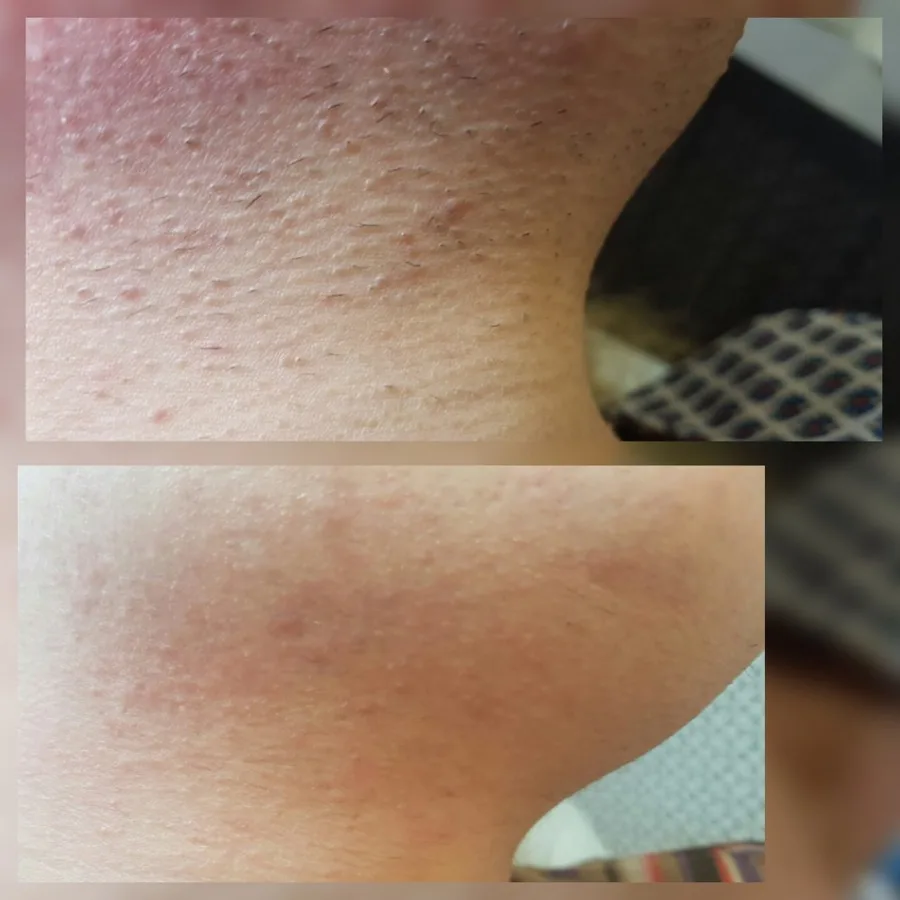
Neck and chin area before and after electrolysis at Real Skin Beauty. Individual results vary.
Why Laser Often Fails Menopausal Clients
Laser hair removal is a legitimate, effective technology for the right candidate. I want to be honest about where menopausal clients fit in that picture, because many arrive at my studio after spending significant amounts on laser treatments that did not produce the lasting results they hoped for.
Laser works by targeting melanin, the pigment molecule in the hair shaft. The laser energy is absorbed by melanin and converted to heat, which damages the follicle. This process is effective on dark, pigmented hair with sufficient contrast against the surrounding skin. It cannot address hair that contains little or no melanin, because there is nothing for the laser energy to be absorbed by. The laser light passes through unpigmented hairs without effect.
Menopausal chin hair frequently includes gray and white hairs alongside darker ones. In some clients, particularly those who are further into post-menopause or who have naturally fair coloring, gray and white hairs constitute the majority of the chin hair. Even clients who start laser treatment with predominantly dark chin hairs find that as treatment progresses and time passes, an increasing proportion of their remaining chin hairs are gray or white, because the darker hairs were treated but the unpigmented hairs were not.
This creates a frustrating pattern that I see from clients across Irvine and throughout Orange County: laser sessions initially produced noticeable improvement. Then results plateaued. Eventually, the client was spending money on sessions that produced minimal additional benefit, while still managing gray and white hairs by other means. Some were told to come back for more sessions. Some were told their skin type had changed. The actual explanation, in many cases, was that laser had done what it could do and the remaining hair was outside its effective range.
The FDA classifies laser as achieving "permanent hair reduction," not permanent removal. For menopausal clients with mixed-pigmentation chin hair, even that reduction applies only to the pigmented fraction. Electrolysis is the only method that addresses the complete hair population regardless of color, which makes it the more appropriate primary treatment for most post-menopausal clients.
The Gray Hair Problem with Laser
Laser targets melanin (pigment) in the hair shaft. Gray and white hairs contain no melanin. Laser passes through them without effect. Many menopausal women have a mix of dark and gray or white chin hairs, and the gray and white fraction grows over time. Electrolysis treats every color equally.
Electrolysis for Post-Menopausal Facial Hair
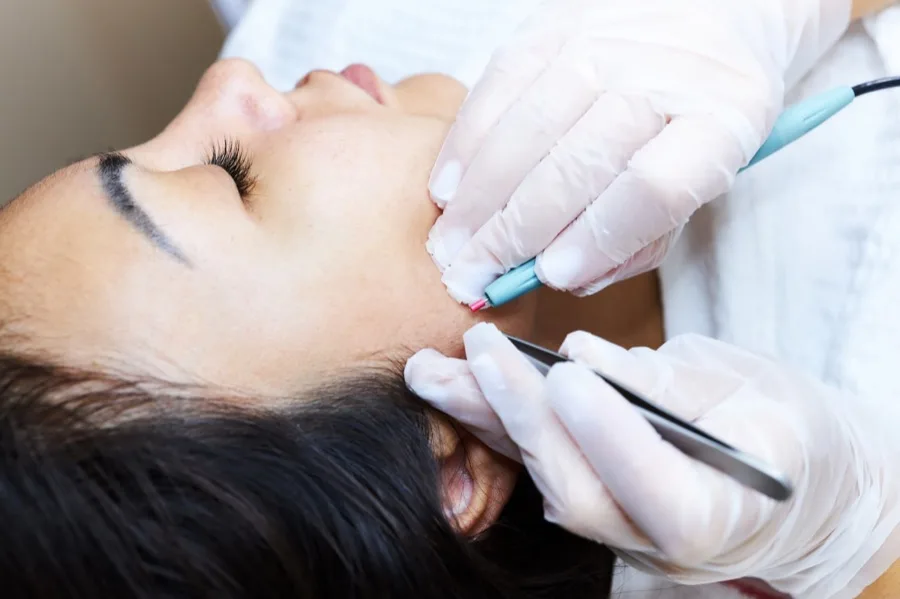
Electrolysis is the only hair removal method the FDA recognizes as permanent, and it works through a mechanism that has no relationship to hair color. An ultra-fine probe is inserted alongside the hair shaft into the follicle, reaching the base where the dermal papilla lives. An electrical current is then delivered, deactivating the papilla through a combination of chemical and thermal action. Once the papilla is properly deactivated, that follicle cannot produce hair. The treatment outcome is the same whether the hair being treated is jet black, dark brown, or fully white.
For post-menopausal clients, this is the defining advantage. I can treat the complete population of chin and jaw hairs in a single consistent modality, without needing to plan around which hairs are dark enough for laser and which ones require a separate approach. Every hair in every session gets the same effective treatment.
I use the blend modality for most post-menopausal cases: a combination of galvanic current (which produces a sodium hydroxide reaction at the papilla) and thermolysis (which delivers localized heat). The blend achieves thorough deactivation even in well-established follicles, which is particularly relevant for menopausal clients who may have been managing their chin hairs by tweezing for several years and whose follicles are correspondingly more developed.
For more background on the electrolysis process, visit the electrolysis service page. If you are dealing with hormonal hair growth more broadly, the PCOS and hormonal hair page covers the treatment approach for different hormonal causes in more detail.
One thing post-menopausal clients often appreciate about electrolysis compared to laser: the treatment can begin immediately with the first session producing permanent removal of treated hairs. There is no waiting for hairs to grow to a specific length (beyond the length needed to see and treat them). Each appointment makes cumulative, permanent progress.
Electrolysis treats each chin hair individually, which is why it works on grey and white hair too.
Timeline and Results for Menopausal Clients
Post-menopausal clients are, in my experience, often the most satisfied with their electrolysis results. The reason is partly hormonal: without the aggressive ongoing follicle recruitment of active PCOS, the total population of chin and jaw follicles is more finite and more predictable. The hormonal environment is relatively stable compared to a client with highly active PCOS. This means timelines can be estimated with more confidence.
Hair still grows in cycles, and the same principle applies as for any electrolysis treatment: at any given time, approximately 20 to 30 percent of follicles are in the anagen (active growth) phase most responsive to treatment. Multiple treatment rounds are needed to cycle through the full follicle population. But the total population being treated is usually smaller and less subject to unpredictable new additions than in PCOS cases.
Typical timelines for menopausal clients treating chin and jaw hair:
Perimenopause with recent onset, few established hairs: 6 to 12 months of biweekly sessions, moving to monthly as clearance progresses
Post-menopausal with a few years of established chin hair: 12 to 18 months, sessions every one to two weeks initially
Dense chin and jaw hair present for many years before treatment, history of long-term tweezing: 18 to 24 months, with steady visible progress throughout
Session length is typically 30 to 45 minutes, adjusted for individual hair density and skin sensitivity. Most menopausal clients find that visible improvement is apparent within the first 3 to 4 months of consistent sessions. They notice they are reaching for the tweezers less often, that the hairs that appear are fewer and sometimes finer, and that the overall texture of the chin area is becoming smoother between sessions.
Some clients ask whether new hairs can appear during treatment. The answer is yes, occasionally. In the early months of treatment, some follicles that were in telogen (resting) at the start may activate and produce new hairs. These are caught in subsequent sessions. The overall trajectory is consistently downward: the population of active follicles decreases with every appointment, and the rate of new hair appearance slows significantly over the first year of treatment.
Skin Sensitivity Changes After Menopause
Post-menopausal skin is different from younger skin in ways that matter for electrolysis technique, and I adjust my approach specifically for each client rather than using a one-size-fits-all setting. Understanding these changes helps clients know what to expect from their skin response during and after sessions.
Estrogen supports collagen production in the dermis. As estrogen declines at menopause, collagen synthesis slows, and the dermis becomes progressively thinner. By 5 to 10 years post-menopause, the dermis has lost a measurable percentage of its original thickness. Thinner skin means the follicle may be closer to the surface than it was in younger years, and the surrounding tissue is more reactive to heat and electrical current.
Post-menopausal skin also tends to be drier. Reduced sebum production (sebaceous gland activity declines with estrogen loss) leaves skin with a compromised lipid barrier, which makes it more susceptible to mild irritation. Redness, pin-point marks, and minor skin response after electrolysis sessions are more common in mature skin than in younger skin, though they resolve in the same timeframe (typically 24 to 48 hours).
How I adapt electrolysis technique for mature post-menopausal skin:
Use fine-gauge probes appropriate for the follicle depth and diameter
Deliver current at lower intensity with slightly longer duration, which achieves equivalent follicle deactivation with less thermal spread to surrounding tissue
Assess skin response carefully during the first session and adjust settings in real time
Space probes slightly further apart when multiple follicles in close proximity are being treated in the same session
Recommend specific post-treatment care: gentle cleansing, fragrance-free moisturizer, strict sun avoidance on treated areas for 48 hours
I want to be direct about something many mature clients worry about: adjusting for skin sensitivity does not compromise the treatment's effectiveness. The electrical current still deactivates the follicle completely. Lower settings with longer treatment time achieve the same result at the papilla level as higher settings with shorter time. The technique adjustment protects the skin around the treatment site without sacrificing any permanent result.
Clients frequently tell me that electrolysis on mature skin was gentler than they expected. The mental image people often have before their first session is more aggressive than the reality. Thin, sensitive post-menopausal skin responds very well to appropriately calibrated technique, and most clients find that their skin heals quickly and cleanly after sessions.
If you are also interested in addressing other menopausal skin concerns alongside hair removal, our facial treatments include options specifically suited for mature skin: hydrating, collagen-supporting, and restorative treatments that complement the electrolysis process. Book a free consultation to discuss what makes the most sense for your specific combination of concerns, or visit the FAQ page for more answers before your appointment.
Technique Adjustment, Not Compromise
Post-menopausal skin calls for calibrated technique: finer probes, adjusted current settings, careful monitoring. This protects the skin without reducing effectiveness at the follicle. The papilla is deactivated completely regardless of the settings used to reach it. Most mature-skin clients find the treatment gentler than they expected.
Frequently Asked Questions
Why am I suddenly getting chin hair after menopause? +
When estrogen drops at menopause, testosterone (present in all women throughout life) becomes relatively dominant in the hormonal ratio. This androgenic shift activates androgen-sensitive follicles on the chin, jaw, and upper lip that were previously held in check by estrogen's moderating influence. The process can begin during perimenopause, years before periods stop entirely.
Is chin hair after menopause permanent? +
The tendency to grow new chin hairs often continues into the early post-menopausal years as the hormonal transition stabilizes. However, electrolysis permanently destroys each individual follicle it treats. Treated hairs will not return, even as a small number of additional follicles may activate in the early months of your treatment course. These are caught in subsequent sessions.
Can menopausal women use laser for chin hair? +
Laser can help if the hair is dark and skin is light, but many menopausal women have a mix of dark and gray or white chin hairs. Laser targets melanin and cannot treat unpigmented hairs. Electrolysis treats all hair colors equally, making it the more complete and appropriate primary solution for post-menopausal chin and jaw hair.
Does hormone replacement therapy affect chin hair growth? +
HRT can slow new chin hair activation by restoring some estrogen balance, which partially moderates the androgenic effect on facial follicles. It will not, however, remove existing established follicles. Electrolysis is still needed to permanently remove visible hairs even with HRT. The two work well together: HRT slows new activation while electrolysis removes what is already present.
Is electrolysis safe for aging or sensitive menopausal skin? +
Yes. I adjust treatment intensity and probe selection specifically for thinner, more reactive post-menopausal skin. Modern electrolysis technique can achieve complete follicle deactivation while minimizing skin response in mature skin. Most clients find treatment gentler than they expected, and the skin response (mild redness) resolves quickly with appropriate aftercare.
Licensed electrologist and cosmetologist with 20+ years of experience. Aida sees clients at Real Skin Beauty, 18021 Sky Park Circle, Suite N, Irvine, CA 92614.
Book a free consultation with Aida Khazieva at Real Skin Beauty in Irvine, CA. Get a realistic timeline, answers to your skin-specific questions, and a clear plan for permanent chin hair removal.
This article is for informational purposes and reflects Aida Khazieva's clinical experience. It does not replace a personalized medical consultation. Individual results vary.