Does Plucking or Shaving Make Hair Grow Back Thicker?
No. Shaving and plucking do not change how thick, dark or fast your hair grows. Thickness, color and growth rate are set by the follicle under the skin, and a razor or a pair of tweezers does not alter it. What changes is how the hair looks and feels: a shaved hair has a blunt tip instead of a fine taper, so it feels coarse and prickly, and a fresh dark hair stands out against clean skin. Here is the full explanation, plus what really does change hair and what to do about it.
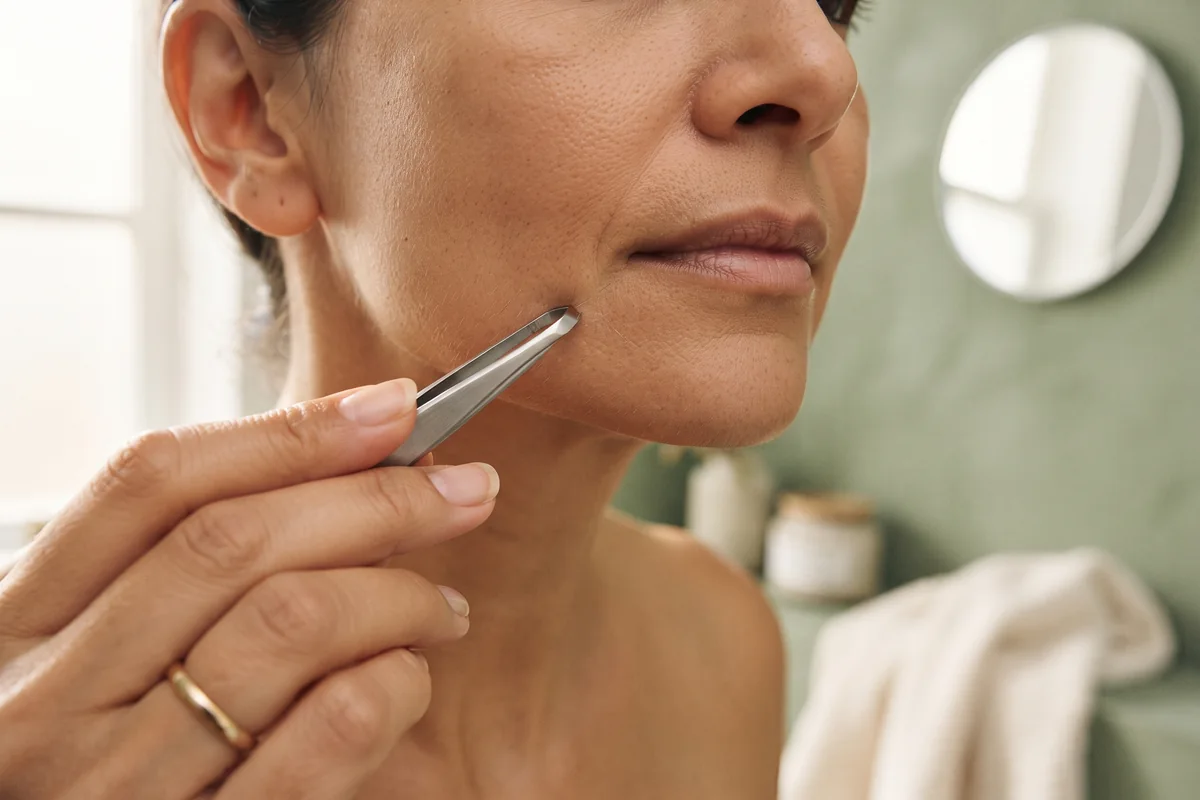
- Shaving and plucking do not make hair thicker, darker or faster. The follicle decides those things.
- Regrowth feels coarse because a shaved hair has a blunt tip, and it looks darker against freshly cleared skin.
- Real causes of thicker hair: puberty, hormones, pregnancy, menopause, some medications and medical conditions.
- Plucking can still cause ingrown hairs, irritation and distorted follicles. Only electrolysis is FDA-recognized as permanent hair removal.
Where Does the Myth Come From?
Almost everyone has heard it from a mother, an older sister or a friend: shave your legs and the hair will come back thicker. Pluck your eyebrow and it will grow back wilder. The belief is so common that many people never test it, and the few who do see results that seem to confirm it.
It sounds logical. Something is cut or pulled, and the body "responds" by growing something stronger, like a callus on a hand. But hair is not like skin. The visible part of a hair is made of dead keratin. There is nothing alive in it to react. All the living activity happens down in the follicle, and a razor works on the surface, never reaching it.
The myth also gets help from timing. Many people first shave in their early teens, which is also when hormones convert fine, pale hair on the legs, underarms and upper lip into thicker, darker hair. The razor arrives at the same moment as the change, so it gets the blame.
The Short Version
Shaving cuts the hair. Plucking pulls it out. Neither changes the follicle, and the follicle is the thing that decides what kind of hair grows. Studies that measured hair after repeated shaving have not found an increase in thickness, color or growth rate. That does not mean regrowth feels the same, and the next sections explain why.
Why Shaved Hair Feels Thicker
Several effects add up. None of them involves actual change in the hair.
1. The Blunt Tip
A natural hair tapers to a fine point, which feels soft against skin and clothing. A razor slices that tapered end off flat. A hair that has been cut straight across has a hard edge, and that edge is what you feel as stubble. The shaft itself is the same width as before, but a square end feels coarser than a pointed one.
2. Growth at the Skin Surface
When hair grows back after shaving, it first appears right at the surface, where you see it as a dark dot. Hair that has grown out naturally for weeks bends and curves, so it lies flat. A short, straight hair stands up and catches the light, so it seems denser.
3. Contrast Against Clean Skin
Freshly shaved skin is smooth and often paler. A dark hair that breaks through against bare skin stands out much more than the same hair did when it was one of many longer hairs. The change is in the contrast, not in the hair.
4. Hair Is Thicker Near the Root
Every hair is slightly wider close to the skin than at its tip. Shaving removes the thin end. When the thicker lower section grows out again, you meet that wider part first. It is the same hair, now seen in its sturdiest section.
5. More Hairs Appear at Once
Hairs grow in cycles and not all at the same time. Some are active, some are resting, and some are just about to start. After shaving, the cut ones regrow, and the ones that were hidden under the surface catch up. For a short while the area seems more crowded. This is the normal range of the area appearing together, not new hairs.
| What you notice | What is really happening |
|---|---|
| --- | --- |
| Stubble feels coarse | Blunt cut tip instead of a tapered end |
| Hair looks darker | Contrast against smooth skin, and the widest part of the shaft shows first |
| Area looks denser | Hairs in different growth stages surface together |
| Hair seems to grow faster | You see regrowth within a day because the skin was bare |
| Hair stands up | Short, cut hairs are straight and have not yet bent under their own length |
What About Plucking and Waxing?
Plucking and waxing pull the hair out from the root. This is different from shaving, and the first question is whether it changes the next hair. For hair thickness, the answer is the same: no. The follicle makes a new hair, and it comes back with the same properties as before, usually after weeks.
Some people believe repeated plucking weakens the follicle and makes hair finer. This idea is popular, especially with eyebrows, and I would be careful with it. Pulling hairs repeatedly can damage some follicles, and sparse brows after years of overplucking are a common story, but that damage is unpredictable and not something to count on as a hair removal plan. It can also produce the opposite result: distorted follicles that grow hair at an angle, which leads to ingrown hairs and bumps.
There are real downsides to plucking and waxing that have nothing to do with thickness:
- Irritation and redness, especially around the upper lip, chin and bikini line.
- Ingrown hairs, when a regrowing hair curls back into the skin. See ingrown hairs and when electrolysis helps.
- Dark marks, particularly on deeper skin tones, after repeated inflammation.
- Distorted follicles, which make later electrolysis harder because the probe has to follow a bent path.
- Broken hairs, where a hair snaps at the surface instead of lifting from the root. These regrow quickly and feel stubbly.
For the cost of keeping up with these methods over time, see electrolysis vs waxing, the real long-term cost.

What Actually Changes Hair Thickness
Hair really does get thicker, darker or more plentiful. It just does not happen because of a razor. These are the real reasons.
Puberty
Rising androgens convert fine, pale vellus hair into thicker, darker terminal hair in the underarms and pubic area, and later on the legs and arms. In boys, the face and chest follow. This is the biggest change in most lives, and it is easy to confuse with the first shave.
Pregnancy and Hormone Shifts
Hormones move a lot during and after pregnancy, and hair growth can change. Some people notice more facial or body hair, and some notice shedding after delivery. These changes are driven by hormones and vary between people. If you are pregnant or planning to be, bring questions to your physician.
Perimenopause and Menopause
As estrogen falls, the balance with androgens shifts, and many women notice stiffer chin and upper-lip hairs while scalp hair thins. I cover this in detail in chin hair after menopause.
Hormonal Conditions
Polycystic ovary syndrome (PCOS) is one of the common causes of coarse hair on the face, chest and abdomen in women. Thyroid and adrenal conditions can also play a role. If coarse growth shows up quickly or comes with irregular periods, acne or scalp thinning, see a physician. Hair removal does not treat the cause. You can read more in PCOS facial hair removal and why facial hair grows.
Medications
Some medications can increase hair growth on the face or body as a side effect. Do not stop any prescription on your own. If you suspect a link, ask your prescriber.
Age and Genetics
Genes decide where on your body hair is dense and how dark it gets. Age shifts it, with some areas growing stronger and others thinning. This is why two sisters can have very different growth patterns.
Laser and Light Treatments
A small group of people see more hair, or coarser hair, in the treated area after laser or IPL, a rare effect called paradoxical hair growth. It is a specific reaction to the device, not to shaving. I explain it in more hair after laser.
Plucking vs Shaving vs Waxing: What Each Really Does
The three methods behave differently, and none of them changes thickness. This table covers what to expect from each.
| Method | What it removes | Typical regrowth | Effect on follicle | Common downsides |
|---|---|---|---|---|
| --- | --- | --- | --- | --- |
| Shaving | Hair at the skin surface | Visible within a day or two | None | Stubble, razor bumps, nicks |
| Plucking | Whole hair with the root bulb | Often several weeks | None in most cases, repeated trauma may distort some | Pain, ingrown hairs, irritation |
| Waxing | Whole hair with the root bulb, many at once | Often a few weeks | None in most cases | Redness, lifting skin, ingrowns, breakouts |
| Threading | Whole hair, row by row | Often a few weeks | None in most cases | Redness, mild irritation |
| Electrolysis | Hair, and the follicle that grows it | Treated follicles stop producing hair | Treated directly, FDA-recognized permanent method | Time, a series of visits, temporary redness |
Regrowth timelines vary a lot from person to person and area to area, so treat the table as a general guide. The difference between the first four methods and the last is simple: the first four act on hair, electrolysis acts on the follicle. For a deeper comparison of home options for the lip area, see upper lip hair removal options.
Does Hair Grow Faster After Shaving?
This is the sister myth. Hair grows at a rate set by the follicle, usually a fraction of a millimeter a day. Shaving does not speed that up. It does make regrowth visible sooner, because the hair no longer has its old length. A hair that was 3 millimeters long yesterday and is 3.3 today looks like nothing. A hair that was cut to zero yesterday and shows at 0.3 millimeters today looks like a dot, and your eye notices the dot.
The same applies to hair color. A hair does not become darker because it was cut. A hair seen at the surface looks darker than a long one that has thinned and lightened toward the tip, partly from sun and wear.
How to Test the Myth Yourself
If you want to see this for yourself, here is a simple way, and it needs no products.
- Choose a small patch, for example a few centimeters on the lower leg.
- Take a close photo in the same light before you start, and keep a ruler or coin in the frame.
- Shave only that patch, leaving the surrounding skin alone.
- Take the same photo after a few weeks of regrowth, then compare the shaved patch with the untouched skin beside it.
You should find no difference in hair thickness between the two. Most people expect a clear difference and are surprised. The point of a comparison patch is that it removes the effect of the changing light, the changing contrast, and your own expectations.
Practical Tips If You Shave or Pluck
Not everyone wants to stop shaving or plucking, and that is fine. Here is how to do it with fewer side effects.
Shaving
- Shave after a warm shower when the hair is softer.
- Use a clean, sharp razor and replace blades or heads regularly.
- Use a gentle shaving gel or cream, and shave in the direction of growth first.
- Do not press hard or go over the same patch many times.
- Moisturize afterward with something plain and fragrance-free.
Plucking
- Pluck only stray hairs, not whole areas.
- Clean the skin and tweezers first, and pluck in the direction of growth.
- Hold the skin taut so the hair comes out whole, not broken.
- Do not pluck hairs growing from moles, and do not pluck hairs from an inflamed area.
- Soothe the skin afterward and avoid picking at the bump if redness appears.
Hair Treated by Electrolysis
If you plan to start electrolysis, do not wax or pluck beforehand. The probe follows the hair down into the follicle, and it needs hair to follow. Trimming rather than plucking is the usual advice. I explain what to do in shaving, plucking and waxing between electrolysis sessions.
When Hair Really Has Become Thicker
If you have noticed a real change, with hair that is darker, longer, growing in new places, or all three, shaving is not the explanation. Here is a way to think about it.
| What you notice | Possible reasons | What to do |
|---|---|---|
| --- | --- | --- |
| Coarse hair on chin or upper lip appearing in your 40s or 50s | Hormone changes around menopause | Mention it to your physician, and consider electrolysis for the hair |
| Fast new growth on face, chest or abdomen, with irregular periods or acne | Possible hormonal condition such as PCOS | See a physician for evaluation |
| Hair growth that changed after starting a medication | Possible side effect | Ask your prescriber, do not stop on your own |
| Hair that became thicker after laser or IPL | Possible paradoxical growth | Stop laser on that area and ask a professional about electrolysis |
| Gradual increase through your 20s and 30s | Genetics and normal hormone shifts | A consultation to plan removal if it bothers you |
Electrolysis treats the hair and not the underlying cause. If a hormonal condition is behind your growth, hair may keep appearing from new follicles, and a physician's help is part of the plan. I would rather say that clearly in your first visit than promise a result that depends on something outside the treatment.
What to Do Instead of Chasing Stubble
If the cycle of shaving, plucking and re-shaving is wearing on you, the question changes from "does it make hair thicker" to "how do I stop doing this." The options are:
- Keep shaving or plucking for occasional areas and low-maintenance growth. This is a perfectly reasonable choice.
- Waxing or threading for longer gaps between sessions. Skin irritation and cost over time are the tradeoffs.
- Laser or IPL for dark hair on lighter skin, with limits on light, gray and red hair. See electrolysis vs laser.
- Electrolysis for any hair color and skin tone. It is FDA-recognized as permanent hair removal. It takes time because each follicle is treated individually. Read is electrolysis permanent for the details.
For reference, electrolysis at Real Skin Beauty is priced per visit by area, starting at $50 for the upper lip (20 minutes) and $65 for the chin (30 minutes). Cheeks, neck and hairline are $90 for 45 minutes. A free in-studio consultation covers your hair, your options and an honest estimate. Clients visit from Irvine, Tustin, Newport Beach and the rest of Orange County.
Myths and Facts at a Glance
- Myth: Shaving makes hair grow back thicker. Fact: it does not change thickness, color or speed.
- Myth: Plucking one hair makes two grow back. Fact: one follicle produces one hair. Two hairs in the same spot were already there, with one hidden or in a resting phase.
- Myth: Waxing makes hair finer over time. Fact: some people notice sparser regrowth, but it is unpredictable, and it is not a reliable way to remove hair.
- Myth: Hair grows faster in summer. Fact: seasonal changes in growth rate are small. You see more hair because you shave more often and show more skin.
- Myth: Stopping shaving will make hair softer. Fact: the tip tapers again as it grows out, so it feels softer, but the hair is the same.
- Myth: Hair is dead, so it cannot grow thicker. Fact: the visible shaft is dead, but the follicle is alive and responds to hormones, which is why hair can change.
Questions I Hear Most
People often ask the same follow-up questions after they hear that shaving does not thicken hair. Here are short answers.
"Then why did my hair change after I started shaving?" Most likely because of age and hormones, as described above. The two things happened together and the razor took the blame.
"Should I stop plucking my eyebrows?" Not necessarily. Occasional shaping is fine. Heavy, repeated plucking in the same spot can irritate follicles and may thin brows in some people, so go gently. Permanent shaping is a bigger decision. See my eyebrow electrolysis guide.
"Does tweezing a hair spread it?" No. Hair does not spread. If more hairs appear around the area you pluck, they were there and were hidden or small.
"Can I switch from shaving to electrolysis without waiting?" Hair needs to be long enough to treat, and your electrologist will tell you how long. Do not wax or pluck beforehand. The first appointment guide covers preparation step by step.
If you want an honest look at your own hair, you can book a free consultation in Irvine. We can look at it under magnification and talk about what is changing and why. The electrolysis page lists areas and prices.
Frequently Asked Questions
No. Shaving cuts the hair at the surface and does not change the follicle that decides thickness, color and growth speed. Regrowth feels coarse because the cut leaves a blunt tip instead of a fine taper.
No. Plucking removes the hair from the follicle, and the follicle usually grows a hair with the same properties as before. Repeated plucking can irritate skin and cause ingrown hairs.
A fresh hair stands out against freshly cleared skin, and you see the wider base of the shaft first. The color has not changed, only the contrast.
No. Growth speed is set by the follicle. Regrowth becomes visible sooner because the hair no longer has its earlier length.
Hormones are the main driver: puberty, pregnancy, perimenopause and menopause, and conditions such as PCOS. Some medications and genetics also play a part. See a physician if growth changes quickly.
Repeated pulling can irritate or distort some follicles. This can cause ingrown hairs and make later electrolysis more technical. It is unpredictable and not a reliable hair removal method.
Electrolysis is the FDA-recognized method for permanent hair removal. It treats each follicle directly, and treated follicles stop producing hair. Shaving, plucking and waxing do not reliably change hair.
Stop plucking and waxing, because the probe needs hair to follow into the follicle. Trimming is usually fine. Ask your electrologist how long the hair should be for your area.

Licensed electrologist and cosmetologist with 20+ years of experience. Aida sees clients at Real Skin Beauty, 18021 Sky Park Circle, Suite N, Irvine, CA 92614.
Related treatment at the studio: electrolysis. Book a free consultation.
Talk Through Your Hair Growth
Book a free consultation with Aida Khazieva at Real Skin Beauty in Irvine, CA. She will look at your hair under magnification, tell you what is changing and what is only a trick of the eye, and outline your options.
Book Free ConsultationThis article is for informational purposes and reflects Aida Khazieva's practitioner experience. It does not replace a personalized medical consultation. Individual results vary.
Questions? Aida Answers Them All.
Visit our FAQ or book a free consultation to discuss your specific skin and hair concerns.