Mineral vs Chemical Sunscreen: Which One Should You Wear Daily?
By Aida Khazieva·Facials and Skin Care·15 min read·Real Skin Beauty, Irvine CA·Updated October 20, 2026
The best daily sunscreen is the one you will actually wear every morning, and both types protect when used correctly. Mineral sunscreens (zinc oxide, titanium dioxide) sit on the skin and block UV. Chemical sunscreens absorb into the top layer and convert UV into heat. Mineral formulas suit sensitive skin and skin recovering from peels. Chemical formulas feel lighter and rarely leave a white cast. Here is how I help Irvine clients choose.
Quick answer
Mineral: zinc oxide and titanium dioxide. Often better for sensitive, reactive or freshly treated skin. May leave a white or gray cast.
Chemical: ingredients such as avobenzone or octocrylene. Thin, clear feel, easy under makeup. More likely to sting around the eyes.
Choose broad spectrum, SPF 30 or higher, and apply about a quarter teaspoon to the face and neck.
Reapply about every two hours outdoors. Daily use matters more than which type you pick.
Quick Comparison: Mineral vs Chemical Sunscreen
Sunscreens belong to two families, and many products now blend both. The labels say "mineral" or "physical" for the first group, and the active ingredient list tells you the rest. Here is the short version before the details.
Feature
Mineral (physical)
Chemical (organic)
Active ingredients
Zinc oxide, titanium dioxide
Avobenzone, octocrylene, octisalate, homosalate, oxybenzone and others
How it works
Sits on the skin and reflects and scatters UV, and also absorbs some
Absorbs into the top skin layer and converts UV to heat
Feel and finish
Thicker, may leave white or gray cast, matte or dewy
Thin, clear, easy to blend
Wait before sun
Works as soon as it is applied, though many labels suggest waiting about 15 minutes
Usually needs 15 to 20 minutes to form a protective film
Sensitive skin
Usually better tolerated
More likely to sting, especially near eyes
After a peel or procedure
Often preferred
Possible once skin is calm; patch test first
Under makeup
Can feel heavy, may pill
Often smoother under makeup
Regulatory note
FDA recognizes both as safe and effective
FDA has asked for more safety data on many of these ingredients
The regulatory row deserves explanation. In the United States, the FDA has said zinc oxide and titanium dioxide are generally recognized as safe and effective. For many chemical filters, it has asked manufacturers for more safety data, particularly on how much enters the bloodstream. That is a request for data, not a finding that those products are harmful, and dermatology groups continue to say that using sunscreen is far better than going without. Ask your physician if you have specific concerns.
How Each Type Actually Works
Mineral sunscreens
Zinc oxide and titanium dioxide are minerals. In the past they were thick and white, because the particles were large. Modern formulas use smaller particles, which spread more easily, though a trace of white cast remains with many products. Mineral filters work mostly by scattering and reflecting UV away from the skin, and they absorb a share of it too. Zinc oxide protects across both UVB and most of the UVA range, which is why it appears in many broad-spectrum products. Titanium dioxide is strong against UVB and shorter UVA, and weaker in the long UVA range, so products often combine the two.
Chemical sunscreens
Chemical filters are carbon-based molecules. They absorb UV radiation and release it as a tiny amount of heat. Each filter covers a different slice of the UV spectrum, so a good formula combines several. That is why you see a long list of actives on the back of a chemical sunscreen. Newer filters are more stable and give broad coverage with a lighter feel. Older ones such as oxybenzone are controversial for environmental reasons, and Hawaii has restricted sales of sunscreens containing oxybenzone and octinoxate because of concerns about coral reefs.
Hybrid products
Many sunscreens contain both types. A hybrid can give a lighter feel than a pure mineral cream while keeping some of the mineral benefits. Read the active ingredient box to know what you are buying, rather than relying on front-label terms like "gentle" or "clean," which have no regulated meaning.
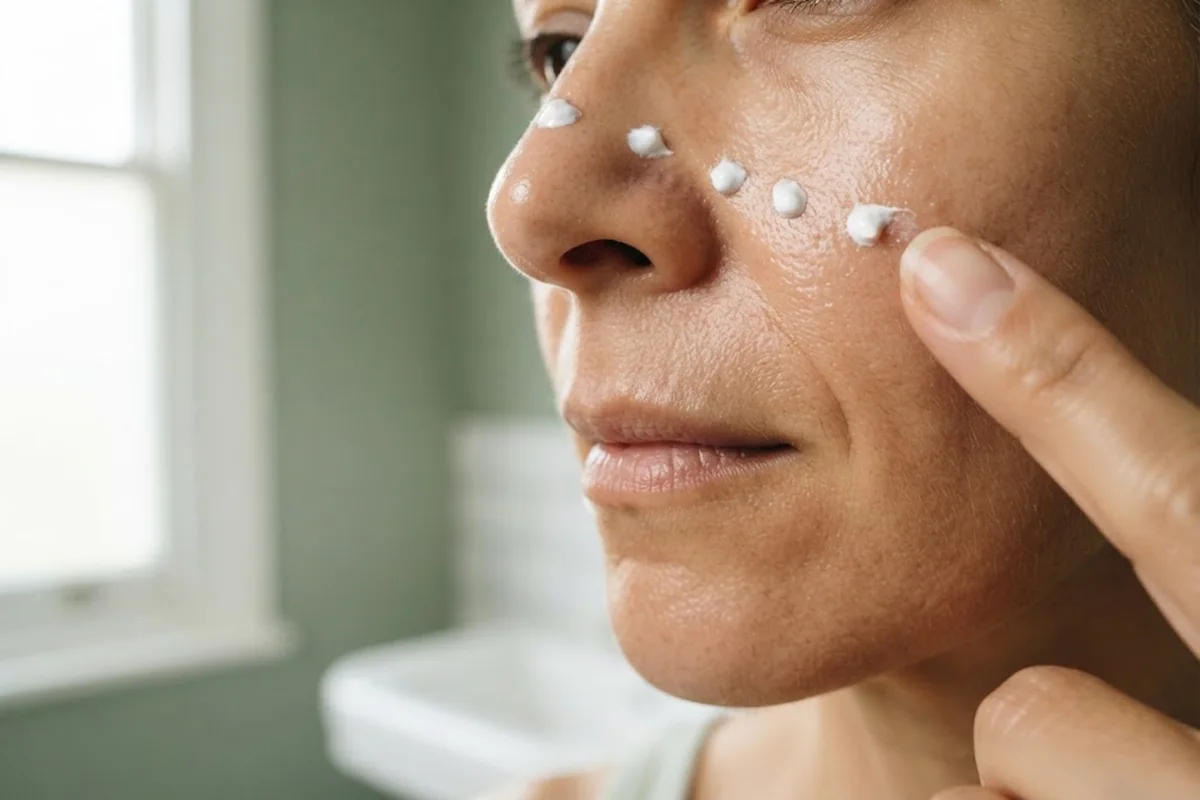
Dots across the cheeks, forehead, nose and chin, then blend. Most people apply too little.
What SPF and "Broad Spectrum" Really Mean
SPF measures protection against UVB, the rays that cause sunburn. It does not tell you about UVA, the longer rays that go deeper and contribute to aging and pigmentation. The words "broad spectrum" on a US label mean the product has passed a test showing UVA protection proportional to its SPF.
SPF
Approximate UVB filtered
Practical note
15
About 93 percent
Minimum, rarely enough for daily facial use
30
About 97 percent
A good daily standard for most people
50
About 98 percent
Useful for long outdoor time, fair skin or after treatments
100
Marginally more
The gain is small; reapplication matters more
The jump from SPF 30 to 50 looks big on the bottle and small in practice. What counts is how much you apply and how often you reapply. The SPF number on the label comes from testing at a specific thick layer, and most people use half or less. That cuts the real protection a lot.
Look for "broad spectrum," "SPF 30 or higher," and a water resistance claim of 40 or 80 minutes if you swim or sweat. "Waterproof" is not allowed on US labels, since no sunscreen survives water indefinitely.
Which Skin Types Do Better With Each Type
Your situation
Leaning toward
Why
Sensitive or reactive skin
Mineral
Fewer irritation reports, and no filters absorbing in the skin
Rosacea or easily flushed skin
Mineral
Heat from chemical filters can aggravate redness for some people
Acne-prone and oily skin
Either; look for lightweight, oil-free formulas
Fluid chemical or fluid mineral both work. Thick mineral creams can feel heavy
Deeper skin tones
Chemical, tinted mineral or a sheer mineral fluid
Untinted mineral can look gray or ashy
Melasma or stubborn dark marks
Tinted mineral (iron oxides) with broad spectrum
Visible light can darken pigment; iron oxides help block it
Children and babies
Mineral
Commonly recommended by pediatricians. Check with yours for infants under six months
Daily wear under makeup
Chemical or lightweight hybrid
Finish is smoother under foundation
Swimming, sports, sweat
Water-resistant of either type
Reapply after towel drying
If you have pigmentation, the details matter. Visible light from the sun and indoor screens can worsen melasma, and tinted mineral sunscreens with iron oxides offer protection that clear chemical ones do not. My guide on melasma and the one on how to fade hyperpigmentation explain why sunscreen is the first step in both.
What about skin of color?
Sunburn is less visible on deeper skin, but UV still causes damage, and dark spots after a breakout or treatment can last for months. Daily sunscreen helps those marks fade. Look for sheer mineral fluids with small particles, tinted mineral formulas that match your tone, or chemical formulas. Test a swatch on the jawline in daylight before buying, since indoor lighting hides cast.
Sunscreen Before and After Peels, Facials and Electrolysis
This is the section clients in the studio ask about most. Treated skin is more sensitive to UV, so the choice of product matters.
Treatment
Sun protection advice
Chemical peel (glycolic, lactic, mandelic)
Strict daily SPF 30 or higher in the following weeks. Mineral is often gentler in the first days when skin is tight or peeling
Microdermabrasion or dermaplaning
Daily SPF. Fresh surface skin is more reactive for a few days
Facial extractions or deep cleansing
Daily SPF; avoid direct sun for the first day
Facial electrolysis
Apply sunscreen to treated skin that is exposed, once it has healed. Avoid sun on fresh follicles in the first 24 hours
Retinol or acid use at home
Daily SPF, because the skin renews faster and is more reactive
After a peel, the skin barrier is temporarily thinner. Apply sunscreen even when you are indoors near a window and on cloudy days, since UVA passes through glass and clouds. I usually tell clients to avoid chemical sunscreens with alcohol or fragrance on very raw skin and to use a plain mineral cream until peeling has stopped. The full recovery guide is in the chemical peel recovery timeline. If you are choosing a peel, my guide to which peel suits your skin covers depth and downtime.
After electrolysis, the problem is not scabs themselves but the pigment risk: irritated skin that sees strong sun can darken. I tell clients to keep the area covered or protected until the skin looks normal again. The aftercare guide covers the first days in detail.
How Much Sunscreen to Apply and How to Layer It
Most people use too little. For the face and neck, the usual guidance is about a quarter teaspoon. That is more than it sounds like and feels thick the first time. Here is the method.
Finish your skin care routine and let moisturizer settle for a minute.
Squeeze or dot sunscreen across the forehead, nose, both cheeks, chin and neck.
Blend gently until the film is even. Do not rub until it disappears; you want a layer.
Add extra to ears, hairline, the back of the neck and the tops of hands if exposed.
Wait 10 to 15 minutes before heading out, especially with chemical filters.
Reapply every two hours if you are outside, and after swimming or heavy sweating.
If you wear makeup, reapply with a spray, a powder with SPF or a thin lotion over makeup. These are less effective than a full layer, so treat them as top-ups, and pair them with a hat or shade. Never rely on SPF in foundation alone, because nobody applies enough foundation to reach the label number.
Where sunscreen goes in a routine
It is the last skin care step in the morning, before makeup. Vitamin C, niacinamide and hyaluronic acid go before it. In my vitamin C guide I explain how antioxidants and sunscreen work as a pair, and the beginner routine shows the order step by step.
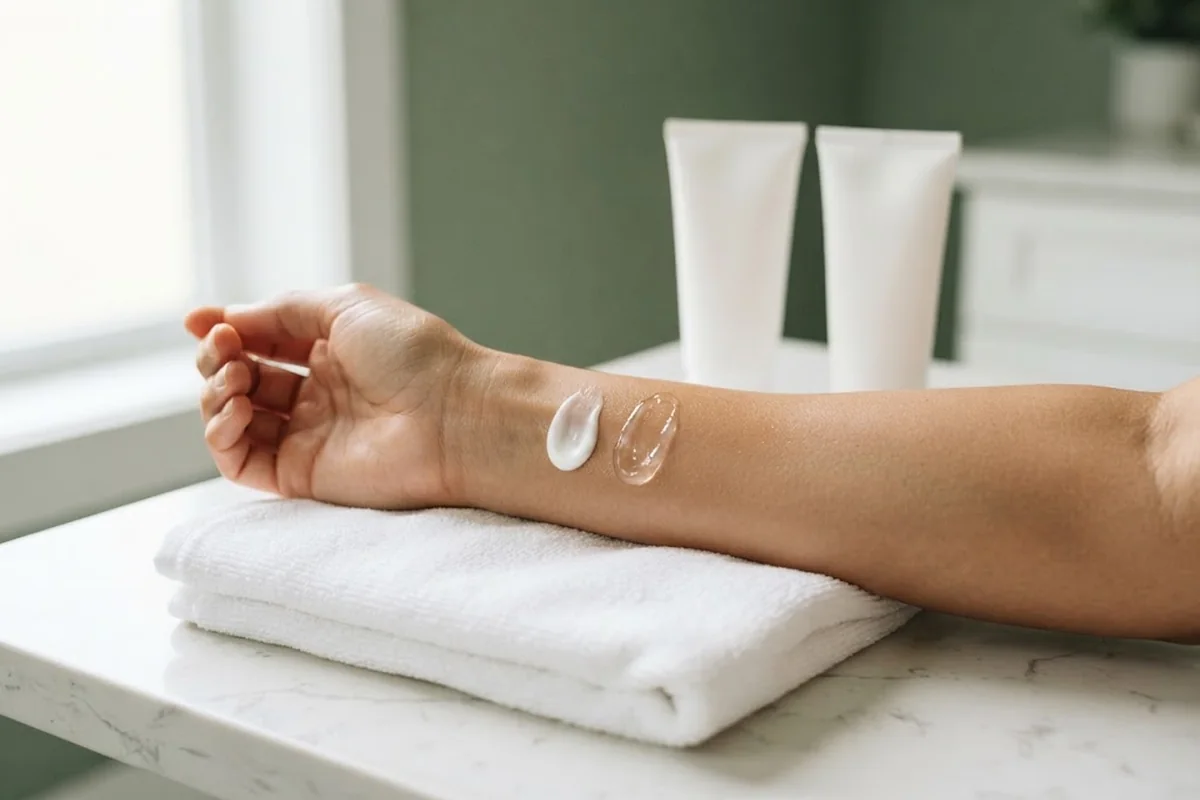
Swatch test on the inner forearm: mineral formulas can show a white cast, chemical lotions rub in clear.
Common Sunscreen Mistakes
Applying too little. A thin film gives a fraction of the label SPF.
Skipping it indoors and on cloudy days. UVA passes through windows and clouds.
Forgetting neck, ears, chest and hands. These age visibly and are often missed.
Using last year's tube. Check the expiration date, and discard sunscreen that has separated, smells off or has been baked in a hot car.
Not reapplying. Protection wears off with sweat, oil and rubbing. Reapply about every two hours outdoors.
Relying on makeup SPF. It helps, but it is not enough alone.
Buying by SPF number only. A comfortable SPF 30 you wear daily beats an SPF 100 you hate.
Skipping the patch test. If your skin burns or stings, stop and see a physician if it swells or blisters.
Another point: sunscreen is one layer. It does not replace shade, hats, sunglasses or sleeves in strong sun. Orange County has a lot of sun for most of the year, and the beach and the 405 both add reflected and window-filtered UV. I treat sunscreen as the daily baseline and add a hat and shade for longer outings.
Special Situations: Eyes, Lips, Scalp, Sport and Travel
Eye area. Chemical filters are the usual cause of stinging eyes. A mineral stick or cream used gently along the orbital bone is often more comfortable. Wear sunglasses too.
Lips. Lips have little natural protection. Use a lip balm with SPF 30 or higher and reapply after eating and drinking.
Scalp and part line. A sun hat is the easiest answer. A powder or spray designed for the scalp can help, and you should avoid inhaling spray formulas.
Ears and neck. These are the spots people miss most, and dermatologists see skin changes there often.
Exercise. Sweat dilutes everything. Use a water-resistant formula, put it on before you warm up and reapply after towel drying.
Driving. Car side windows block much UVB but let UVA through. Drivers often show more sun damage on the side of the face next to the window. Apply sunscreen before you get in.
Flying and travel. UV exposure is higher at altitude and near water or snow. Pack a small tube and keep it out of hot cars, since heat breaks formulas down.
For clients who spend most of the day indoors, daily facial sunscreen plus a hat on the weekends is realistic. For those who run, golf or surf, I suggest two products: a face formula that does not sting, and a body formula that is easy to apply fast. The face is where you will notice sun damage first, and where the skin is usually thinnest. If your plan includes a peel, microdermabrasion or dermaplaning, add one rule. For the week or two after the service, plan outdoor time early or late in the day and bring a hat.
Do not forget the back of your hands. Hands show age quickly, and they hold the steering wheel in direct sun. Whatever is left on your fingers after applying sunscreen to your face can go onto the back of the hands. It takes ten seconds and adds up over years.
Sunscreen Safety Questions: Absorption, Reef, Vitamin D and Benzene
There are a few topics where online claims run ahead of the evidence. I will keep these brief and hedged, because I am an esthetician, not a toxicologist.
Absorption of chemical filters. Small studies have found that some chemical filters are detectable in the blood after repeated application. Detection does not equal harm, and the FDA has asked for further study. If this worries you, mineral sunscreen is a reasonable choice.
Nanoparticles. Modern mineral sunscreens use small zinc and titanium particles. Studies so far suggest they stay on the surface of healthy skin. Avoid spray mineral products you could inhale.
Reef safety. Some jurisdictions restrict oxybenzone and octinoxate. If you swim in the ocean, check local rules and consider mineral formulas.
Vitamin D. Daily sunscreen use does not appear to cause deficiency in most people, but your physician can test your level if you are concerned.
Recalls. Occasionally products are recalled for contamination, especially sprays. Check the FDA site if you are unsure about a product you own.
If you are pregnant, nursing or treating a medical condition, ask your physician which sunscreen they recommend. Mineral formulas are commonly suggested during pregnancy, but your own doctor should decide.
How to Choose and Test a Sunscreen You Will Actually Wear
Daily compliance is the real skill. The best formula on paper does nothing if it stays in the drawer. Use this checklist when you try a new one.
Does the label say broad spectrum, SPF 30 or higher?
Is the texture comfortable on your skin type: fluid, lotion, cream, stick or tinted?
Test on the jawline or inner forearm. How does it look after 15 minutes and in daylight?
Does it sting your eyes or cause breakouts after three days?
Does it sit smoothly under your moisturizer and makeup?
Can you afford to use enough? An expensive tube you ration is a poor choice.
It is also reasonable to own two. A mineral or hybrid fluid for work days under makeup and a water-resistant one for beach and exercise days. Some clients keep a tinted mineral for evenings with sun. Keep one in your bag, not only in the bathroom, so you can reapply.
If you struggle to find something that suits your skin, I can look at it under magnification and suggest what to avoid based on your skin type and treatments. Book a free consultation in Irvine and bring your current tube. I will read the label with you.
Hat, sunglasses and sunscreen: sunscreen works best as one layer of protection, not the only one.
Sunscreen and Acne, Redness and Dark Marks
Breakouts after sunscreen are usually caused by a heavy base, or by not cleansing it off properly at night, not by the filters themselves. If you are acne-prone, look for "non-comedogenic," oil-free, fluid textures, and double-cleanse at night when you wear water-resistant formulas or makeup. For redness, choose fragrance-free mineral formulas and avoid alcohol-heavy sprays.
For dark marks, sunscreen is the most important product you can own. Without it, the skin keeps reproducing pigment as soon as the sun hits. That is why every peel or pigmentation plan I design begins with protection. See chemical peels for dark spots for what actually moves pigment.
The Bottom Line: A Simple Decision Guide
If you want
Choose
Fewest irritation worries, skin recovering from treatments
Plain mineral SPF 30 or higher, fragrance-free
A clear finish with no white cast
Chemical or hybrid fluid, broad spectrum
Pigmentation or melasma protection
Tinted mineral with iron oxides
Water sports
Water-resistant, reapply after toweling
Deeper skin tone, no ashy look
Sheer mineral fluid, tinted mineral or chemical
Both types protect when you use enough and reapply. Pick a texture you enjoy, wear it daily, and add shade. If you are booking a peel or a facial in Orange County, ask your esthetician which sunscreen will fit your treatment plan before you buy a new tube. A free consultation takes about 30 minutes and covers exactly that.
Frequently Asked Questions
+ Which is better for daily use, mineral or chemical sunscreen?
Neither is better for everyone. Mineral suits sensitive skin and post-treatment skin, while chemical feels lighter with makeup. The right choice is a broad-spectrum SPF 30 or higher that you will wear every day.
+ Does mineral sunscreen protect as well as chemical sunscreen?
Yes, when it is broad spectrum and applied in enough quantity. Zinc oxide protects across UVB and most UVA. Reapplying every two hours outdoors matters more than the type.
+ Why does mineral sunscreen leave a white cast?
Zinc oxide and titanium dioxide are white minerals that sit on the skin. Sheer, small-particle and tinted formulas reduce the cast. Testing a swatch in daylight helps you pick one that suits your skin tone.
+ Is chemical sunscreen safe?
Chemical sunscreens are widely used and recommended by dermatology groups over going unprotected. The FDA has requested more data on absorption of some filters. If you are concerned, choose a mineral formula and ask your physician.
+ What sunscreen should I use after a chemical peel?
Many estheticians prefer a plain, fragrance-free mineral sunscreen while skin is tight or peeling, then any broad-spectrum SPF 30 or higher once the skin has calmed. Follow your esthetician's aftercare instructions.
+ How much sunscreen should I put on my face?
Most guidance is about a quarter teaspoon for the face and neck. Apply dots across the forehead, cheeks, nose, chin and neck, blend evenly, and wait 10 to 15 minutes before going outside.
+ Do I need sunscreen indoors or on cloudy days?
Yes, if you are near windows or outside at all. UVA rays pass through clouds and glass and contribute to aging and dark marks. Daily morning sunscreen is a habit worth building.
+ Can I wear sunscreen under makeup?
Yes. Apply sunscreen after moisturizer and let it settle for a few minutes before makeup. Chemical and hybrid fluids often sit more smoothly under foundation than thick mineral creams.
Licensed electrologist and cosmetologist with 20+ years of experience. Aida sees clients at Real Skin Beauty, 18021 Sky Park Circle, Suite N, Irvine, CA 92614.
Book a free consultation with Aida Khazieva at Real Skin Beauty in Irvine, CA. She will check your skin, explain which sun protection suits it and tell you what to use after a peel.
This article is for informational purposes and reflects Aida Khazieva's practitioner experience. It does not replace a personalized medical consultation. Individual results vary.
Questions? Aida Answers Them All.
Visit our FAQ or book a free consultation to discuss your specific skin and hair concerns.