Melasma Treatment: What Actually Works and Setting Realistic Goals
By Aida Khazieva·Pigmentation·13 min read·Real Skin Beauty, Irvine CA·Updated July 27, 2026
Melasma is the hyperpigmentation condition I see most often in my Irvine CA practice, and it is also the one where I have the most difficult conversations about expectations. Clients come in having tried everything, sometimes for years, and they want to know why nothing has cleared it permanently. The honest answer is that no current treatment permanently eliminates melasma. But significant, lasting improvement is absolutely achievable with the right approach.
Quick answer: Melasma has no permanent cure, but it can fade significantly with ongoing management. Daily SPF 50 is the foundation, combined with gentle lactic or mandelic peels, vitamin C serum and sometimes prescription tyrosinase inhibitors. Aggressive treatments and many lasers can worsen it, and pigment can return with sun or hormonal changes.
What Melasma Is and Why It Is So Stubborn
Melasma is a chronic form of hyperpigmentation characterized by symmetrical patches of increased pigmentation on the face, most commonly across the cheeks, upper lip, nose bridge, chin, and forehead. It affects women far more than men, with women accounting for roughly 90 percent of cases. The patches vary in color from light brown to dark brown to grayish-brown depending on how deep in the skin the pigmentation sits.
What makes melasma uniquely stubborn compared to other hyperpigmentation types is the combination of two independent triggers that reinforce each other. Hormones sensitize melanocytes, the pigment-producing cells in the skin, to UV light. UV light then activates those sensitized melanocytes, triggering overproduction of melanin at a level that far exceeds the normal UV response. The result is persistent, deep pigmentation that returns whenever either trigger is present.
This dual-trigger mechanism explains why melasma treatment always requires addressing both the UV exposure and the hormonal component simultaneously. Treatments that target only one factor produce partial results at best. I have seen many clients in my Orange County practice who diligently applied topical treatments for months with minimal improvement because they were applying those treatments without adequate sun protection. The UV trigger was overriding every intervention they made.
Melasma pigmentation can sit in three different skin depths, which is another reason it is challenging. Epidermal melasma, in the upper skin layers, appears more brown and responds best to topical treatment. Dermal melasma, which has migrated into deeper skin layers, appears more gray or blue-brown and does not respond significantly to topicals. Mixed melasma has components at both depths. Determining which type a client has requires professional assessment, because the distinction changes the entire treatment strategy.
The UV and Hormone Double Trigger That Drives Melasma
To understand melasma treatment, you need to understand exactly how estrogen and UV radiation interact at the cellular level. Estrogen receptors are present on melanocytes. When estrogen levels are elevated, whether from pregnancy, oral contraceptives, or hormone replacement therapy, those receptors increase melanocyte sensitivity to all stimulation, including UV light. A melanocyte that would normally produce a modest amount of melanin in response to sun exposure produces dramatically more when it is in a hormonally sensitized state.
UV radiation is the second necessary ingredient. Most people with melasma notice that their patches darken significantly in summer and may fade somewhat in winter. This seasonal pattern is direct evidence of the UV component at work. In Southern California, where I practice in Irvine, the UV index rarely drops below 3 even in winter, and regularly reaches 10 to 11 in summer months. This means year-round UV management is essential for my clients in ways that may be less critical in less sunny climates.
Visible Light and Infrared Radiation
Research published in the past decade has established that visible light, not just UVA and UVB, also triggers melasma. Specifically, high-energy visible light (HVEV) in the blue-violet spectrum has been shown to stimulate melanin production in darker skin tones with the same intensity as UV radiation. This is an important and underappreciated factor because standard sunscreens do not block visible light. Only tinted sunscreens with iron oxide pigments provide meaningful visible light protection.
For my melasma clients in Orange County, I specifically recommend tinted mineral sunscreens with iron oxide rather than clear sunscreens, precisely because of this visible light component. The added protection layer makes a measurable difference in results, particularly for clients with Fitzpatrick skin types IV through VI who are most sensitive to visible light-triggered pigmentation.
Heat as a Third Trigger
Heat independently stimulates melanocytes through a mechanism separate from UV. Hot environments, hot showers, vigorous exercise that generates significant body heat, and thermal treatments including steam facials and hot stone massage can all trigger melasma flares. This is relevant both for avoiding flare triggers and for choosing appropriate professional treatments, because any treatment that introduces significant heat into melasma-affected skin can worsen rather than improve the condition.
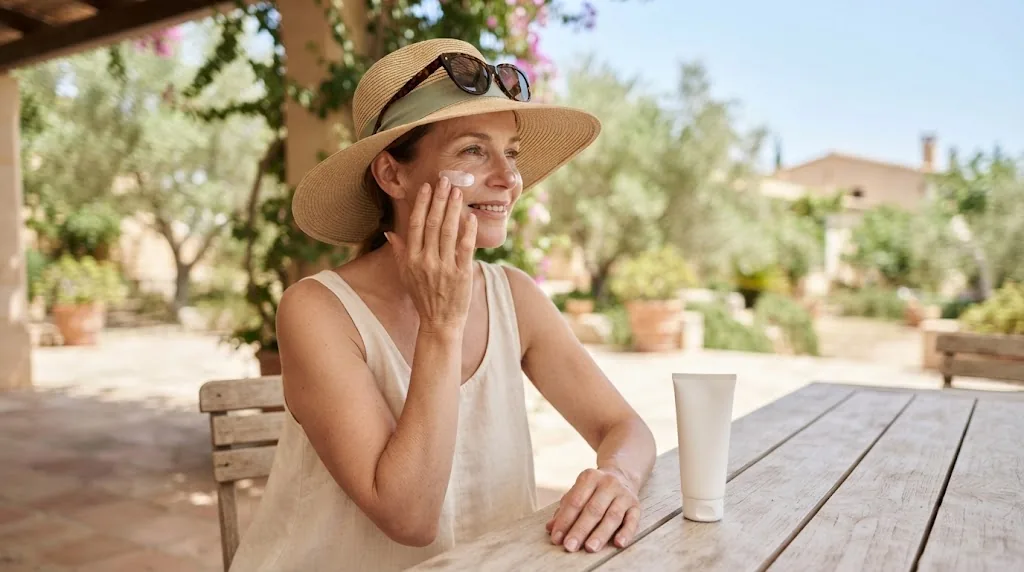
Shade, a wide-brim hat and sunscreen reapplied through the day matter as much as any in-studio treatment for melasma.
Why Melasma Is Not Just a Cosmetic Problem
I want to address something directly because it comes up often in consultations. Melasma is classified as a cosmetic condition, but the psychological burden it carries is substantial. Studies consistently show that melasma significantly affects quality of life, self-confidence, and social function. Clients who come to my Irvine studio with melasma are frequently dealing with significant distress about their appearance, and they often feel dismissed when the condition is described as "just cosmetic" by providers who underestimate its impact.
Understanding the full scope of the problem, including its psychological dimension, informs how I approach treatment planning. Goals need to be realistic, communication about timelines needs to be honest, and the management strategy needs to be sustainable enough to maintain over the long term. A treatment plan that requires heroic effort every day is unlikely to be followed consistently, and consistency is everything with melasma.
I also take time in consultations to discuss what "success" looks like with melasma, because it differs from other pigmentation conditions. Success with sun spots might mean near-complete clearing. Success with melasma more realistically means significant lightening, stable maintenance, and the ability to manage the condition without it dominating daily life. Framing treatment around management rather than cure produces more sustainable outcomes and more realistic satisfaction with results.
Sun Protection as the Primary and Most Important Treatment
If I had to choose one intervention for a melasma client and nothing else, it would be strict daily broad-spectrum SPF 50 applied correctly every morning and reapplied every two hours during sun exposure. Not because other treatments are ineffective, but because no other treatment works in the presence of uncontrolled UV exposure. Sun protection is the foundation without which the entire structure of melasma treatment is unstable.
For melasma specifically, the sunscreen requirements are more demanding than for general skin protection:
SPF 50 or higher: Not SPF 30. The additional UVB filtration matters when melanocytes are in a sensitized state.
Broad-spectrum coverage: Must protect against both UVA (aging and pigmentation rays) and UVB (burning rays).
Tinted formula with iron oxide: Protects against visible high-energy visible light which standard sunscreens do not block.
Physical (mineral) filter preferred: Zinc oxide or titanium dioxide reflects UV rather than absorbing it. Less heat generation on the skin surface compared to chemical filters, which is relevant given heat's independent role as a melasma trigger.
Correct application amount: A quarter teaspoon for the face alone. Most people use a fraction of this amount, reducing effective protection significantly.
Reapplication every two hours: During outdoor activity. In Southern California, even a morning walk or car commute with the window down constitutes meaningful sun exposure.
The Minimum Effective Dose
SPF applied once in the morning gives meaningful protection for approximately 2 hours of direct sun exposure. After that, protection degrades. In Irvine's UV environment, treating melasma without midday reapplication on any day spent partly outdoors is treating with one hand tied behind your back.
Professional Treatments That Actually Help Melasma
The professional treatment approach to melasma is different from the approach to other hyperpigmentation types. The key distinction: aggressive treatments that work well on sun spots and PIH often make melasma worse. The inflammation, heat, and trauma produced by aggressive peels or laser can trigger post-inflammatory hyperpigmentation on top of existing melasma, deepening and complicating the picture.
Gentle Chemical Peel Series
A series of low-dose chemical peels with gentle acids is the most consistently effective professional treatment for melasma in my practice. I specifically use lactic acid and mandelic acid peels for melasma clients rather than glycolic acid, because their larger molecular sizes produce slower, more even exfoliation with significantly less irritation risk.
Lactic acid at 30 to 40 percent is my starting point for most melasma clients. It is the most hydrating of the alpha-hydroxy acids, which helps counteract the dryness that can accompany treatment. It exfoliates slowly enough that the inflammatory response is minimal, reducing the risk of PIH that can complicate melasma treatment in darker skin tones.
Mandelic acid is particularly well-suited for Fitzpatrick skin types IV through VI, where the risk of procedure-triggered PIH is highest. It has the largest molecular size of common AHAs, penetrates very slowly and evenly, and carries antibacterial properties that help maintain clear skin as a secondary benefit. A series of 6 mandelic acid peels spaced 3 to 4 weeks apart produces visible melasma improvement without the irritation risk of more aggressive approaches. Visit the chemical peels page for information on what to expect during a professional peel appointment.
Vitamin C Professional Treatments
Professional vitamin C infusions at 20 to 30 percent L-ascorbic acid concentration, delivered with iontophoresis or ultrasound to drive penetration into the active skin layers, are a powerful complement to the peel series. Vitamin C inhibits tyrosinase, the enzyme that produces melanin, and provides antioxidant protection that intercepts the UV-to-melanin signaling chain. In my Irvine studio, I often pair a vitamin C infusion treatment with gentle lactic acid peels in the same session for melasma clients, because the brightening effects of both modalities are additive.
Topical Tyrosinase Inhibitors
Prescription topical treatments prescribed by a dermatologist, including hydroquinone at 4 percent, azelaic acid at 15 to 20 percent, and kojic acid, directly inhibit tyrosinase activity and are highly effective when used as part of a comprehensive protocol. These prescriptions are outside the scope of my esthetic practice but I frequently coordinate with my clients' dermatologists to ensure topical prescriptions and professional peel timing are aligned rather than working against each other. Check the FAQ for guidance on how to discuss melasma with your dermatologist if you are also receiving professional treatments.
What to Absolutely Avoid With Melasma
This section matters as much as the treatment recommendations, because the wrong interventions can set melasma treatment back by months. I have seen clients come into my Irvine practice with significantly worsened melasma after aggressive treatments that were entirely inappropriate for their condition.
Laser treatments without expert melasma-specific experience: Many laser wavelengths that work well on sun spots and vascular concerns cause significant heat in the skin and trigger immediate melasma flares. Fractional lasers and IPL are frequently contraindicated for melasma. If a provider recommends laser for melasma without a thorough discussion of your skin tone and melasma depth, seek a second opinion.
High-concentration glycolic acid peels as the first-line approach: Glycolic acid's small molecular size allows it to penetrate rapidly, which in sensitized melasma skin can trigger the inflammation that deepens pigmentation rather than lightening it.
Heat-based treatments: Steam facials, hot stone massage, infrared saunas, and any treatment that generates significant heat on melasma-affected skin can trigger immediate darkening. All heat-generating treatments should be discussed with your esthetician before booking if you have active melasma.
Exfoliation during a peel recovery phase: Scrubs, physical exfoliants, and at-home AHA products during the 5 to 7 days following a professional peel interfere with the post-peel cell turnover cycle and can cause uneven exfoliation that produces patchy results in melasma skin.
Stopping sun protection when pigmentation fades: This is the most common reason for melasma relapse. When treatment succeeds and patches lighten, the underlying sensitivity of the melanocytes has not changed. Removing SPF immediately triggers re-darkening.
Before Any New Treatment
Always disclose active melasma to any esthetician or provider before a new treatment. What is safe and effective for general hyperpigmentation may be contraindicated for melasma. This applies to facials, peels, laser treatments, and even some body treatments that use heat.
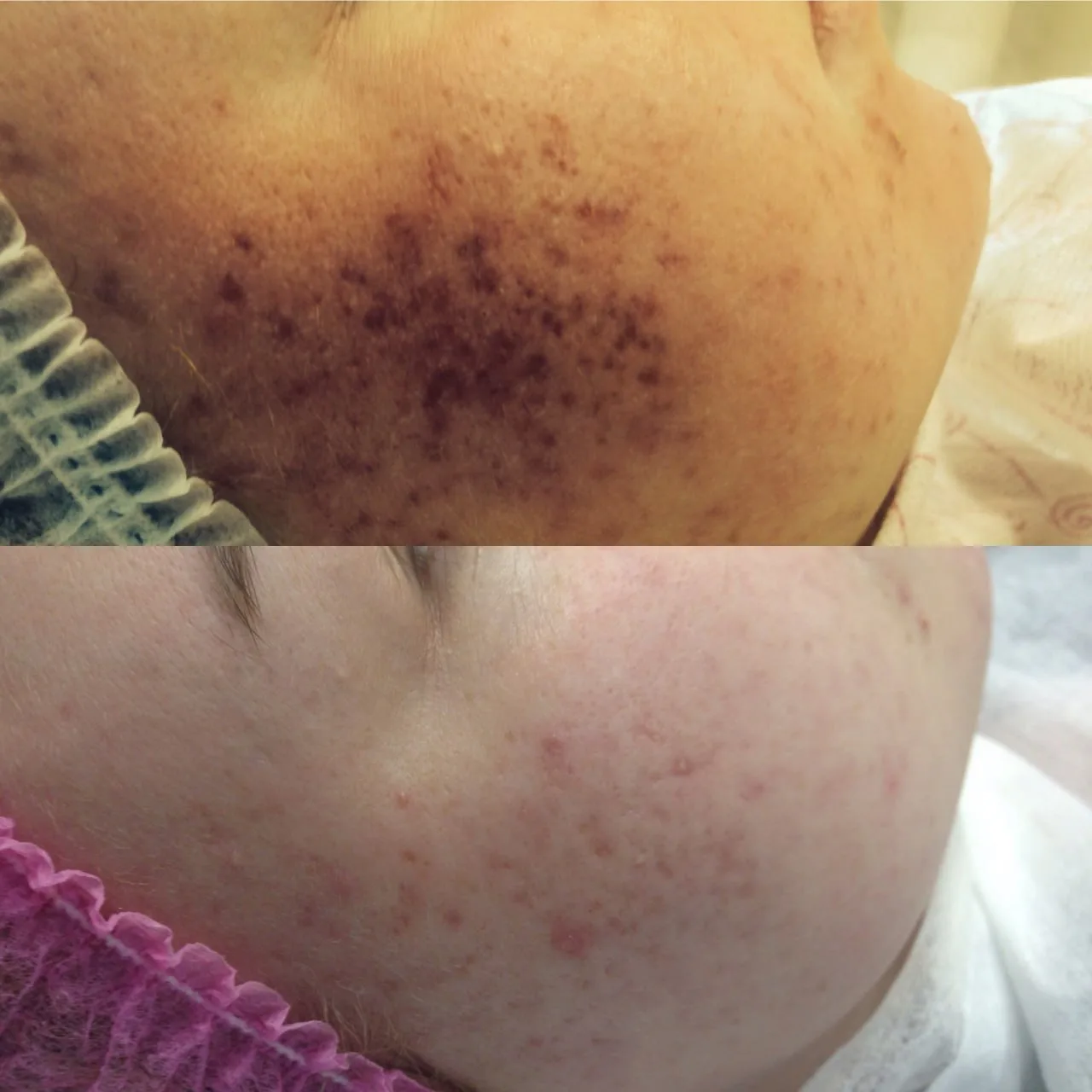
Pigmented area before and after treatment at Real Skin Beauty. Individual results vary.
Pregnancy-Related Melasma: Special Considerations
Melasma that develops during pregnancy, commonly called the "mask of pregnancy," is driven by the dramatic hormonal shifts of the second and third trimesters. It follows the same pattern as hormonal melasma: symmetrical patches across the cheeks, upper lip, and forehead that are often more pronounced than non-pregnancy melasma because estrogen and progesterone levels during pregnancy are significantly higher than during contraceptive use.
Treatment during pregnancy is significantly restricted. The following interventions are generally considered safe during pregnancy for melasma:
Broad-spectrum mineral sunscreen (zinc oxide, titanium dioxide) at SPF 50, applied daily. This is the primary intervention during pregnancy.
Topical vitamin C at concentrations up to 20 percent L-ascorbic acid. Studies do not show concern at standard cosmetic concentrations.
Azelaic acid at 10 percent concentration, which is generally regarded as safe during pregnancy at this level, though confirmation with your OB-GYN is appropriate.
What should be avoided during pregnancy:
Hydroquinone, even though it is topical, because systemic absorption is not fully studied during pregnancy.
Retinoids and retinol at any concentration, which are contraindicated during pregnancy.
High-concentration chemical peels. Superficial low-dose lactic acid may be acceptable after the first trimester with OB-GYN clearance, but this is a decision that involves your medical provider, not just your esthetician.
Many clients find that pregnancy melasma improves significantly in the months after delivery when hormone levels normalize. Some resolves completely without active treatment. Those who retain significant pigmentation post-partum can then begin a full treatment protocol without the restrictions pregnancy imposes. Book a free consultation at Real Skin Beauty to discuss timing and appropriate post-partum treatment planning.
Living With Melasma: A Long-Term Management Mindset
The single most important reframe for melasma clients is this: melasma management is more like managing a chronic skin condition than completing a course of treatment. The underlying tendency toward melanocyte hyperactivity does not go away with successful treatment. It is present and can be reactivated at any point by the right combination of hormonal exposure and UV light.
This does not mean melasma is unmanageable. It means managing it requires an ongoing commitment to certain habits rather than a finite treatment course with a definite endpoint. The clients in my Orange County practice who maintain the best long-term results share a few consistent characteristics:
They treat sunscreen as a non-negotiable, year-round daily step. Not a summer product. Not an optional extra. A daily essential on par with brushing teeth.
They maintain a brightening home-care routine even during good periods when melasma is well-controlled. Dropping the routine entirely the moment skin looks good is the most reliable way to trigger a relapse.
They schedule maintenance professional peels every 6 to 8 weeks during spring and summer, when UV exposure is highest, and can space to every 8 to 12 weeks in winter.
They communicate with their esthetician proactively if they change hormonal contraceptives, become pregnant, or notice new darkening before it becomes significant.
They invest in protective clothing, hats with wide brims, and UV-protective sunglasses for outdoor activities. Sunscreen alone, while essential, is not as effective as sunscreen plus physical UV barriers.
Results with this approach are genuinely good. Many clients with well-managed melasma maintain skin that looks uniformly clear without visible patches for months or years at a time. The condition has not been eliminated, it is being actively managed. That distinction, once accepted, shifts the relationship with melasma from frustrated and reactive to informed and proactive. That shift alone tends to improve outcomes because clients stop abandoning protocols the moment they see some improvement and instead maintain the habits that produced the improvement.
If you have melasma and have not yet had a clinical assessment of your specific type, depth, and severity, I would encourage you to start there. The appropriate professional treatment approach differs significantly depending on whether you have epidermal, dermal, or mixed melasma, and on your Fitzpatrick skin type. A facial consultation at Real Skin Beauty includes this assessment and gives you a realistic protocol tailored to your actual skin rather than a generic plan.
Frequently Asked Questions
Can melasma be permanently cured? +
There is currently no permanent cure for melasma. Treatment fades existing pigmentation significantly, but melasma can return with UV exposure or hormonal changes. Think of melasma management as ongoing maintenance rather than a one-time fix.
Which professional treatment works best for melasma? +
A multi-pronged approach: strict SPF 50 daily as the foundation, low-dose lactic or mandelic acid peels that are gentler on darker skin tones, vitamin C serum, and sometimes topical tyrosinase inhibitors prescribed by a dermatologist. Aggressive treatments often worsen melasma rather than improve it.
Does laser help melasma? +
Laser is controversial and often contraindicated for melasma. Some lasers temporarily improve it but frequently cause post-inflammatory hyperpigmentation, especially in darker skin tones. Most experienced dermatologists and estheticians prefer topical and gentle peel approaches over laser for melasma.
Will melasma go away on its own after stopping birth control? +
Hormonal melasma often improves when the triggering hormone is removed, but UV damage has typically already been deposited in the skin. Sun protection and active treatment are still necessary to fade existing pigmentation fully.
How long until melasma treatment shows visible results? +
With consistent SPF, daily vitamin C and monthly gentle peels, significant improvement is typically visible at 3 to 6 months. Full treatment commonly takes 6 to 12 months. Without ongoing sun protection, results will not hold regardless of how diligently the professional treatment is applied.
Licensed electrologist and cosmetologist with 20+ years of experience. Aida sees clients at Real Skin Beauty, 18021 Sky Park Circle, Suite N, Irvine, CA 92614.
Book a free consultation with Aida Khazieva at Real Skin Beauty in Irvine, CA. Get a professional assessment of your melasma type and depth, and an honest treatment plan built for your skin.
This article is for informational purposes and reflects Aida Khazieva's clinical experience. It does not replace a personalized medical consultation. Individual results vary.