How Many Electrolysis Sessions Do You Need? Honest Answers
By Aida Khazieva·Electrolysis·12 min read·Real Skin Beauty, Irvine CA·Updated July 27, 2026
One of the first questions every new client asks me is how many sessions they will need. I understand why. You want to know what you are committing to before you start. The honest answer is that no single number applies to everyone, but there are real ranges based on specific factors I can assess directly, and at my Irvine, CA studio I always provide a meaningful estimate at your first consultation. Here is the full explanation of what determines your number and why.
Quick answer: There is no honest fixed number. Even the fastest cases need at least 6 to 8 sessions, because only 20 to 30 percent of hairs are actively growing at once. The total depends on hair density, coarseness, area size, hormones such as PCOS and consistency. Sessions start every 2 to 4 weeks, then space out.
Why There Is No Single Answer to This Question
When I hear an electrolysis provider quote a flat number of sessions without examining the client first, I am skeptical. The session count is determined by several interacting variables, and no one can give you an accurate number without assessing at least a few of them directly. Any provider who tells every client they will need exactly 12 sessions, regardless of treatment area or hair density, is giving you a marketing figure rather than a clinical estimate.
The variables that determine your specific session count:
Treatment area and its size: The upper lip and the full back require vastly different total treatment hours. A chin clearance and a full-leg clearance have almost nothing in common in terms of session volume.
Hair density in that area: Two clients treating their upper lip can have dramatically different follicle counts. One client might have 200 active follicles in that area; another might have 800. Hair density is one of the biggest variables I assess at consultation.
Hair coarseness: Coarse, terminal hair requires more current intensity per follicle and more precise probe placement. Fine vellus hair, while sometimes numerous, requires less energy per follicle. Coarser hair generally means longer individual sessions and more treatment time per area.
Hormonal factors: Active hormonal conditions, particularly PCOS and elevated androgens, continuously activate dormant follicles throughout your treatment period. This effectively extends the total session count because new follicles appear that were not present or treatable at the start of treatment.
Consistency of scheduling: Clients who follow recommended session intervals progress faster than those who skip appointments. The hair growth cycle does not wait for your schedule, and irregular sessions miss follicles cycling through their active phase.
Skin sensitivity and healing response: Some clients need slightly longer intervals between sessions to allow adequate skin recovery. This extends the calendar timeline without necessarily changing the total session count, but it affects how long the overall process takes in real time.
What I can tell you at a consultation is a realistic range based on examining your specific hair density, coarseness, treatment area, and hormonal history. That range is always more informative than a generic number pulled from a website.
The Hair Growth Cycle and Why It Dictates Your Timeline
Understanding the hair growth cycle is the single most important piece of context for understanding why electrolysis takes multiple sessions. This is not a limitation of the method. It is biology.
Hair follicles cycle through three distinct phases:
Anagen (active growth): The follicle is fully formed, the hair shaft is connected to the papilla and actively growing, and the follicle is at its most vulnerable to electrolysis treatment. This is the only phase during which electrolysis can effectively destroy the follicle. A hair in anagen releases cleanly with zero resistance after proper treatment.
Catagen (transition): The follicle begins to shrink, the hair shaft detaches from the papilla and starts to move upward in the follicle. This phase lasts a few weeks and marks the end of active growth.
Telogen (resting/shedding): The hair is no longer attached to the base of the follicle, the follicle is resting, and the hair eventually sheds. A new anagen hair then begins to form. During telogen, the follicle is not receptive to electrolysis treatment.
At any given moment, only roughly 20 to 30 percent of the follicles in any treatment area are in the anagen phase. The rest are in catagen or telogen, resting and cycling. Electrolysis can only permanently treat follicles in anagen, which means any single session can only address the fraction of follicles that are currently active.
Why Multiple Sessions Are Biologically Necessary
At any given time, only 20 to 30 percent of follicles in a treatment area are in the active anagen phase where electrolysis can permanently destroy them. A minimum of 3 to 4 full cycles through the growth phase are needed to treat all follicles in an area, which is why even the simplest cases require months of treatment, not a single session.
The anagen phase also varies in duration by body area. Facial hair anagen lasts roughly 1 to 4 months. Scalp hair anagen lasts 2 to 7 years. Body hair falls in between. These durations affect how often follicles cycle through the treatable phase, which in turn affects session scheduling frequency.
This cycle biology is also why I emphasize consistency. Skipping sessions is not simply delaying your timeline by the same number of weeks you skipped. It means missing follicles at the precise window when they are treatable, and those follicles will not reach that window again for weeks to months depending on the body area.
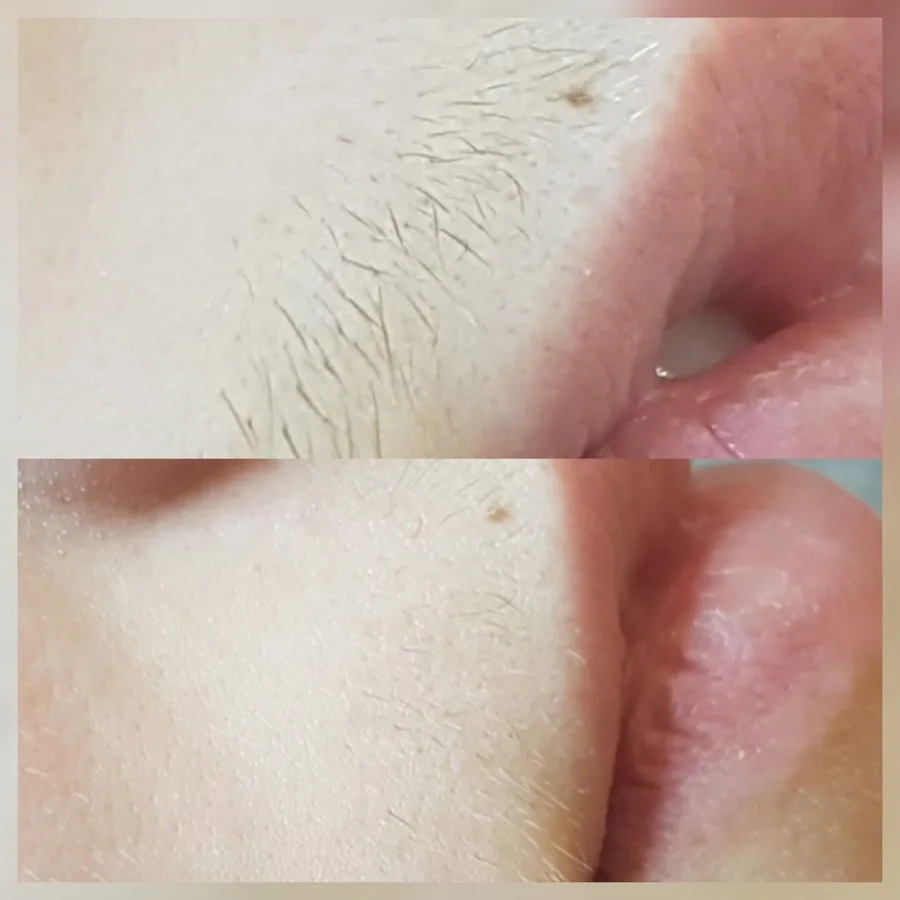
Upper lip and chin before and after a course of electrolysis. Individual results vary.
Sessions by Body Area: Realistic Estimates
The following ranges are based on clients I see in my Orange County practice. These are realistic estimates for clients without active hormonal conditions and with average hair density. Hormonal factors, higher-than-average density, or inconsistent scheduling all push these numbers toward the higher end.
Treatment Area
Typical Session Range
Typical Timeline
Notes
Upper Lip
10 to 25 sessions
12 to 24 months
Sensitive area; consistent intervals critical
Chin
12 to 25 sessions
12 to 24 months
Coarse hair adds treatment time per session
Full Face
20 to 40 sessions
18 to 36 months
Includes upper lip, chin, jaw, cheeks, neck
Underarm
12 to 22 sessions
12 to 24 months
High-density area; curled follicles common
Bikini Line
15 to 30 sessions
18 to 30 months
Coarse hair, curved follicles
Full Brazilian
25 to 50 sessions
24 to 36 months
Largest intimate area; most variation
Lower Legs
25 to 50+ sessions
24 to 36 months
Large surface area; density varies significantly
Full Legs
50 to 120+ sessions
36 to 60 months
Often combined with laser for density reduction first
Back or Chest
30 to 80+ sessions
24 to 48 months
Density varies enormously; longer sessions needed
These numbers look substantial, and I want to be direct: electrolysis is a commitment. Anyone who tells you that full permanent clearance takes only 6 or 8 sessions for most body areas is not being accurate. The biological process of cycling through all follicle growth phases across a treatment area takes time. What makes it worth that commitment is that the endpoint is real and permanent.
How Hormonal Conditions Affect Your Session Count
Hormonal conditions, particularly PCOS and other forms of elevated androgen activity, change the session count equation significantly. If you have been told you need electrolysis for PCOS-related facial hair, you should plan for more sessions than the typical ranges above suggest, and here is the specific reason why.
Under normal circumstances, the pool of follicles in your treatment area is relatively fixed. As you work through multiple treatment sessions, you are systematically treating the follicles in that pool during their active phases. Over time the pool depletes and you reach clearance.
With PCOS and active androgen stimulation, that pool is not fixed. Androgens continuously activate previously dormant follicles throughout your treatment period. These newly activated follicles were not present or visible at the start of treatment. They appear as new hair growth in an area you have been treating for months. This is not regression of previous treatment. Previously treated follicles are permanently gone. But new follicles from a separate population are activating alongside your ongoing treatment.
PCOS and Session Count
Standard session ranges assume a fixed pool of follicles that depletes over treatment. PCOS and elevated androgen activity continuously activate new follicles throughout treatment, extending the timeline. Medical management of PCOS alongside electrolysis, including medications like spironolactone, reduces the rate of new follicle activation and can meaningfully shorten the overall treatment period.
Other hormonal and medical factors that affect session count:
Corticosteroid medications: Long-term steroid use can increase hair density and follicle activity
Anabolic steroids: Significantly elevate androgens and increase facial and body hair in all skin types
Certain blood pressure medications: Some antihypertensives, particularly minoxidil, increase hair growth
Post-pregnancy hormonal shifts: The hormonal transition after pregnancy can activate dormant follicles and temporarily increase facial hair
Menopause: Declining estrogen relative to androgens can activate new facial follicles, which is why many clients first notice chin and upper lip hair in perimenopause
Thyroid conditions: Both hypothyroidism and hyperthyroidism can affect hair growth patterns
If any of these factors apply to you, I factor them explicitly into the treatment estimate at your consultation. Medical management of the underlying hormonal condition, wherever possible, is the most direct way to limit ongoing follicle activation and bring the total session count down over time. I encourage clients with PCOS to work alongside their endocrinologist or gynecologist during electrolysis treatment. You can also visit the PCOS electrolysis page for a more detailed discussion of the hormonal hair treatment approach.
Each session clears the hairs that are in the active growth phase at that moment, which is why a series is needed.
What Happens If You Skip or Space Out Sessions
This is the question that determines how many clients actually reach their permanent clearance goal, and the answer matters practically for how you structure your schedule from the beginning.
Missing sessions does not simply delay your endpoint by the same number of weeks. It affects your timeline disproportionately because of the hair growth cycle timing.
Here is what actually happens: Follicles that were in telogen (resting) during your last session have now cycled into anagen (active) and are ready to be treated. If you skip the session when they are active, they complete their anagen phase, re-enter telogen, and you have to wait for them to cycle active again before treating them. Depending on the body area, that anagen window can be 4 to 12 weeks long. Missing it can set back those follicles by an entire additional growth cycle.
In practice, what clients who skip sessions experience:
Regrowth appears to "come back" because newly active follicles (never previously treated) are appearing alongside any previously treated follicles
Sessions that should be getting shorter (because density is decreasing) continue to take as long as early sessions because new follicles are appearing
The overall timeline extends, sometimes by months or more depending on how many sessions are skipped and at what stage of treatment
Motivation to continue decreases, because the visual progress clients expect to see is not happening on schedule
The consistent schedule is not about preference. It is the mechanism by which you catch follicles in their optimal treatment window and make actual progress. Early in treatment, I recommend sessions every 2 to 4 weeks for facial areas. As hair density decreases, sessions naturally space to 4 to 8 weeks because there is less to treat per appointment. That natural spacing is a sign of progress. Forced early spacing is what creates problems.
How to Speed Up Your Progress
There are real, practical things you can do to reach permanent clearance faster. Some of these I discuss at consultation; others I reinforce as treatment progresses.
Keep your scheduled appointments. This is the most impactful factor you control directly. Consistent scheduling is the single biggest variable within your control, and it matters more than any other optimization.
Stop tweezing and waxing entirely. Between sessions, do not tweeze or wax. These methods remove the hair shaft that the probe needs to track into the follicle during your next session. They also distort the follicle over time, making accurate probe insertion harder. Between sessions, trim or shave only. The hair needs to be present and traceable to treat the follicle properly.
Treat multiple areas per session when possible. If you have multiple areas requiring treatment, addressing several in a single longer session can be more efficient than separate short appointments for each area.
Manage hormonal conditions medically. If PCOS or elevated androgens are a factor, working with your physician to manage hormone levels reduces the rate of new follicle activation. Spironolactone, for example, blocks androgen receptors and meaningfully reduces the stimulation of new follicle growth. This does not eliminate the need for electrolysis but can reduce the total number of sessions required by limiting the size of the follicle pool you need to work through.
Communicate what you are observing between sessions. If you notice significant new growth in an area that seemed to be clearing, let me know at your next appointment. This helps distinguish between newly activated follicles (expected with hormonal conditions) and any other factors affecting your progress.
Plan your treatment area strategically. For large areas like the legs or back, starting with the highest-visibility zones and working outward creates visible progress in the areas that matter most to you, which helps with motivation and consistency throughout a longer treatment process.
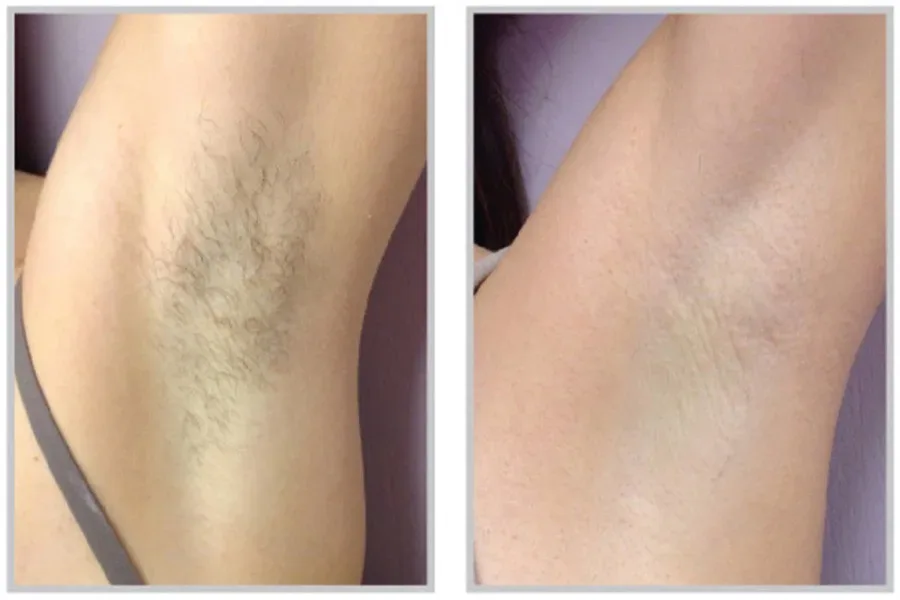
Underarm area before and after electrolysis treatment at Real Skin Beauty.
First Session vs. Final Session: What Changes Over Time
The difference between a client's first electrolysis session and their last session in the same area is significant enough that it is worth describing specifically. Understanding this arc makes it easier to stick with the process during the early phases when progress feels slower.
Early sessions: The follicle population is at its maximum density. Every session treats a large number of hairs relative to what remains. Sessions are longer because there is more to treat. Hair coarseness is typically at its maximum because the follicles that have been active longest tend to be the coarsest. Current intensity requirements are higher for these coarser follicles. Redness and minor skin reaction after treatment are more pronounced because the density of treated sites is high. In summary, early sessions are the most physically demanding both to receive and to recover from.
What you experience in the first two to three months: It may not look like much is changing between sessions. This is normal. You are working through the fraction of follicles in anagen during each visit, but the telogen follicles have not yet cycled into view. Many clients feel discouraged at this stage. Stay consistent. The change is happening at the follicle level before it is visible on the surface.
Middle sessions: Density is noticeably decreasing. Sessions begin to take less time because there are fewer hairs per appointment. The hairs remaining tend to be finer than the first ones treated, because the most stimulated and coarsest follicles were typically in the active phase earliest. Current intensity requirements decrease. Skin recovery between sessions becomes faster and more complete.
Late sessions: Density is sparse. Sessions are significantly shorter. The remaining hairs are often fine and require minimal current. Redness after treatment clears within hours rather than days. The intervals between sessions stretch naturally because there is simply less to treat per visit. This is the most satisfying phase of treatment for clients who have been consistent.
The Natural Arc of Treatment
Sessions that feel most demanding early on become progressively shorter, less intense, and easier to recover from as treatment progresses. The discomfort of early sessions is a function of high hair density, not the method itself. By the final few sessions, many clients describe the experience as almost trivial compared to where they started.
The final session: There is a real endpoint. At some point in your treatment area, there are simply no more follicles to treat. The last session is unremarkable because there is very little to do. When I can examine a previously dense area and find no active hairs remaining over two or three consecutive visits at the appropriate intervals, that area is complete. The permanence is not a gradual fade to near-zero. It is a real, definable, testable endpoint.
Making a Realistic Treatment Plan at Your Consultation
Every new client at my Real Skin Beauty studio in Irvine, CA starts with a free consultation. The session count estimate I give you at that consultation is based on direct observation of your specific situation, not a generic script.
At a consultation I assess:
The treatment area or areas you want to address
Hair density in each area (visually and by feel)
Hair coarseness, which affects treatment time per follicle
Skin type and likely healing response
Any hormonal history (PCOS, medications, recent pregnancy, perimenopause)
Your prior hair removal history, including whether you have been tweezing or waxing
Based on these factors, I give you a realistic session range for each area, an estimated session frequency for each phase of treatment, and a total cost projection so you can plan accordingly. I am direct about higher-end estimates when they apply. Telling a client with dense PCOS-related chin hair that they will need 10 sessions would be setting them up for disappointment. The accurate answer serves you better even if it is not the one you were hoping to hear.
I also address scheduling logistics at consultation: what interval to start with, how to recognize when spacing can widen, and what to watch for between sessions that indicates the treatment is progressing as expected. For answers to the most common questions clients ask before starting, visit the FAQ page. To see the full scope of electrolysis services I offer across the Irvine and Orange County area, that page covers treatment zones, modalities, and practical details. When you are ready to start, book your free consultation and we will build your specific plan together.
Frequently Asked Questions
+ What is the minimum number of electrolysis sessions anyone needs?
Even the fastest cases require at least 6 to 8 sessions, and most clients need more. Hair grows in cycles with only 20 to 30 percent of follicles active at any given time. You must treat each follicle during its active anagen growth phase, which means multiple treatment rounds spread over months before all follicles in an area have been reached. Cases with very low hair density in a small area can reach clearance faster, but the cycle biology means there is no shortcut to treating fewer than a minimum number of rounds.
+ Why do some people need more sessions than others?
The primary factors are hair density, treatment area size, hair coarseness, hormonal activity, and session consistency. Higher density means more follicles to treat, which directly increases total session count. Hormonal conditions like PCOS continuously activate new follicles during treatment, extending the timeline as new hairs appear throughout the course of treatment. Inconsistent scheduling misses follicles at their optimal treatment window, requiring additional sessions to catch them in a later cycle.
+ How often should electrolysis sessions be scheduled?
Early in treatment, sessions every 2 to 4 weeks per area are ideal to systematically catch follicles as they cycle into the active anagen phase. As hair density decreases, the interval between sessions naturally extends to 4 to 8 weeks because there is less to treat at each visit. I adjust frequency recommendations based on your individual growth patterns and how your skin is responding. Forcing early spacing slows overall progress; natural widening of intervals is a sign the treatment is working.
+ Is there a way to estimate my total session count before starting?
Yes. At your free consultation, I assess hair density, coarseness, the size of the treatment area, and any relevant hormonal history and provide a realistic session range and cost projection specific to your situation. This is always more accurate than any generic estimate you will find online because it is based on direct observation of your actual hair, not a statistical average.
+ Will sessions eventually end completely?
Yes. This is one of the most important things to understand about electrolysis. There is a real permanent endpoint. Once all follicles in a treatment area have been treated during their active growth phase, hair does not return. The last session is followed by no more growth. No maintenance sessions, no annual touch-ups, no coming back because the hair returned. That permanent endpoint is what distinguishes electrolysis from every other hair removal method available.
Licensed electrologist and cosmetologist with 20+ years of experience. Aida sees clients at Real Skin Beauty, 18021 Sky Park Circle, Suite N, Irvine, CA 92614.
Book a free consultation with Aida Khazieva at Real Skin Beauty in Irvine, CA. She will assess your specific concerns and create a personalized treatment plan with realistic session estimates.
This article is for informational purposes and reflects Aida Khazieva's clinical experience. It does not replace a personalized medical consultation. Individual results vary.
Questions? Aida Answers Them All.
Visit our FAQ or book a free consultation to discuss your specific skin and hair concerns.