Glycolic Acid Peel: Complete Benefits Guide and What to Expect
By Aida Khazieva·Chemical Peels·12 min read·Real Skin Beauty, Irvine CA·Updated July 27, 2026
Glycolic acid is the peel I perform more than any other at Real Skin Beauty in Irvine. Clients come in asking about it specifically, having read about it online or been recommended it by friends, and they all have the same questions: what will it actually do, will it hurt, what does recovery look like, and is the professional version really different from the glycolic products they already own. All of those questions have concrete answers, and I cover every one in this guide.
Quick answer: A glycolic acid peel uses an alpha-hydroxy acid from sugar cane with the smallest molecule of all AHAs, so it penetrates quickly to loosen dead cells and stimulate collagen. Professional peels run 20 to 70 percent. A 20 to 30 percent peel is a good start for first-timers, with minimal downtime.
What Glycolic Acid Is and Why It Works on Skin
Glycolic acid is an alpha-hydroxy acid, one of a family of naturally occurring organic acids used in skin care for their exfoliating and skin-renewing properties. It is derived from sugar cane, though it is typically synthesized for cosmetic and clinical use to ensure precise purity and concentration. Among all the AHAs, glycolic acid has the smallest molecular weight, a property that directly determines how it behaves on skin and why it is so effective as a professional treatment.
Small molecular weight means faster and deeper penetration through the epidermis. While lactic acid and mandelic acid work more slowly due to their larger molecules, glycolic acid penetrates quickly and reaches further into the skin layers with a given contact time. This is the fundamental reason it produces more pronounced results at lower concentrations than other AHAs and why it is the standard against which other brightening and exfoliating acids are measured.
Glycolic acid works through two primary mechanisms. The first is keratolytic action: it dissolves the intercellular cement that holds dead skin cells together in the stratum corneum, the outermost skin layer. This dissolution causes dead cells to shed far faster than they would through normal turnover, revealing the fresher, less pigmented, smoother cells beneath. This process is what produces the visible smoothing and brightening effects clients notice after the peeling phase resolves.
The second mechanism is dermal stimulation. Even at superficial concentrations, glycolic acid reaches the upper dermis and activates fibroblasts, the cells responsible for producing collagen and elastin. This fibroblast stimulation triggers new collagen synthesis, improving the density and organization of the dermal matrix over time. Clients who commit to a series of glycolic peels typically notice improvements not just in surface pigmentation and texture but in overall skin firmness and the appearance of fine lines. The treatment addresses both epidermal concerns (dullness, spots, rough texture) and early dermal concerns (early laxity, fine lines) simultaneously.
The pH level of a glycolic peel matters as much as the concentration. Glycolic acid is effective only when applied at a pH low enough to keep it in its active, un-ionized form. At-home products that contain glycolic acid are formulated at higher pH levels for safety, which significantly reduces the acid's ability to penetrate and exfoliate. Professional peels use lower pH formulations that maintain full acid activity, which is one of the key reasons professional treatments produce results that home products simply cannot replicate regardless of the glycolic concentration listed on the label.
In my practice at Real Skin Beauty in Irvine, I use professionally formulated glycolic acid solutions from established cosmeceutical suppliers with documented pH and concentration accuracy. Predictable results depend on knowing exactly what is in the product being applied, and that precision is only available in professional-grade formulations.
Benefits of Regular Glycolic Acid Peels
The benefits of a consistent glycolic peel series extend well beyond the basic exfoliation description that most people have heard. The full scope of clinical improvements I see in clients who commit to 4 to 6 sessions at appropriate intervals covers multiple skin concerns simultaneously, which is part of why glycolic peels have remained the most popular professional peel option for decades.
Reduction of hyperpigmentation and dark spots. Glycolic acid accelerates the removal of melanin-bearing surface cells and partially disrupts the transfer of melanin from melanocytes to keratinocytes. The combined effect produces visible lightening of solar lentigines, post-inflammatory hyperpigmentation from acne, and uneven tone from sun damage accumulated over years of Orange County outdoor living. Results typically become visible after the peeling phase of sessions two and three.
Improved skin texture and smoothness. The removal of dead cell buildup from the stratum corneum produces an immediate tactile difference that clients notice when they touch their skin. Over a series, the progressive reduction in dead cell accumulation produces a lasting smoothness that makes skin feel genuinely different, not just temporarily improved from a single treatment.
Reduction of fine lines and early wrinkles. The collagen stimulation triggered by repeated glycolic acid treatments produces measurable improvement in fine lines around the eyes, forehead, and upper lip over a 3 to 6 month series. This is a slower benefit than the immediate brightening, but clients who photograph their skin at baseline and at session six consistently note it as one of the most meaningful long-term changes they observe.
Unclogged pores and reduced congestion. By removing the dead cell buildup that traps sebum inside pores and contributes to blackheads and comedonal acne, glycolic acid keeps pore openings clearer between sessions. Clients with congested skin typically notice pore appearance improving after sessions two and three, with continued improvement as the series progresses.
Enhanced absorption of home-care products. One of the most practical benefits is that a clean, freshly exfoliated skin surface absorbs serums and moisturizers more effectively than one covered in accumulated dead cells. Clients on glycolic peel series consistently report that their home-care products feel more effective. This is not a placebo effect; product penetration does genuinely improve on exfoliated skin, making every dollar spent on serums go further.
Improved skin radiance and glow. The dull, flat appearance of skin with heavy dead cell accumulation is one of the most common complaints I hear from new clients. Glycolic acid addresses this directly. After a series, the visible light reflection from the skin surface changes noticeably, producing the healthy luminosity that is difficult to achieve through moisturization alone.
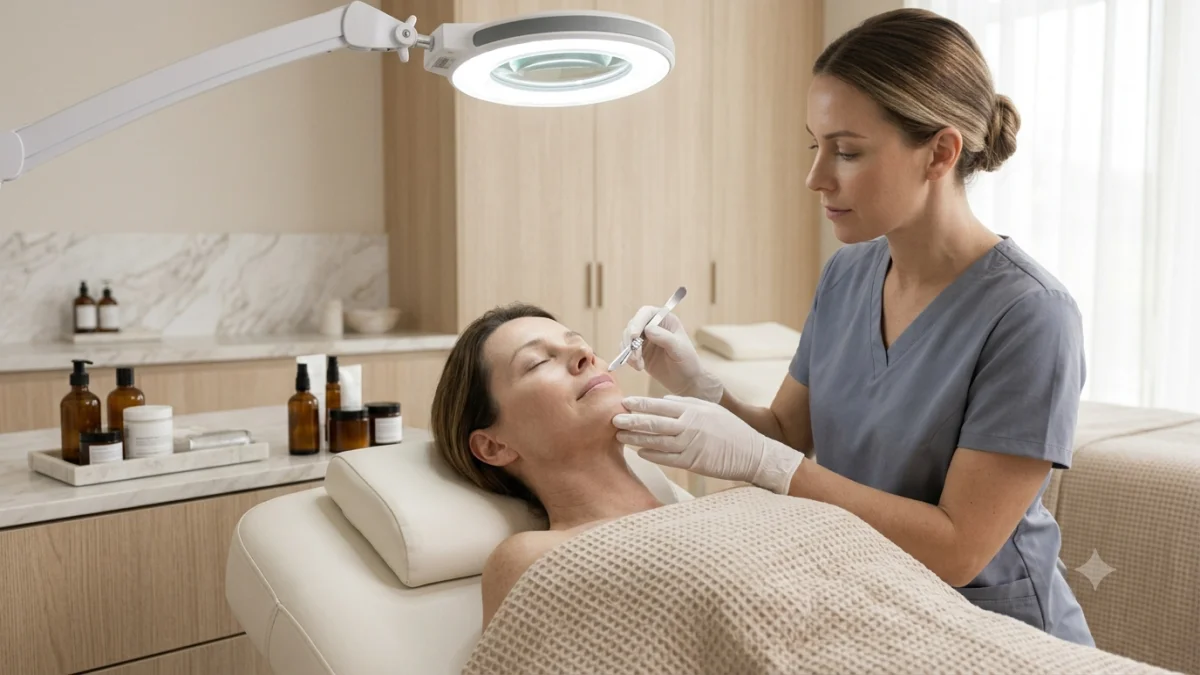
A professional peel is applied by a licensed esthetician after a skin assessment, never as a one-size-fits-all product.
Who Is the Ideal Candidate for Glycolic Peels?
Glycolic acid peels produce the best results in clients who match a specific profile, and understanding that profile helps set realistic expectations before starting a series. The characteristics that predict the most favorable outcomes include both skin type factors and lifestyle factors.
The ideal glycolic peel candidate has one or more of these skin concerns:
Solar lentigines (sun spots) or uneven skin tone from UV exposure, a concern I see constantly in clients who have spent years living in Southern California
Mild to moderate post-inflammatory hyperpigmentation from resolved acne
Rough or dull skin texture caused by dead cell accumulation and slow natural cell turnover
Early fine lines, particularly superficial ones in the upper layers of the epidermis
Congested pores, blackheads, or comedonal acne without active cystic lesions
Overall lack of radiance and healthy glow that does not improve with moisturization alone
From a skin type perspective, glycolic peels work particularly well on normal, combination, and oily skin types in the Fitzpatrick I through III range. Clients with normal skin who want preventive anti-aging and maintenance brightening respond predictably and consistently. Combination skin with congested areas benefits from glycolic's pore-clearing and brightening action. Oily skin that tends toward congestion and enlarged pore appearance responds well, and the regular exfoliation helps manage sebum backup between sessions.
Lifestyle factors matter considerably for ideal candidacy. Clients who are committed to using SPF 50 daily and can avoid direct midday sun during recovery periods will see dramatically better results than those who cannot. In Irvine and across Orange County, where outdoor activity is embedded in daily life, I discuss SPF habits with every prospective glycolic peel client before booking their first session. Clients who are not yet consistent with SPF are candidates for glycolic peels, but they need to understand that building that habit is as important as the treatment itself for lasting results.
Clients in their thirties and forties who are seeing the first signs of photoaging alongside skin that feels less fresh and bright than it used to represent some of the most satisfying clients to work with. Glycolic acid addresses the specific combination of concerns that characterizes this stage: accumulated solar pigmentation, texture changes from years of environmental exposure, and early collagen loss that is just becoming visible. The results in this age group tend to be significant and the clients motivated to maintain them.
The Combination Skin Sweet Spot
Combination skin with an oily T-zone, some congestion, and mild solar spots in the dry zones is one of the presentations that responds most comprehensively to glycolic peels. The acid addresses oiliness and congestion in the forehead and nose area while brightening and smoothing the drier cheek zones simultaneously. I see this skin type frequently in my Irvine client base and glycolic consistently performs well for it.
Who Should Avoid Glycolic Acid Peels
Glycolic acid peels are not appropriate for every client, and identifying contraindications before treatment is as important as knowing the benefits. Proceeding with glycolic when a contraindication exists risks adverse outcomes ranging from increased sensitivity to treatment-induced hyperpigmentation, and these complications can be difficult to resolve. I screen carefully for the following:
Active skin infections or open lesions. Active cold sores, infected acne lesions, open cuts, and any active bacterial or viral skin infection are absolute contraindications. Applying an acid peel to compromised skin can spread infection, worsen inflammation, and produce unpredictable results. Any client with a history of cold sores needs prophylactic antiviral medication prescribed by their physician before receiving any chemical peel.
Recent use of isotretinoin (Accutane). Clients who have completed isotretinoin treatment within the past 6 to 12 months have significantly altered skin barrier function and may have compromised wound healing capacity. Most experienced practitioners wait a minimum of 6 months post-Accutane before performing any chemical peel, and many prefer a full 12-month wait for medium-depth treatments.
Active rosacea with flushing or visible vessels. Active rosacea flares, or rosacea characterized by visible telangiectasias and significant baseline redness, respond poorly to glycolic acid. The acid's penetration and the mild inflammatory response it triggers can worsen rosacea symptoms and prolong flares. I use calming, non-acid treatments for clients with active rosacea and introduce very low-concentration glycolic only after baseline redness is controlled and the client has had calming treatments to stabilize their skin.
Fitzpatrick types IV through VI without modification. Deeper skin tones carry elevated risk of post-inflammatory hyperpigmentation from glycolic peels, particularly at higher concentrations. This does not mean glycolic is never appropriate for darker skin tones, but it means I approach it conservatively, starting at lower concentrations, monitoring response carefully, and having the discussion about risk versus benefit explicitly rather than assuming equivalence with lighter-toned clients.
Pregnancy and nursing. While glycolic acid at very low concentrations is generally considered low-risk during pregnancy, I do not perform professional peels on pregnant clients without physician clearance. The conservative approach is appropriate given the systemic absorption potential of professional concentrations and the importance of eliminating any unnecessary risk during pregnancy.
Eczema, psoriasis, or significant barrier compromise in the treatment area. Active eczema lesions, psoriasis plaques, and skin with significantly compromised barrier function from any cause are contraindications to glycolic peels until the condition is adequately controlled. Applying acid to already-compromised skin amplifies irritation rather than producing the intended exfoliating benefit.
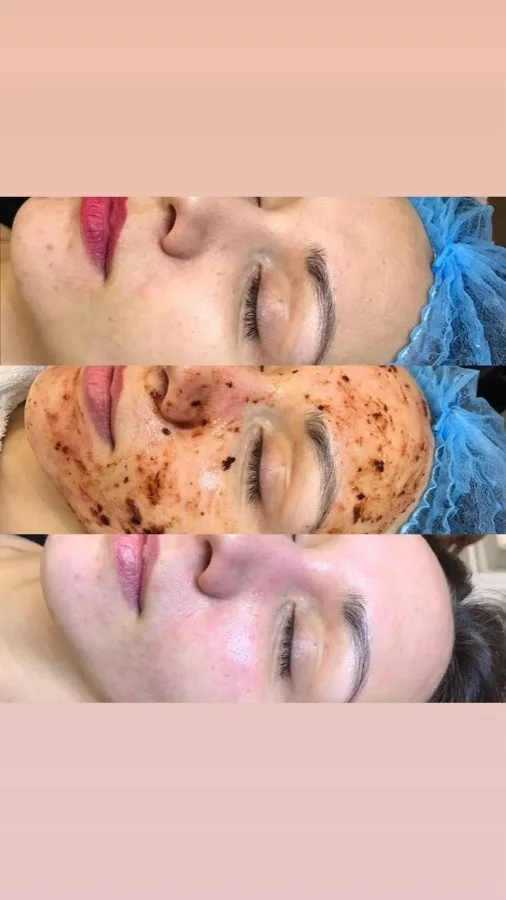
Before, during and after a chemical peel at Real Skin Beauty in Irvine, CA.
Concentration Levels: 20% vs 30% vs 50% vs 70%
The concentration of glycolic acid in a professional peel is one of the primary variables I adjust based on individual skin assessment, treatment goals, skin history, and what the previous session showed me about that particular client's response. Each concentration range produces different results with different recovery demands, and understanding the differences helps clients participate more meaningfully in their own treatment planning.
20 to 30 percent: The entry range. This is where I start with every new peel client, and with clients who are returning after a long gap since their last treatment. At this concentration, glycolic acid produces genuine exfoliation and beginning brightness improvement with the most minimal downtime of any professional peel. Redness lasts 2 to 12 hours after treatment. Flaking, if it occurs at all, is subtle and resolves within 3 to 5 days. Most clients can apply tinted mineral SPF and return to work the same afternoon. This range is appropriate for clients who need to manage their social calendar around treatment, and it still produces measurable cumulative results across a series.
30 to 50 percent: The mid-range for established clients. After one or two sessions at lower concentration to assess tolerance and barrier response, I typically move clients who are responding well into this range. At 30 to 50 percent, the exfoliation is more aggressive, cell turnover acceleration is more pronounced, and results arrive faster. Clients typically experience redness for 12 to 24 hours and more noticeable flaking over 4 to 6 days. Improvement in pigmentation and texture is visible after each session rather than gradually accumulating over the full series.
50 to 70 percent: The high-concentration range. These concentrations are reserved for clients who have built tolerance through multiple sessions at lower concentrations, have normal-to-oily skin with intact barrier function, and have specific goals such as stubborn solar spots or texture that has not fully resolved at mid-range concentrations. At 50 to 70 percent, the treatment is noticeably more intense during application, typically described as a stronger tingling or stinging sensation. Recovery involves visible flaking for 5 to 7 days and redness that may persist for 24 to 48 hours. Results are correspondingly more significant. I do not start clients at 70 percent under any circumstances, regardless of what they have read about high-concentration glycolic producing faster results.
It is worth noting that concentration alone does not determine peel depth and effectiveness. The pH of the formulation, the condition of the skin at the time of treatment, the contact time, and whether the skin was properly prepared all interact with concentration to determine the actual outcome. A 70 percent glycolic peel applied to unprepared, dehydrated skin may produce less controlled results than a 50 percent peel applied to well-prepped skin with a clean, hydrated barrier. Professional assessment and preparation matter as much as the number on the bottle.
Why Starting Low Is Not Settling for Less
I regularly see clients who want to start at 70 percent because they want fast results. Starting at 20 to 30 percent is not a slower path to the same destination. It is a safer path that preserves the skin barrier, allows me to accurately assess your individual response, and prevents setbacks from irritation or peel-induced hyperpigmentation that would delay the overall timeline by weeks. Rushing concentration escalation costs time, not saves it.
What a Professional Glycolic Peel Session Feels Like
Understanding what actually happens during a professional glycolic peel session removes a significant amount of the anxiety that first-time peel clients bring to their appointment. The process is well-defined, predictable, and considerably more comfortable than most people anticipate from descriptions they have read online.
A standard glycolic peel session at Real Skin Beauty follows this sequence:
Consultation and skin assessment. Before any product touches the skin, I examine the skin under magnification, discuss the client's concerns and home-care routine, confirm there are no contraindications, and select the appropriate concentration and contact time for that specific session. This assessment changes with each visit based on how the skin responded to the previous session.
Double cleanse. The skin is cleansed twice to ensure complete removal of makeup, oil, sunscreen, and any product residue. Residue left on the skin surface creates an uneven barrier to acid penetration and produces patchy results. This step takes approximately 3 to 5 minutes and is not rushed.
Degreasing and pre-peel prep. A gentle alcohol-free degreaser is applied to remove any remaining sebum from the skin surface. This step standardizes the starting condition of the skin and allows more predictable penetration of the acid.
Acid application. The glycolic solution is applied evenly across the treatment area using a fan brush or gauze, working quickly to ensure even coverage. The skin is monitored throughout the contact period. During this time clients typically feel a mild to moderate tingling or stinging sensation. At lower concentrations, this is easily tolerable for most people. At higher concentrations, it becomes a more pronounced sensation but not a painful one.
Neutralization. After the designated contact time, a neutralizing solution is applied to stop the acid's action. This brings immediate relief from any tingling sensation. Neutralization is a precise step; leaving glycolic on the skin beyond the intended contact time increases risk of over-exfoliation without proportional benefit.
Post-peel treatment. After neutralization, I apply a calming serum, a barrier-supportive moisturizer, and mineral SPF 50. Many sessions also include LED therapy to reduce any residual redness and support healing.
Total session time runs 45 to 60 minutes including consultation. The acid itself is on the skin for 2 to 8 minutes depending on concentration and individual skin response. Clients leave with skin that looks pink or lightly flushed and feels clean and tight. The flush resolves within a few hours for most people.
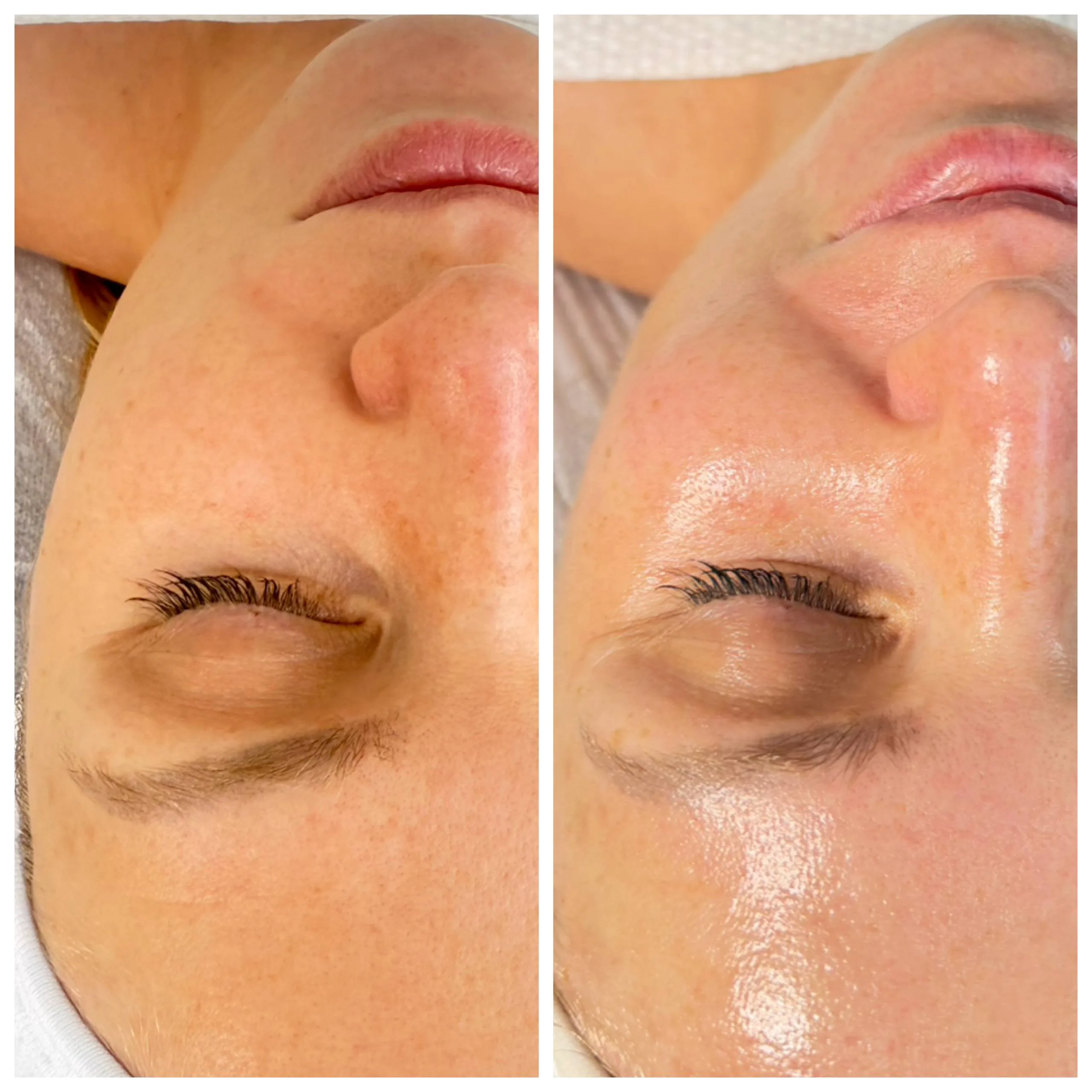
Skin tone and texture before and after a peel. Individual results vary.
The Peeling Phase: What Happens Day by Day
The peeling phase is the part of glycolic peel recovery that most clients are both most curious and most anxious about. The actual experience varies considerably depending on the concentration used, individual skin thickness and sensitivity, and how well the client follows post-peel care instructions. Here is what to expect at different concentration levels.
After a 20 to 30 percent glycolic peel:
Day 1: Skin appears pink, feels mildly tight and sensitized. No visible peeling. Apply gentle moisturizer and SPF only.
Days 2 to 3: Redness resolves for most clients. Skin may feel slightly rough or dry to the touch. Some clients notice very fine, barely visible flaking beginning around the nose and mouth, areas where skin is thinner and cell turnover faster.
Days 3 to 5: Subtle flaking if it occurs at all. Some clients notice none at lighter concentrations. The cellular renewal is still occurring even when there is no visible peeling. Skin may look slightly duller before it brightens as the new cells come to the surface.
Day 5 and beyond: Skin clarity begins to improve noticeably. Clients describe their skin looking cleaner, more even, and more luminous. This is when results from the first session become visible.
After a 50 to 70 percent glycolic peel:
Days 1 to 2: More pronounced redness that may last into the second day. Skin feels tight and may feel warm. No active peeling yet but skin texture becomes noticeably different.
Days 3 to 4: Visible peeling begins, typically starting around the nose, chin, and areas of thicker skin first. Skin appears to be shedding in fine sheets or patches. This is normal and not a sign of complication.
Days 4 to 6: Peak peeling. The most visible flaking occurs during this window. The critical instruction is not to pick, pull, or manually remove peeling skin. Premature removal can produce uneven results and, in worst cases, scarring.
Days 6 to 8: Peeling resolves. New skin is visible beneath the shed layer. Clients typically describe their skin as looking and feeling dramatically different, with significant improvement in clarity and evenness compared to before treatment.
The Rule About Picking
Do not manually remove peeling skin at any point during recovery. The peeling skin is still attached to living tissue beneath it and pulling it away before it is ready can remove cells that are not yet ready to shed. The result is either a raw, irritated patch or a small scar. Let the skin shed on its own schedule. It takes only a few days more and the outcome is significantly better.
Planning a Glycolic Peel Series for Maximum Results
A single glycolic peel produces improvement. A properly planned series produces transformation. The difference lies in timing, concentration progression, home-care support, and consistency. Understanding the logic behind how I plan a series helps clients commit to the full protocol rather than stopping after two or three sessions when they start seeing early results and assume the work is done.
The standard glycolic peel series I design for most clients with brightening and anti-aging goals looks like this:
Session 1 (baseline): 20 to 30 percent, 3 to 4 minute contact time. This session establishes the baseline skin response, allows me to see how this specific client's skin reacts to glycolic acid, and begins the cell turnover cycle. It is the data-collection session as much as the treatment session.
Session 2 (4 weeks later): 30 to 40 percent, adjusted contact time based on session 1 response. Clients typically notice visible improvement after this session's peeling phase resolves. The increase in concentration deepens the exfoliation meaningfully while remaining within a well-tolerated range.
Sessions 3 and 4 (at 4-week intervals): 40 to 50 percent. These middle sessions are where the most visible cumulative changes accumulate. Dark spots begin fading more significantly, texture improvement becomes apparent to people who see the client regularly, and overall skin radiance is noticeably different from pre-series photographs.
Sessions 5 and 6: 50 to 70 percent depending on individual response. The highest concentration tolerable by that client's skin is used to address remaining stubborn areas and consolidate the overall result. Some clients reach 70 percent by this stage; others plateau at 50 percent and produce excellent results there. I adjust based on what the skin is showing me rather than following a fixed concentration escalation.
Between sessions, the home-care protocol that supports results includes:
Vitamin C serum every morning to reinforce antioxidant protection and melanin management
Niacinamide 10 percent to support barrier integrity and reduce inflammation between sessions
Broad-spectrum SPF 50 daily without exception, reapplied every 2 hours during outdoor exposure
A gentle, sulfate-free cleanser to avoid stripping the barrier between treatment sessions
No retinol for 5 to 7 days before each session
After the initial series concludes, most clients move to a maintenance schedule of one glycolic peel every 4 to 8 weeks depending on their skin type and goals. Oily, congested skin with ongoing brightening needs benefits from more frequent maintenance. Drier, less pigmented skin that responded fully to the series may need only quarterly sessions to maintain results.
The overall timeline from first session to final session-six result is approximately 5 to 6 months. Clients who photograph their skin at session one and again at the 6-month mark consistently express genuine surprise at how significant the cumulative difference is, even when each individual session felt like modest progress. This is why I encourage clients to take their own baseline photographs at home before starting. The camera captures changes that our adapted perception misses when we see our own skin every day.
For new clients ready to start, our peels page covers what to expect from your first appointment. You can also browse our facials page for complementary treatments that pair well with a glycolic series. When you are ready to book, the booking page has current appointment availability, and our FAQ answers any remaining questions about the process.
Frequently Asked Questions
What does glycolic acid actually do to skin? +
Glycolic acid is an alpha-hydroxy acid derived from sugar cane. Its very small molecular size allows it to penetrate deeply into the epidermis, breaking the bonds between dead skin cells to accelerate their shedding. Simultaneously, it stimulates collagen production in the dermis. The combined effect over a series of treatments is measurable improvement in surface pigmentation, texture, pore appearance, and early fine lines.
Is a 20% glycolic peel worth getting vs. a stronger concentration? +
Yes, especially for first-time clients or those with sensitive skin. A 20 to 30 percent peel provides real exfoliation and beginning brightening with minimal downtime. As skin builds tolerance through multiple sessions, concentrations increase appropriately. Jumping to 70 percent without preparation risks unnecessary irritation, barrier compromise, and uneven results that set back the overall timeline.
How is a professional glycolic peel different from at-home products? +
Professional concentrations run from 20 to 70 percent. Over-the-counter products are capped at around 10 percent and formulated at higher pH levels that reduce acid activity significantly. Professional peels use lower pH formulations that maintain full acid penetration potential, combined with precise contact time management and neutralization. The combination is not replicable at home regardless of product concentration.
How long does the flaking last after a glycolic peel? +
After 20 to 30 percent peels, flaking is subtle or absent, lasting 3 to 5 days if it occurs. Higher concentrations produce more visible peeling for 5 to 7 days. Not everyone peels visibly after lighter concentrations, which surprises clients who expected dramatic shedding. Cellular renewal is still occurring even when there is no visible peeling, and the brightening result arrives regardless.
Can I combine glycolic acid peels with other treatments? +
Yes. Glycolic peels pair well with LED therapy, microcurrent, and dermaplaning when sequenced appropriately. Avoid combining with strong retinol or other exfoliating acids on the same day. I design treatment sequences for each client specifically to maximize cumulative results without overlapping acid treatments in ways that would compromise the barrier or produce additive irritation.
Licensed electrologist and cosmetologist with 20+ years of experience. Aida sees clients at Real Skin Beauty, 18021 Sky Park Circle, Suite N, Irvine, CA 92614.
Book a free consultation with Aida Khazieva at Real Skin Beauty in Irvine, CA. We will assess your skin and design a glycolic peel series tailored to your specific goals and skin type.
This article is for informational purposes and reflects Aida Khazieva's clinical experience. It does not replace a personalized medical consultation. Individual results vary.