Best Chemical Peel for Acne Scars: Complete Comparison Guide
By Aida Khazieva·Chemical Peels·13 min read·Real Skin Beauty, Irvine CA·Updated July 27, 2026
Acne scars are not one thing. They are a category that includes at least five distinct structural problems, each sitting at a different depth in the skin and each requiring a different intervention. The most common mistake I see from clients who have tried peels for acne scars without results is that they used the wrong acid for the wrong scar type. This guide maps each scar type to the peel that actually addresses it, explains why the match matters clinically, and gives an honest account of what peels can and cannot do for scarring.
Quick answer: The best peel depends on the scar type. Post-inflammatory hyperpigmentation (dark marks) responds best and fades with lighter peels. Shallow rolling scars and mild texture improve with a peel series, and TCA reaches deeper for moderate scarring. Deep ice pick and boxcar scars usually need microneedling or other treatments alongside peels.
Types of Acne Scars and Why They Respond Differently
Calling everything left behind by acne a "scar" collapses a range of structurally different problems into one category and leads directly to mismatched treatments. Before I recommend any acid or peel protocol for acne scarring, I assess which type or combination of types the client is dealing with, because each one has a different mechanism of formation, sits at a different skin depth, and responds differently to chemical intervention.
Post-inflammatory hyperpigmentation (PIH) is the most common and most treatable category. It is not technically a true scar at all. PIH is flat discoloration, brown, reddish-brown, or gray-brown, left behind after an acne lesion resolves. It sits in the epidermis and upper dermis. No structural collagen damage is involved. Because PIH is fundamentally a pigmentation problem rather than a textural one, it responds well to chemical peels that accelerate cell turnover, inhibit melanin production, and reduce the inflammatory signals that keep melanocytes overactive. This is the category where peels produce their most consistent and most impressive results.
Rolling scars are broad, shallow depressions with gently sloping edges that give the skin a wavy, undulating appearance. They form when fibrous tissue tethers the epidermis to deeper subcutaneous tissue. Shallow rolling scars respond to repeated superficial and medium-depth peels because the progressive collagen stimulation from peel treatments can improve the density of the upper dermis over time, reducing the contrast between normal and depressed areas. Deeper rolling scars typically need subcision (a procedure that releases the fibrous tethering) alongside peels for meaningful improvement.
Boxcar scars are round to oval depressions with sharply defined, vertical edges. They range from shallow to deep. Shallow boxcar scars show meaningful improvement with a series of medium-depth TCA peels. Deep boxcar scars sit below the level that chemical peels can adequately reach, and these typically need microneedling, radiofrequency, or dermal filler augmentation alongside a peel series to achieve significant structural improvement.
Ice pick scars are narrow, deep, V-shaped channels that extend from the surface into the dermis or below. They are the most structurally challenging acne scar type to treat with any modality. Standard chemical peels, even medium-depth TCA, do not reach the depth of ice pick scars. The specialized CROSS technique, which delivers highly concentrated TCA directly into individual ice pick channels, is the peel-based approach that produces results for this scar type.
Hypertrophic scars and keloids are raised scars formed by excess collagen deposition during healing. These are fundamentally different from the depressed scar types and respond to different interventions entirely. Standard chemical peels are not appropriate for hypertrophic or keloid scars and I do not use them on these presentations.
Why Scar Type Assessment Comes First
Before I recommend any peel for acne scarring, I photograph the skin under good lighting and examine texture carefully. A client with primarily PIH needs a completely different protocol than a client with predominantly boxcar scars, even if both describe their concern as "acne scars." Skipping this assessment and jumping to treatment is the reason many clients come to me having spent money on peel series that produced minimal improvement.
Salicylic Acid: Best for Active Acne and Post-Inflammatory Marks
Salicylic acid is a beta-hydroxy acid and the first-line choice when a client presents with concurrent active acne and post-inflammatory marks. This is one of the most common presentations I see in my Irvine practice: someone who still has occasional or frequent breakouts and also has the accumulated dark marks from previous breakouts that have not faded. Both problems need to be addressed simultaneously, and salicylic acid is the one professional peel acid that effectively serves both functions at once.
The oil-solubility of salicylic acid is the property that makes it uniquely useful here. Unlike AHAs, which are water-soluble and work on the skin surface, salicylic acid can penetrate the sebum inside pores. It exfoliates follicular walls, dissolves the plug of oxidized sebum and dead cells that forms comedones, and reduces the bacterial load of P. acnes within the follicle. This pore-clearing action reduces the frequency of new inflammatory events, which means fewer new PIH marks are being added to the skin while the existing ones are being treated.
Simultaneously, salicylic acid's anti-inflammatory properties reduce the strength of the inflammatory signal that tells melanocytes to produce excess melanin. This interrupts the PIH formation mechanism at its source rather than only removing pigment that has already formed. For clients who are still actively breaking out, this early interruption of the PIH cycle is clinically significant and produces faster overall improvement in skin tone than waiting for acne to completely resolve before treating the marks.
Professional salicylic peels run from 10 to 30 percent. I use 20 percent most frequently for acne-PIH clients. At this concentration, the peel provides meaningful follicular cleansing and anti-inflammatory action without the risk of over-drying the skin, which is important because many acne clients are already using drying topical treatments at home. Salicylic peels are generally well-tolerated and require minimal downtime, typically 24 hours of mild redness and 2 to 4 days of subtle flaking.
For clients with only PIH and no active acne, salicylic acid is often still useful for the first 1 to 2 sessions of a series to clear residual follicular congestion that may not be causing active breakouts but is still contributing to surface irregularity. After that, I typically transition to AHA-dominant acids that produce more direct brightening action for the established hyperpigmentation.
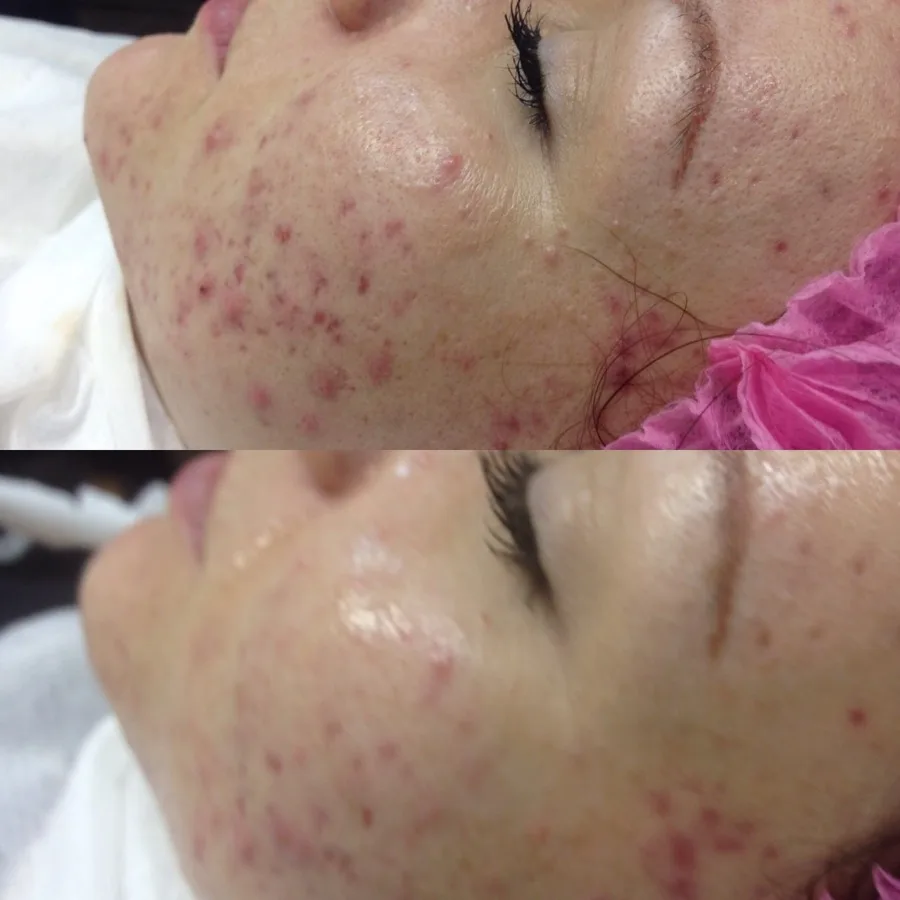
Active acne before and after a series of treatments. Scar work begins once breakouts are under control.
Glycolic Acid for Surface-Level Scar Smoothing
Glycolic acid's small molecular weight and well-documented cell turnover acceleration make it the most effective single acid for surface-level scar improvement. For PIH, shallow textural irregularities, and early rolling scar activity, a glycolic peel series produces reliable, consistent improvement that accumulates meaningfully across sessions.
The mechanism most relevant for scar treatment, beyond the surface brightening effect on PIH, is glycolic acid's stimulation of dermal fibroblasts. Fibroblasts are the cells that produce collagen and elastin in the dermis. When glycolic acid penetrates into the upper dermis, it activates these cells, triggering a wound-healing response that generates new collagen. For clients with shallow rolling scars or generalized textural roughness from post-acne changes, this collagen stimulation improves the density and organization of the upper dermal matrix over time, softening the appearance of depressions and evening out surface texture.
The collagen stimulation benefit accumulates across a series. A single glycolic peel produces limited new collagen. A series of 6 peels spaced 4 weeks apart produces cumulative collagen remodeling that is measurable and visible at the end of the series. I explain this to clients upfront because those who expect dramatic textural improvement after one or two sessions often abandon treatment before the cumulative effect has had time to develop.
For acne scar treatment specifically, I often use glycolic in a more targeted way, higher concentrations (50 to 70 percent) on areas of concentrated shallow scarring while maintaining a lower concentration on surrounding skin. This focal concentration approach delivers more remodeling stimulus to the areas that need it without unnecessarily aggressive treatment of skin that has already recovered well. This kind of selective application is a professional technique that requires precise product control and is not achievable with home-use products.
Glycolic acid also enhances the penetration of post-peel topical actives including niacinamide and vitamin C, both of which support ongoing melanin management and collagen synthesis between sessions. The peel creates the delivery pathway; the topicals extend the treatment into the days between sessions.
Lactic Acid: The Gentle Option for Sensitive Acne-Prone Skin
Acne-prone skin is not always oily, resilient, and tolerant of aggressive treatment. A significant portion of my clients with post-acne scarring have sensitized, barrier-compromised skin from years of using harsh acne treatments: high-concentration benzoyl peroxide, prescription retinoids, multiple active acids, and drying cleansers. For these clients, lactic acid is the appropriate peel choice for scar treatment rather than glycolic or TCA.
Lactic acid's larger molecular size produces gentler, slower penetration than glycolic. It exfoliates and stimulates cell turnover without the degree of barrier disruption that glycolic produces at equivalent concentrations. Its documented tyrosinase-inhibiting effect means it addresses PIH directly through melanin production inhibition, not only through surface cell removal. And its humectant properties add moisture back to a barrier that is already taxed from active acne and past aggressive treatment.
For clients with sensitive, reactive, or rosacea-adjacent acne-prone skin, lactic acid also carries significantly lower risk of treatment-induced inflammation, which matters because any inflammatory response in these clients has a higher-than-average chance of triggering new PIH. Reducing the inflammatory burden of the peel itself, while still producing the exfoliating and brightening effects needed for scar treatment, is exactly what lactic acid achieves that glycolic cannot in these presentations.
I use lactic acid at 30 to 50 percent for sensitive acne-scar clients. The sessions are comfortable, recovery is mild with redness resolving in 12 to 24 hours and subtle flaking over 3 to 5 days, and clients can typically manage treatment without disrupting their professional schedule. The trade-off is that more sessions are needed to achieve the same degree of PIH clearance that glycolic would produce in fewer sessions on a less sensitive skin type. For clients who cannot tolerate glycolic, this is not a trade-off at all. It is the only viable path.
I often alternate lactic with salicylic peels for sensitive acne-scar clients, using lactic sessions for brightening and barrier support and salicylic sessions for ongoing pore management and anti-inflammatory action. This alternating approach addresses both the scarring and any ongoing acne activity without pushing the skin beyond what it can tolerate at each session.
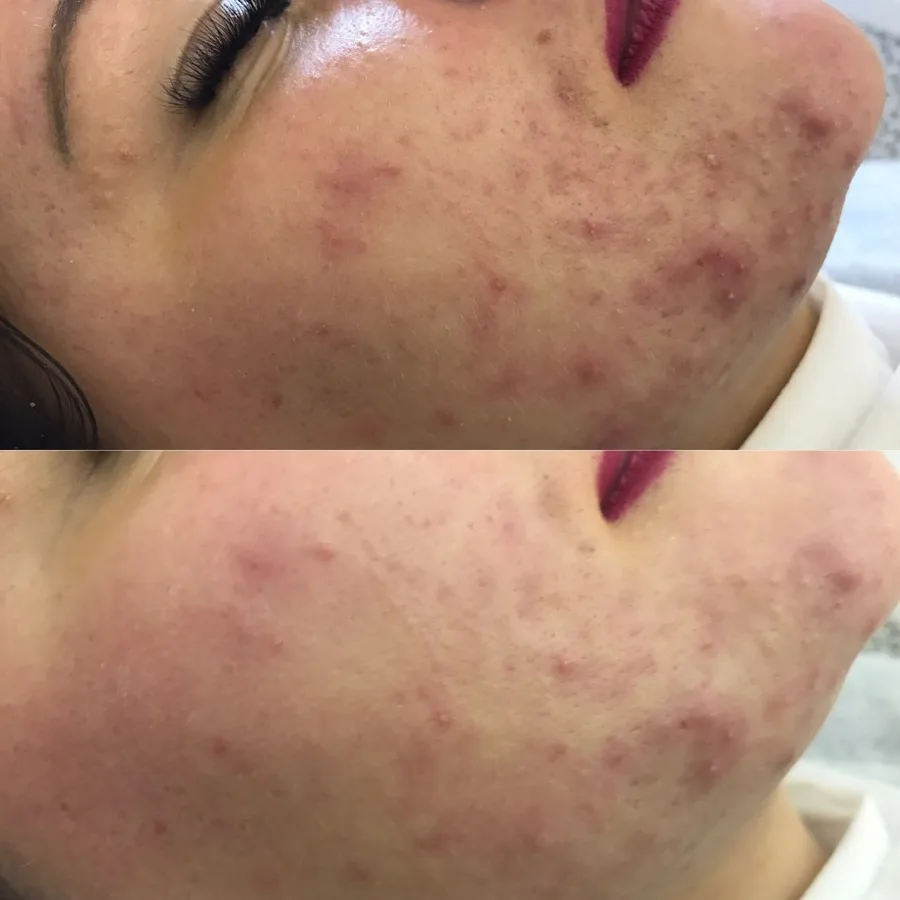
Post-acne dark spots before and after treatment at Real Skin Beauty in Irvine, CA.
TCA Peels: The Most Powerful Professional Scar Treatment
Trichloroacetic acid is the most powerful chemical peel option available in professional practice for acne scar treatment. Its ability to penetrate into the papillary dermis, where the structural components of most acne scars actually reside, distinguishes it from AHA and BHA options that work primarily in the epidermis. For moderate rolling scars, shallow boxcar scars, and deep PIH that has not responded to superficial acid series, TCA provides a level of tissue remodeling that surface-level acids cannot reach.
The mechanism of TCA scar improvement is different from the cell turnover mechanism of AHAs. TCA creates controlled protein coagulation in the tissue it contacts. This coagulation triggers a significant healing and regeneration response in which fibroblasts produce new collagen and elastin in the affected area. This new collagen fills in shallow depressions from below, improving the three-dimensional structure of the scar rather than only the surface appearance. The degree of structural improvement depends on scar depth, skin type, and number of sessions, but for moderate shallow-to-mid depth scarring, the results from a TCA series are genuinely different from what AHA treatment produces.
For acne scar treatment, I typically use TCA at 20 to 30 percent for full-face application on appropriate candidates, or at lower concentrations focused on scarred zones while maintaining AHA-level treatment on surrounding skin. The full-face approach produces the most comprehensive remodeling of the overall surface but requires the full 10 to 14 day recovery associated with medium-depth peels. The focal approach produces targeted improvement with shorter overall recovery.
I require all TCA acne scar clients to complete a pre-treatment priming protocol for a minimum of 4 weeks before their first TCA session. This protocol typically includes:
Daily application of a retinoid (as tolerated) or vitamin A derivative to prime the skin for deeper penetration and collagen response
A kojic acid or arbutin serum to begin melanin suppression before the peel and reduce post-peel hyperpigmentation risk
Daily SPF 50 to ensure the skin is not UV-stimulated at the time of treatment
Stopping all other active acids 7 days before the TCA session
Primed skin responds more uniformly to TCA and produces better collagen remodeling outcomes than unprimed skin. The pre-treatment protocol is not a formality; it is a clinical step that meaningfully improves TCA results and reduces complication risk.
TCA and Darker Skin Tones
For clients with Fitzpatrick type IV through VI skin who have acne scarring, TCA requires careful concentration management to produce scar improvement without triggering peel-induced hyperpigmentation. I use conservative concentrations of 10 to 15 percent for these clients, with extended monitoring during application, and I prioritize the CROSS technique for isolated deep scars rather than full-face TCA application. The goal is scar improvement without creating new pigmentation problems.
The CROSS Technique for Ice Pick Scars
Ice pick scars are the acne scar type most frequently described to me by clients as impossible to treat. They are narrow, deep channels that extend vertically from the skin surface into the dermis. Standard peels, including full-face TCA, do not reach their depth because the acid dilutes across the full treatment surface rather than concentrating in a specific narrow channel. The CROSS technique (Chemical Reconstruction of Skin Scars) addresses this limitation directly.
The CROSS technique uses highly concentrated TCA, typically 65 to 100 percent, applied only to individual ice pick scars using a very fine applicator. A toothpick, fine needle, or specialized applicator is used to deliver a tiny, precisely placed drop of concentrated acid into each ice pick channel. The concentrated TCA triggers intense collagen remodeling within the narrow channel of the scar, causing the walls of the channel to thicken and fill from the inside out. Over a series of CROSS sessions spaced 4 to 6 weeks apart, the depth of ice pick channels progressively decreases as new collagen fills them.
CROSS is not a single-session treatment. Most clients with ice pick scars require 3 to 6 CROSS sessions to achieve meaningful improvement, and deep channels may not fully close. The realistic goal is conversion: transforming narrow, deep ice pick scars into shallower, wider depressions that more closely resemble boxcar scars. This converted morphology is more amenable to further treatment with standard medium-depth peels, microneedling, or resurfacing.
The procedure is not broadly uncomfortable. Each individual scar receives a tiny drop of acid that produces an immediate frosting reaction visible as a white spot. The frosting resolves within a few minutes. Individual scars may scab slightly over the following days. The surrounding untreated skin is not affected. This precision is both the main advantage and the main technical demand of the technique: it requires identifying each ice pick scar individually under good lighting and applying the acid only to the channel, not to surrounding skin.
I combine CROSS sessions with an ongoing brightening protocol for clients who also have PIH alongside their ice pick scars, which is the most common combined presentation. While CROSS sessions address the structural depth of individual channels, regular glycolic or lactic peels treat the overall pigmentation across the face. These two treatment streams run in parallel on alternating session dates rather than on the same day.
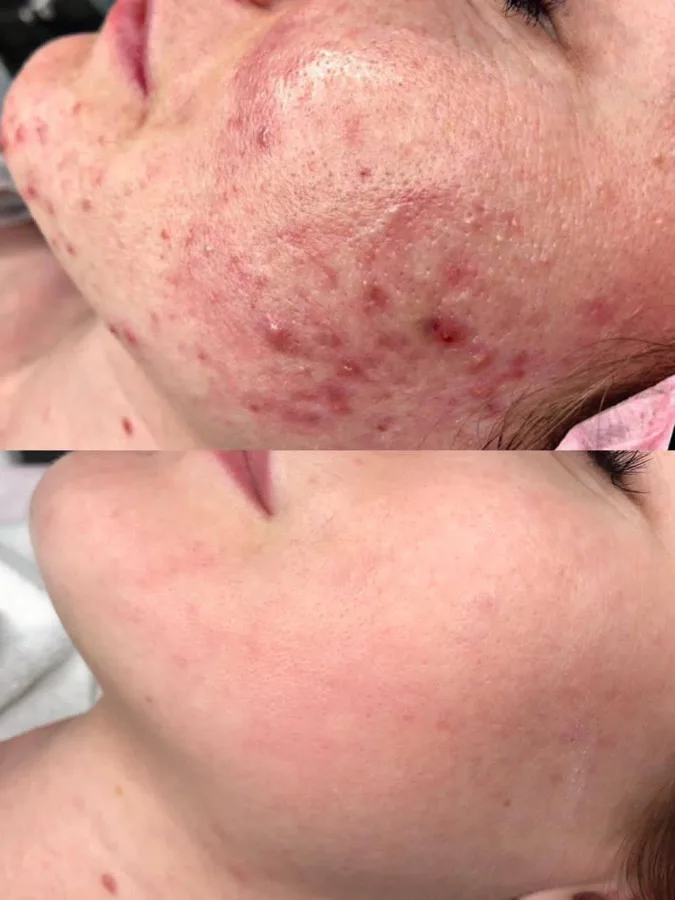
Severe acne on the cheek before and after treatment. Individual results vary.
Building a Multi-Step Scar Treatment Protocol
A comprehensive acne scar protocol typically combines multiple acids and techniques rather than relying on a single peel type. The specific combination depends entirely on which scar types are present, their severity, the client's skin tone and sensitivity, and how much downtime they can manage between sessions. The following represents the general protocol structure I use for clients with mixed acne scarring, primarily PIH with some textural scarring.
Phase 1 (Months 1 to 2): Skin preparation and early treatment
Session 1: Salicylic acid 20 percent to clear any residual congestion and begin anti-inflammatory action on PIH
Session 2: Lactic acid 40 percent to add brightening and barrier support, assessing full skin response to professional acid treatment
Phase 2 (Months 3 to 4): Primary brightening and early remodeling
Session 3: Glycolic acid 40 to 50 percent for intensified cell turnover and beginning collagen stimulation
Session 4: Glycolic acid 50 to 60 percent as concentration progresses based on response
Phase 3 (Months 5 to 6): Deeper remodeling for textural scarring
Session 6: CROSS technique for any identified ice pick scars (if applicable), combined with glycolic maintenance for remaining PIH
Between every session, home care includes:
Vitamin C 15 percent L-ascorbic acid serum every morning for melanin management and collagen support
Niacinamide 10 percent to reduce inflammation and support barrier integrity
SPF 50 every morning without exception, reapplied every 2 hours during outdoor time
Retinoid 2 to 3 nights per week (stopped 7 days before each peel session) to support ongoing collagen remodeling
Gentle, fragrance-free cleanser and moisturizer to maintain barrier health throughout the protocol
The total timeline for meaningful acne scar improvement through a professional peel protocol is typically 4 to 6 months for PIH-predominant presentations, and 6 to 12 months for mixed PIH and structural scarring. Clients who expect resolution in 4 to 6 weeks after one or two sessions consistently feel disappointed, not because the treatment is not working but because they entered with an unrealistic timeline. I set this expectation clearly at the first consultation.
Managing Expectations: What Peels Can and Cannot Do
Setting accurate expectations about what chemical peels can achieve for acne scarring is, in my view, as important as the clinical skill involved in performing the treatments. Clients who enter a peel series with unrealistic expectations end up stopping treatment before it can deliver its full benefit, and they often conclude that peels do not work when the real issue was insufficient information at the start.
Here is an honest accounting of what a professional peel series can and cannot do for the most common acne scar presentations:
What peels can do effectively:
Clear PIH significantly. This is where peels deliver their most dramatic and most consistent results. A well-executed 6-session series can reduce PIH by 60 to 90 percent in favorable presentations. This improvement is real, lasting, and meaningful for clients whose primary concern is the discoloration left by acne.
Improve shallow rolling scars. The collagen stimulation from medium-depth peels improves the density of the upper dermis, softening shallow rolling scar appearance meaningfully over a full series.
Smooth surface texture. Rough, uneven skin texture from post-acne changes responds well to repeated glycolic and TCA treatment. Clients consistently report that their skin feels smoother and that foundation application is easier after a completed series.
Improve shallow boxcar scars. TCA series produce meaningful improvement in shallow boxcar scars, partially filling the depressions from below as new collagen forms.
Convert ice pick scars to a more treatable morphology with CROSS technique.
What peels cannot do:
Fully eliminate deep boxcar or ice pick scars. These require deeper structural intervention including microneedling, subcision, radiofrequency resurfacing, or dermal filler augmentation.
Produce results in a single session for structural scarring. Textural improvement from peel-induced collagen remodeling is cumulative and requires patience across a series.
Prevent future acne scarring if active acne is not also being managed. Treating existing scars while new ones are forming produces a cycle where improvement from each series is partially offset by new damage.
I am direct about these limitations with every acne scar client because managing expectations correctly is the difference between a client who completes the full protocol and achieves meaningful improvement, and one who stops after session three frustrated that their deep boxcar scars have not disappeared. For anyone in the Orange County area who wants an honest professional assessment of their specific acne scarring and a realistic treatment roadmap, I recommend booking a consultation before committing to any protocol. Visit our peels page or facials page for more on what we offer, and use the booking page to schedule your consultation. Our FAQ also covers common questions about acne scar treatment at Real Skin Beauty in Irvine.
Frequently Asked Questions
Can a chemical peel completely eliminate acne scars? +
Peels significantly improve post-inflammatory hyperpigmentation, surface texture, and mild rolling scars. They cannot fully eliminate deep ice pick or severe boxcar scars. Those presentations typically require additional treatments including microneedling, subcision, or dermal fillers alongside a peel series. Peels are one important and effective tool in a comprehensive scar treatment plan, not the entire plan for moderate to severe structural scarring.
Which type of acne scar responds best to chemical peels? +
Post-inflammatory hyperpigmentation, the dark flat marks that remain after breakouts heal, responds most dramatically and most consistently to chemical peels. Shallow rolling scars and minor textural irregularities also respond well to a series. Ice pick and deep boxcar scars need more intensive structural intervention. Accurately identifying which type you have determines which approach is appropriate.
How is TCA different from AHA peels for acne scars? +
TCA penetrates into the dermis, where the structural components of most acne scars actually reside. AHA peels work primarily in the epidermis. TCA physically remodels scar tissue at a deeper level through controlled protein coagulation and the collagen synthesis response it triggers. This makes TCA meaningfully more effective for moderate structural scarring that does not respond adequately to surface-level acids.
How many peel sessions are needed to see improvement in acne scars? +
Superficial peels require 4 to 8 sessions to see meaningful improvement in pigmentation and surface texture. A TCA series typically requires 3 to 5 sessions for significant structural improvement. Most clients see early improvement in PIH by sessions 2 to 3, with textural changes accumulating more gradually through the full series. Significant improvement is consistently achievable with appropriate protocols for the right scar types.
Is it safe to get a peel when I still have active acne? +
Light salicylic acid peels are beneficial during mild to moderate active acne because they clear pores, reduce P. acnes bacterial activity, and interrupt the PIH formation cycle. Deeper peels including medium-depth TCA should wait until active breakouts are controlled to avoid spreading bacteria to surrounding skin and risking additional inflammatory events in already-sensitive tissue.
Licensed electrologist and cosmetologist with 20+ years of experience. Aida sees clients at Real Skin Beauty, 18021 Sky Park Circle, Suite N, Irvine, CA 92614.
Book a free consultation with Aida Khazieva at Real Skin Beauty in Irvine, CA. We will assess your scar types, determine the right protocol, and set honest expectations for what treatment can achieve for your specific skin.
This article is for informational purposes and reflects Aida Khazieva's clinical experience. It does not replace a personalized medical consultation. Individual results vary.