Dermaplaning: Complete Guide to Benefits, Risks and Results
By Aida Khazieva·Anti-Aging·11 min read·Real Skin Beauty, Irvine CA·Updated July 27, 2026
Dermaplaning is probably the most misunderstood treatment I perform. Clients hear "surgical scalpel on your face" and understandably want more information before agreeing. Then there is the hair question, the one I am asked at every consultation: will it grow back thicker? The answer is no, and the explanation of why is simple once you understand what dermaplaning actually does versus what it does not do. In my practice at Real Skin Beauty in Irvine, CA, dermaplaning is one of the treatments clients request as a repeat because the immediate results in skin texture and makeup application are so consistently satisfying. This guide explains exactly what happens during the treatment, who it is right for, who should avoid it, and how it fits into a broader skincare plan.
What Dermaplaning Actually Does to Your Skin
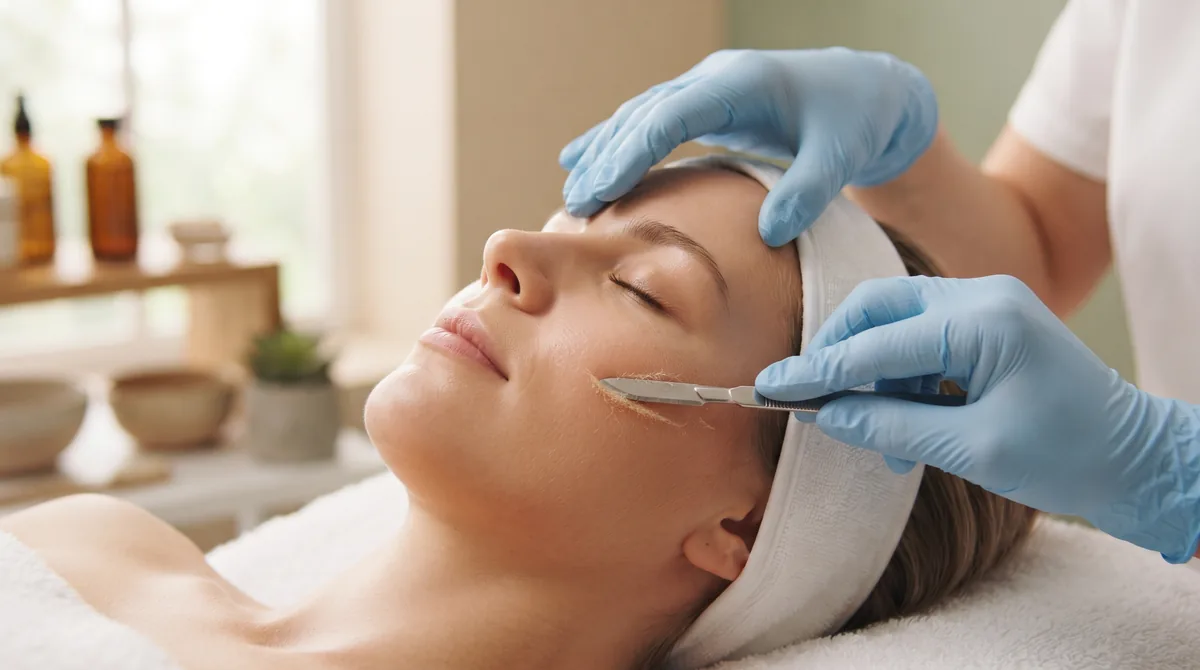
Dermaplaning removes two things from the surface of the skin simultaneously: the layer of dead skin cells that accumulates on the outermost stratum corneum and the vellus hair, commonly called peach fuzz, that covers the face. It does this using a sterile surgical scalpel, specifically a 10R blade, held at a precise 45-degree angle and drawn across the skin in short, controlled strokes by a trained esthetician.
The term "surgical scalpel" sounds alarming in this context, but the procedure is not surgical in any meaningful sense. The blade never penetrates below the very surface of the skin. It skims the epidermis in the same way a very precise, well-controlled shave would, removing only what sits at the outermost surface without creating any wound, bleeding or break in the skin. When performed correctly, dermaplaning is entirely bloodless. If bleeding occurs, it indicates a technique error.
The dead skin cell removal component is the primary clinical benefit. Corneocytes, the dead cells of the stratum corneum, accumulate on the skin surface continuously as part of the normal skin cell turnover cycle. When this turnover slows, as it does with age and as a result of environmental factors, the buildup of dead cells creates a layer that makes skin appear dull and rough in texture, absorbs skincare products before they can penetrate to where they are needed, and causes foundation and powder to sit unevenly on the surface. Removing this layer with a blade produces immediate visible improvement in skin texture and luminosity.
The vellus hair removal is a secondary benefit that many clients find equally impactful in daily terms. Vellus hair, fine and light-colored, is present on essentially all adult faces regardless of skin type. It catches light in a way that diffuses and dulls the apparent glow of the skin, and it causes foundation to sit on top of the surface rather than adhering smoothly. After dermaplaning, both of these issues are eliminated simultaneously with the dead cell layer.
What dermaplaning does not do: it does not penetrate to the dermis, it does not stimulate collagen production, it does not address hyperpigmentation, it does not treat acne at the follicular level and it does not provide the chemical exfoliation effects that acid treatments produce. It is a mechanical surface exfoliation with the specific advantage of also removing vellus hair, and that specificity is what makes it valuable and appropriate for certain clients and treatment goals.
The treatment is performed on completely dry skin. No lubricant, no serum, no water. The blade must contact the dry skin surface directly to achieve consistent, controlled exfoliation. This is one of the key differences between professional dermaplaning technique and home shaving.
Learn more about how dermaplaning fits into a full facial treatment at the facials page at Real Skin Beauty, where it is frequently offered as a stand-alone treatment or as a preparatory step before other modalities.
The Hair Grows Back Thicker Myth: Definitively Debunked
This is the question I receive before virtually every first dermaplaning appointment. It is a logical concern. If you have ever shaved a leg and noticed the regrowth felt stubbly and rough compared to untouched hair, the intuition that shaving changes the hair makes sense. The feeling is real. The explanation for it is not what most people assume.
When a blade cuts a hair shaft, it creates a blunt, flat tip at the cut end. Natural, uncut hair has a tapered tip that comes to a soft point. The tapered tip feels smooth against the skin when touched. The blunt cut tip feels slightly rough, like very short stubble. This tactile difference is the entire basis for the perception that cut hair is coarser. The hair itself is completely unchanged. The follicle is completely unchanged. The color, diameter and growth rate of the hair are all exactly the same as before the cut.
The follicle is the structure that determines hair characteristics. A follicle's size determines hair diameter. A follicle's melanocyte activity determines hair color. A follicle's growth cycle determines how fast and how long hair grows. Dermaplaning, like any form of cutting or shaving, removes only the portion of the hair shaft that exists above the skin surface. It does not enter the follicle, does not alter follicular cell function, does not change the melanocyte population in the follicle and does not increase the follicle's diameter. The biological variables that determine hair characteristics are entirely located below the skin surface, and a blade that moves across the skin surface cannot affect them.
This is not a contested area of biology. Dermatologists, estheticians and trichologists are in complete agreement on this point. The myth persists because the tactile sensation at regrowth is genuinely different, and the mistaken explanation for that difference, that the hair has changed, is more intuitive than the accurate one, that only the tip geometry has changed.
For clients considering dermaplaning who are concerned about the regrowth phase: vellus hair on the face typically has a growth cycle of 3 to 4 weeks. By the time the hair has grown to any perceptible length, the tip has naturally worn and tapered again through friction, and the slight stubbly sensation felt at the 1 to 2 week mark after dermaplaning is temporary and resolves on its own before the next appointment.
The Hair Science in Simple Terms
Hair characteristics, including color, thickness and growth rate, are determined by the follicle below the skin. Dermaplaning removes only what is above the skin. The blade never touches the follicle. The blunt tip created by cutting does feel different than a tapered natural tip, which is where the "thicker" perception comes from. But the hair itself is unchanged. The follicle is unchanged. Every dermatologist and trichologist agrees on this.
Dermaplaning uses a sterile blade held at a shallow angle to remove dead skin cells and fine vellus hair.
Benefits of Dermaplaning Beyond Simple Exfoliation
The benefits of dermaplaning extend past the basic description of dead skin removal. Understanding the downstream effects helps explain why clients who try it once typically schedule it as a regular appointment.
Immediate, same-day skin radiance
The visual improvement in skin brightness and texture after dermaplaning is immediate. There is no 48-hour wait for acid exfoliation to complete its process, no days of peeling to get through before the fresh skin underneath is revealed. Walk out of the studio and the skin looks brighter, smoother and more even within minutes. This predictability and immediacy is one of dermaplaning's most consistently reported advantages from clients in my Irvine practice.
Significantly improved product penetration
The layer of dead skin cells that builds up on the surface acts as a barrier to skincare product absorption. Serums, vitamin C, retinol, hyaluronic acid: all of these penetrate more effectively when they do not have to first move through a layer of cells that are sitting on the surface rather than functioning as active skin. After dermaplaning, the same serums and actives you apply at home absorb more deeply and work more effectively. This is not a minor improvement. Clients who dermaplane regularly and track their skincare results consistently report better performance from their home routine between sessions.
Flawless makeup application
Peach fuzz catches foundation and powder and prevents them from lying flat on the skin. This is why foundation can look patchy or textured in certain lighting, especially when vellus hair catches light at an angle. After dermaplaning, foundation applies smoothly to a flat, hair-free surface and stays put with better coverage and less product required. This is the practical reason many clients in Orange County schedule dermaplaning before weddings, important presentations and photography sessions. The effect on makeup application is immediate and reliable.
Gentle introduction to professional exfoliation
For clients who are sensitive to acids or who have avoided chemical peels due to concerns about irritation, dermaplaning provides meaningful exfoliation with no chemical activity, no tingling, no risk of acid sensitivity reaction. It is purely mechanical, which makes it the right entry point for clients who want the exfoliation benefits of professional treatment without the chemical component. It is also appropriate for pregnant clients for whom many chemical treatments are contraindicated.
No downtime whatsoever
Mild pinkness immediately after dermaplaning resolves within 30 to 60 minutes in most clients. There is no peeling phase, no sensitivity window, no period of sun-avoidance beyond standard SPF use. This zero-downtime profile makes dermaplaning viable for clients whose schedule does not accommodate recovery time between appointments and events.
Who Dermaplaning Is Best For
Dermaplaning is appropriate for a wider range of clients than many people assume. The treatments that are contraindicated are specific, and most skin types and concerns are compatible with dermaplaning when technique is correct.
Clients with dull, textured skin who want immediate improvement. The category where dermaplaning consistently produces the most dramatic same-day result is textured, dull skin that has accumulated a significant dead cell layer. The contrast between pre- and post-treatment in clients with heavy surface accumulation is immediately visible.
Clients preparing for a special event. The combination of immediate glow, smooth makeup application surface and zero recovery time makes dermaplaning specifically useful as a pre-event treatment. I recommend scheduling it 2 to 3 days before an important event to allow any transient flushing to resolve and give the skin a day to settle before makeup application.
Clients who are pregnant or cannot use acid treatments. Dermaplaning provides genuine mechanical exfoliation without any chemical ingredients or acid activity. It is one of the few professional exfoliation options appropriate during pregnancy when alpha hydroxy acids, salicylic acid and retinoids are contraindicated.
Mature skin clients who want gentle exfoliation. The compromised barrier of mature skin often does not tolerate high-concentration acid peels well. Dermaplaning offers effective exfoliation with no acid activity and no barrier challenge, making it an appropriate regular exfoliation option for clients over 50 whose skin is sensitive to chemical treatments.
All Fitzpatrick skin types. Unlike some chemical peels and energy-based treatments that carry greater risk of post-inflammatory hyperpigmentation in darker skin tones, dermaplaning is safe for all Fitzpatrick skin types when performed with correct technique. There is no thermal energy and no chemical reaction that could trigger uneven melanin response.
Clients with visible vellus hair that affects makeup application. The mechanical removal of peach fuzz as part of the treatment makes dermaplaning specifically suited to clients whose primary complaint is that foundation sits poorly or that their face appears dull in photographs due to light catching fine facial hair.
Who Should Avoid Dermaplaning
The contraindications for dermaplaning are specific and not particularly numerous. Most clients can be treated with appropriate technique adjustments. The situations where I do not perform dermaplaning are as follows.
Active acne with open lesions
Active pustules, open comedones and inflamed papules are contraindications for dermaplaning. Drawing a blade across active acne lesions risks spreading P. acnes bacteria to surrounding areas, potentially causing new breakouts. It also risks opening or irritating existing lesions, introducing the possibility of post-inflammatory hyperpigmentation in clients prone to it. I offer alternative treatments for clients with active acne who want professional exfoliation: enzyme peels, salicylic acid treatments and blue LED are all appropriate.
Active rosacea
Rosacea involves chronic vascular inflammation and a heightened reactivity response to physical stimulation. The mechanical action of dermaplaning can trigger flushing and redness flares in rosacea skin. The risk is not injury but exacerbating the underlying vascular condition. For clients with rosacea who want to address the same concerns that bring most dermaplaning clients in, I discuss alternatives including very gentle enzyme exfoliation and LED light therapy for reducing redness and improving overall skin quality.
Current retinoid or Accutane use
Topical retinoids, prescription tretinoin, retinaldehyde and adapalene, thin the skin and increase its sensitivity. Dermaplaning on skin that is actively in retinoid treatment carries a higher risk of micro-abrasion and post-treatment irritation. I ask clients to stop topical retinoids 3 to 5 days before a dermaplaning appointment. Accutane (isotretinoin) is a more significant contraindication. Clients currently taking isotretinoin or who have completed a course within the past 6 months should not receive dermaplaning due to the profound skin thinning effects of the medication.
Seborrheic dermatitis or inflamed eczema
Any active inflammatory skin condition in the treatment area is a contraindication. Inflamed, scaling or broken skin cannot be safely treated with a blade. Once the active flare has resolved, dermaplaning can typically be reconsidered.
If you have any of the above conditions and are looking for exfoliation or texture improvement, book a consultation and I will recommend appropriate alternatives. The goal of the consultation is always to find the right treatment for your skin as it actually is, not to fit your skin into a treatment I have already decided to perform.
How Dermaplaning Compares to Other Exfoliation Methods
Understanding where dermaplaning sits among exfoliation options helps clarify when it is the right choice and when a different approach would serve the skin better.
Dermaplaning vs. chemical peels
Chemical peels dissolve the bonds between dead skin cells and produce a controlled degree of chemical activity in the epidermis and, at higher concentrations, the dermis. They stimulate more significant collagen remodeling than dermaplaning at comparable treatment frequency, and they can address pigmentation irregularities that dermaplaning does not reach. The tradeoff is that peels require a recovery period, involve a sensitivity and tingling component during treatment, and carry higher risk of adverse reactions in certain skin types. Dermaplaning produces immediate results with zero recovery time but does not produce the deeper collagen remodeling or pigmentation improvement that peels achieve.
For maximum effect I often combine both, but in the right sequence and not on the same day. Dermaplaning first, then a peel 3 to 7 days later on freshly exfoliated, smooth skin, or a peel first followed by dermaplaning once the peeling phase is complete. They are complementary, not competing.
Dermaplaning vs. microdermabrasion
Microdermabrasion uses a mechanical diamond tip or aluminum oxide crystals to abrade the skin surface. It exfoliates the dead cell layer but does not remove vellus hair. It involves suction in addition to the abrasion, which can stimulate circulation but also cause temporary bruising in sensitive clients. Dermaplaning is gentler, involves no suction, no pressure beyond the blade's light contact with the surface, and addresses the vellus hair that microdermabrasion leaves in place.
Dermaplaning vs. enzyme peels
Enzyme peels use proteolytic enzymes (papain from papaya, bromelain from pineapple) to digest the protein bonds between dead skin cells without any acid activity. They are gentler than both dermaplaning and acid peels, with virtually no risk of irritation. The tradeoff is that they cannot remove vellus hair and produce milder exfoliation results than dermaplaning. For clients who are too sensitive for dermaplaning but want some form of professional exfoliation, enzyme peels are my usual recommendation. You can review the full range of chemical peel and exfoliation services available at Real Skin Beauty.
Exfoliation Method Comparison at a Glance
Dermaplaning: removes dead cells and vellus hair, immediate glow, no downtime, no chemical activity, no collagen stimulation. Chemical peels: removes dead cells, stimulates collagen, addresses pigmentation, requires recovery time, involves chemical sensation during treatment. Enzyme peels: gentlest option, no acid, no heat, no vellus hair removal, minimal downtime. Each has specific strengths. The best choice depends on the individual skin concern and the client's tolerance and schedule.
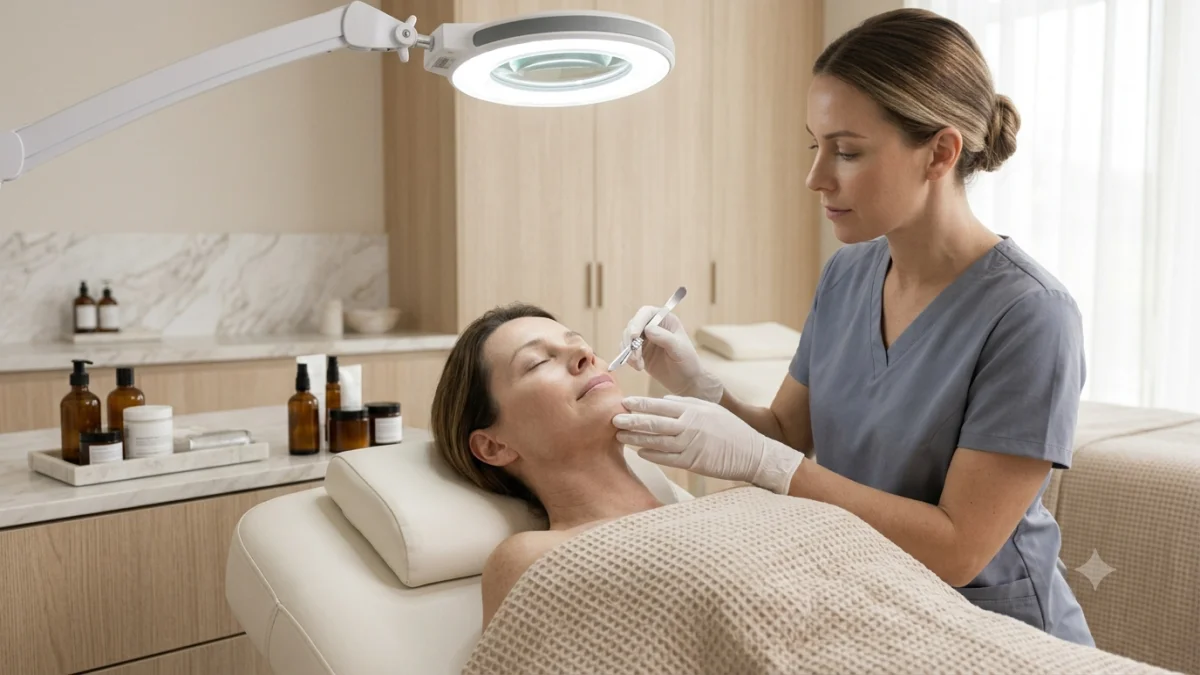
The treatment is done on clean, dry skin and is usually followed by a soothing mask or serum.
What a Professional Dermaplaning Session Looks Like
I describe the procedure to every new dermaplaning client before we begin because knowing what to expect eliminates the anxiety that can make any treatment feel worse than it is. Here is an accurate, specific account of a professional dermaplaning session at Real Skin Beauty.
Consultation and skin assessment. Before any new dermaplaning treatment I assess the skin for contraindications, review current skincare products and medications, and confirm the appropriate treatment for the skin condition that day. If skin is showing signs of active acne or reactivity, I may recommend postponing or choosing an alternative.
Cleanse. A gentle, thorough cleanse removes all traces of makeup, sunscreen and skincare product from the skin surface. The skin must be completely clean. I follow with a toner to ensure the skin surface is completely clean and pH-balanced before the blade is applied.
The dermaplaning treatment. The skin must be completely dry. No product of any kind is applied before the blade. I hold the surgical scalpel at a consistent 45-degree angle and use short, feathering strokes across the skin, working systematically across all areas of the face: forehead, temples, cheeks, upper lip, chin. The strokes are light, controlled and consistent. Clients frequently describe the sensation as unusual but not uncomfortable, similar to a very light, gentle scraping across the surface.
What the treatment does not involve:
No pressure beyond the weight of the blade itself
No pain (correctly performed dermaplaning is painless)
No bleeding (any bleeding indicates incorrect angle or pressure and requires immediate technique adjustment)
No downtime (mild pinkness for 30 to 60 minutes is normal and resolves without intervention)
Post-treatment application. Immediately after the blade treatment I apply a hyaluronic acid serum to the freshly exfoliated surface. The absence of the dead cell layer means active ingredients penetrate immediately and more deeply. I follow with a calming peptide serum and a physical barrier SPF. No fragranced or highly active products are applied on the same day because the fresh surface is temporarily more permeable.
A full face dermaplaning session takes approximately 45 to 60 minutes including cleansing, treatment and post-treatment application. Standalone dermaplaning takes 30 to 40 minutes when combined with other treatments as a preparatory step.
After the appointment clients can apply their own makeup immediately and return to all normal activities. SPF is the one non-negotiable: freshly dermaplaned skin has a thinner dead-cell buffer against UV exposure and SPF that day, and consistently thereafter, is important.
Combining Dermaplaning With Other Treatments for Maximum Effect
Dermaplaning works well as a standalone treatment and exceptionally well as a preparatory step before other modalities. The removal of the dead cell layer and vellus hair creates a surface that is more receptive to subsequent treatments, and this enhanced penetrability is the mechanism that makes combination protocols more effective than either treatment alone.
Dermaplaning with LED light therapy
This is my most commonly recommended combination for clients focused on glow, anti-aging maintenance and improving overall skin quality. Dermaplaning as the first step removes the surface layer. LED light therapy applied immediately after penetrates to the dermis more effectively on a freshly exfoliated surface. Red LED collagen stimulation is enhanced when the surface layer is freshly removed. This combination has no downtime and produces beautiful immediate results plus cumulative collagen benefit.
Dermaplaning as preparation for a facial
When dermaplaning precedes a hydrating or anti-aging facial, every product applied during the facial, from serums to masks to treatment ampoules, penetrates more deeply and produces stronger results. Clients who add dermaplaning to their regular facial appointment consistently report that their skin feels more responsive to subsequent products. I offer dermaplaning as an add-on step at the beginning of most facial appointments for exactly this reason.
Dermaplaning before an enzyme peel
An enzyme peel applied after dermaplaning has less dead skin cell buildup to work through and can focus its action on the fresh epidermal cells below. The combination produces better texture and radiance results than either treatment alone and is appropriate for clients who are too sensitive for acid peels but want stronger exfoliation than dermaplaning alone provides.
What not to combine on the same day
Dermaplaning and acid peels on the same day: The freshly exfoliated, more permeable surface after dermaplaning absorbs acid more aggressively than intact skin. Combining a strong acid peel on freshly dermaplaned skin significantly increases the risk of over-exfoliation, barrier disruption and irritation. If both are planned, separate them by at least 3 to 7 days.
Dermaplaning and microneedling on the same day: Both are active skin treatments. Combining them in a single session is over-treating the skin and will cause unnecessary irritation. Separate by at least 2 weeks.
Dermaplaning and waxing on the same day in the same area: The combined mechanical stimulation is too much for the skin in one session.
If you want to discuss which combination protocol makes the most sense for your specific skin goals, a free consultation at Real Skin Beauty in Irvine is the right starting point. The FAQ page also covers common questions about dermaplaning preparation, aftercare and scheduling frequency.
Frequently Asked Questions
Does dermaplaning make facial hair grow back darker or thicker?
No. The blade removes only the hair shaft above the skin surface. The follicle, which determines hair color, diameter and growth rate, is entirely unaffected. The slight stubbly sensation at regrowth comes from the blunt tip created by the blade cut, compared to the naturally tapered tip of uncut hair. The hair itself is completely unchanged. This is not a contested claim. It is basic hair biology.
Is dermaplaning the same as shaving?
Both use a blade but the similarity ends there. Professional dermaplaning uses a sterile surgical scalpel held at a precise 45-degree angle by a licensed esthetician, moving in controlled short strokes to remove both vellus hair and the dead skin cell layer simultaneously. Home shaving uses a different tool geometry, a different angle, no dead cell removal protocol and no trained esthetician managing the process. The clinical outcomes are meaningfully different.
How long do dermaplaning results last?
Skin smoothness and radiance from the dead cell removal typically last 3 to 4 weeks, aligned with the natural skin cell turnover cycle. Vellus hair begins to regrow in 2 to 4 weeks depending on your individual hair growth cycle. Most clients schedule dermaplaning every 3 to 4 weeks to maintain the results consistently.
Can I wear makeup right after dermaplaning?
Yes. Immediately after the appointment is fine, and the makeup application experience is notably better. Foundation and powder glide onto the smooth, hair-free surface more evenly, with better coverage using less product. Many clients in Orange County schedule dermaplaning specifically before events or photography for this reason. Just ensure you apply SPF first, as freshly dermaplaned skin has a reduced dead-cell buffer against UV exposure.
Can people with active acne or rosacea get dermaplaning?
Active acne with open pustules or inflamed cysts is a contraindication because the blade can spread bacteria from active lesions to surrounding skin, causing new breakouts. Rosacea is generally contraindicated because the physical stimulation of the blade can trigger flushing and worsen chronic vascular reactivity. I offer appropriate alternatives for both: salicylic acid treatments and blue LED for active acne, and gentle enzyme peels and LED for rosacea clients who want professional exfoliation.
Licensed electrologist and cosmetologist with 20+ years of experience. Aida sees clients at Real Skin Beauty, 18021 Sky Park Circle, Suite N, Irvine, CA 92614.
Book a free consultation at Real Skin Beauty in Irvine, CA. I will assess your skin, confirm whether dermaplaning is appropriate and explain exactly what to expect from your first session.
This article is for informational purposes and reflects Aida Khazieva's clinical experience. It does not replace a personalized medical consultation. Individual results vary.