PCOS Hair Growth vs. Normal Hair: How to Tell the Difference
By Aida Khazieva·PCOS & Hormonal Hair·10 min read·Real Skin Beauty, Irvine CA·Updated July 27, 2026
Clients who come to me with facial or body hair concerns almost always ask the same question first: is this normal, or is something wrong? The honest answer is that both things can be true at once. Some women have hair patterns outside typical female ranges without any diagnosable condition, and some have PCOS without knowing it. After 20 plus years of working with clients throughout Irvine and Orange County, I take this distinction seriously because it shapes both treatment planning and the realistic expectations I can offer. This guide walks through how to tell the difference, what signs to watch for, and what a proper evaluation looks like.
Quick answer: PCOS-related hair is coarse, dark terminal hair growing in androgen-sensitive areas such as the chin, jaw, upper lip, chest, abdomen and inner thighs. Normal female hair there is usually fine vellus hair. Isolated chin hair can also come from genetics or perimenopause, so a blood panel and ultrasound confirm PCOS.
What Normal Female Hair Actually Looks Like
All women have hair follicles covering virtually every surface of the body except the palms, soles of the feet, lips, and eyelids. The critical distinction in any conversation about "normal" versus "abnormal" hair is not whether hair is present, but what type of hair is growing and where it appears.
Hair comes in two fundamental types. Vellus hair is fine, light in color, short (usually under 2 millimeters), and largely transparent to the naked eye. It covers the majority of the female face and body and serves a thermoregulatory function. Terminal hair is coarse, pigmented, longer, and structurally more robust. It grows from larger, deeper follicles with well-developed dermal papillae.
In women without elevated androgen activity, terminal hair is expected in specific locations:
Scalp, eyebrows, and eyelashes
Underarms (axillary region)
Pubic area
Lower legs
Forearms in many women, particularly those with darker natural coloring
Fine terminal or transitional hair on the upper lip is present in many women and by itself, particularly if it is light in color and not coarse, is generally within normal variation. A few hairs on the lower abdomen or navel line are also common, particularly in women of Mediterranean, South Asian, or Middle Eastern descent. None of these represent clinical hirsutism.
Hirsutism, the clinical term for androgen-driven hair growth in androgen-sensitive areas, refers specifically to coarse, dark, terminal hair growing on the chin, jaw, neck, chest, upper back, or upper abdomen. The type of hair matters as much as the location. Fine vellus hair on the chin, even if it covers a relatively large area, is not the same clinical finding as three or four coarse, dark, easily visible terminal hairs on the chin. The distinction sounds subtle but is diagnostically meaningful.
What makes this hard to self-assess is that everyone's baseline differs. Women from certain ethnic backgrounds have higher baseline androgen receptor sensitivity, which means more terminal hair is simply within their normal range. Women in the same family can have dramatically different baseline hair patterns for genetic reasons. Comparing your hair to your friends' or to an idealized standard misses the point. The relevant comparison is to what your own body has done previously, and whether visible change is occurring over time.
Key Patterns That Signal PCOS-Related Hair Growth
PCOS-related hair growth has characteristic features that distinguish it from normal variation in most cases. Knowing these features helps you decide whether a medical evaluation is warranted and gives you more specific language to use when describing your concerns to a physician.
The clearest signals that facial or body hair may be PCOS-related rather than normal variation:
Location: coarse hair on the chin, jaw, neck, or chest. These are the most androgen-sensitive areas of the female face and upper body. Coarse terminal hair here in a woman under 40 strongly suggests androgen activity beyond normal female ranges.
Hair type: the hair is coarse, dark, and comparable to male beard or chest hair in texture. Not fine and light, but visibly pigmented and thick enough to cast a shadow under the skin.
Progressive worsening: PCOS hirsutism does not typically appear all at once. Most clients I see in my Irvine practice describe a gradual progression: a few hairs at 17 or 18, more by 22, noticeably problematic by 25 to 30. Hair that is getting worse over time is more clinically significant than hair that has been stable for years.
Onset in the reproductive years: PCOS hirsutism typically begins in the teens to mid-20s, following the hormonal shifts of puberty. New coarse facial hair appearing after age 40 or 45 is more likely to be menopausal in origin.
Multifocal distribution: hair appearing in more than one androgen-sensitive area (chin and upper lip together, chin and chest, jaw and lower abdomen) suggests systemic androgen excess more strongly than isolated single-site growth.
The single most important question to ask yourself is whether the hair is getting worse over time. A few stable chin hairs that have not changed in five years are a different clinical picture from chin hairs that are becoming denser, coarser, and spreading to adjacent areas. Progressive worsening without an obvious cause (like a new medication or menopause) is the clearest signal that a medical evaluation is worthwhile.
I often ask clients to bring a photo from five years ago if they have one. The comparison frequently reveals progression that is hard to perceive day by day but is visually obvious when seen over a longer interval. Some clients are surprised by what they see. Some feel vindicated in having sought an evaluation at all.
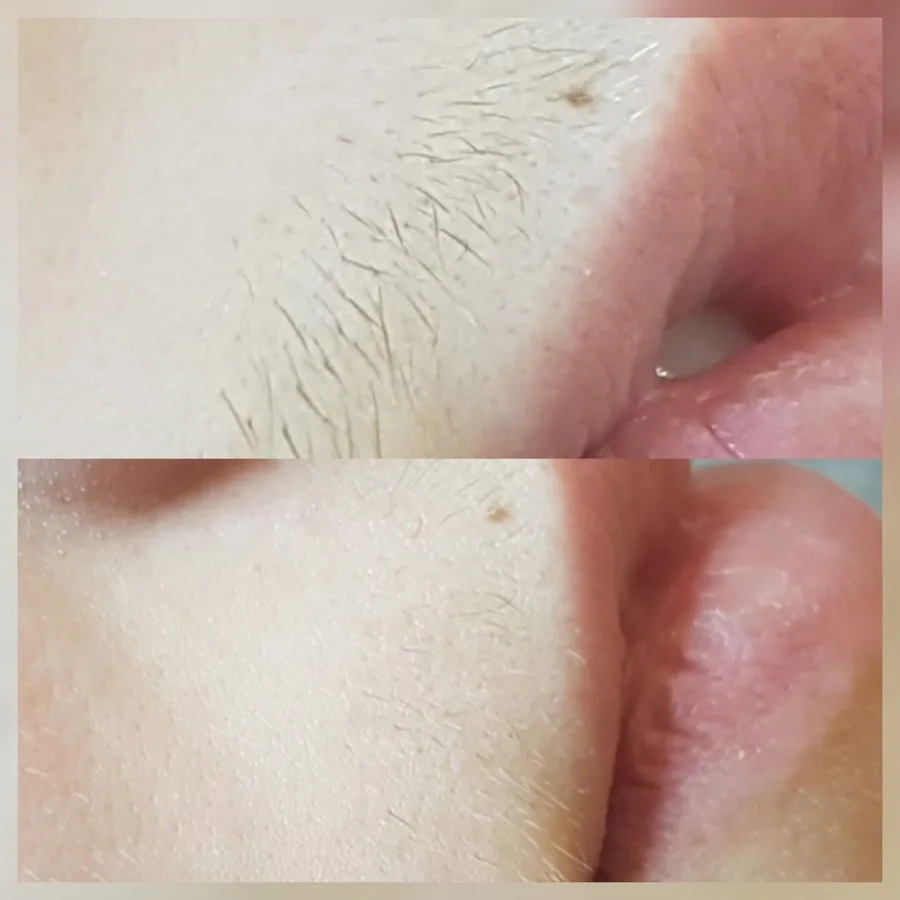
Upper lip and chin are the areas where hormonal growth usually shows first.
The Ferriman-Gallwey Scale Explained
The Ferriman-Gallwey (FG) scale is a clinical scoring system developed in the 1960s and still widely used today in its modified form. It gives clinicians and patients a standardized way to assess and communicate the degree of hirsutism, which makes it useful both for diagnosis and for tracking change over time.
The modified FG scale scores hair growth in 9 body areas, each rated from 0 to 4:
Body Area
Score 0
Score 1-2
Score 3-4
Upper lip
No visible terminal hair
Small amount at outer corners to mid-line
Full mustache distribution
Chin
No visible terminal hair
Scattered hairs to small concentrations
Complete heavy beard
Chest
No visible terminal hair
Circumareolar hairs to midline
Complete breast and sternal coverage
Upper back
No visible terminal hair
Scattered hairs
Complete coverage
Lower back
No visible terminal hair
Sacral tuft to lateral extension
Complete coverage
Upper abdomen
No visible terminal hair
Few midline hairs
Half to full coverage
Lower abdomen
No visible terminal hair
Midline line of hair
Inverted V pattern
Upper arm
No visible terminal hair
Sparse to more than 25% surface
Complete coverage
Thigh
No visible terminal hair
Sparse to anterior surface
Complete coverage
Total scores are interpreted as follows:
0 to 7: within normal range for most women in most ethnic backgrounds
8 to 14: mild hirsutism; warrants hormonal evaluation
15 to 24: moderate hirsutism; high likelihood of a diagnosable androgenic cause
25 and above: severe hirsutism; evaluation is urgent and should be comprehensive
The cutoff of 8 applies to Caucasian women. East Asian women tend to have lower baseline follicle density, so a lower cutoff is applied in that context. South Asian, Middle Eastern, and Mediterranean women tend to have higher baseline density, and their ethnic-adjusted cutoff reflects that. Your physician should interpret your score with your ethnic background in mind.
One important limitation of the FG scale: it scores density and coverage, not hair coarseness. A woman with a score of 6 but very coarse, dark chin hairs may have more clinically significant androgenic activity than a woman scoring 9 with fine transitional hair across multiple areas. The scale is a useful quantitative starting point, not the complete picture. I mention it to clients because being able to go to a doctor's appointment with a self-assessed FG score and a description of hair coarseness gives the physician a much more complete picture than "I have some chin hair."
Scoring Yourself Before Your Doctor Appointment
A self-assessed Ferriman-Gallwey score, combined with a description of hair coarseness and how long it has been worsening, gives your physician far more useful information than a general description of "extra hair." The scale takes about 5 minutes to apply yourself. Ethnic context matters for interpreting the total score.
Other Symptoms That Often Accompany PCOS Hair Growth
PCOS is a syndrome, meaning it is defined by a cluster of features rather than a single abnormal test result. The more features present alongside facial hair, the stronger the clinical picture for a PCOS diagnosis. Knowing the full symptom pattern helps you have a more productive conversation with your physician and may shorten the time to a correct diagnosis.
The symptoms most commonly associated with PCOS alongside hirsutism include:
Irregular menstrual periods: fewer than 8 periods per year, cycles consistently longer than 35 days, or periods that are highly unpredictable. This is one of the three Rotterdam diagnostic criteria. However, some women with PCOS have regular periods; their PCOS manifests primarily through hyperandrogenism and ovarian morphology on ultrasound.
Acne: particularly adult chin and jaw acne that persists after the teen years, tends to be cystic or deep nodular rather than surface-level, and does not respond well to typical over-the-counter treatments. The same androgens that drive facial hair growth drive this type of acne.
Scalp hair thinning: a proportion of PCOS clients experience androgenic alopecia alongside facial hirsutism. The scalp follicles respond to androgens in reverse compared to body follicles: androgens miniaturize scalp follicles instead of enlarging them. Crown and temple thinning in a woman under 40 alongside chin hair is a specific pattern worth discussing with a physician.
Difficulty managing weight: insulin resistance is present in 50 to 80 percent of women with PCOS. Insulin resistance makes losing weight harder and can cause weight to accumulate centrally (abdomen) even in women whose overall BMI is in the normal range.
Acanthosis nigricans: dark, velvety patches of skin in body folds (the back of the neck, underarms, groin). This is a visible sign of insulin resistance and, when present alongside hirsutism, strongly suggests PCOS with an insulin-resistant component.
Fatigue and mood changes: hormonal dysregulation affects energy and emotional regulation in a subset of PCOS clients. This is less specific than the other features but is worth mentioning in context.
A client who presents with coarse chin hair, irregular periods, chin-and-jaw acne, and mild central weight gain has a strongly suggestive picture for PCOS even before any bloodwork is done. A client with only isolated chin hair and no other features could have PCOS, genetics, idiopathic hirsutism, or early perimenopause, and the workup is needed to distinguish them.
Some women have what is sometimes called lean PCOS or "silent PCOS": elevated androgens and polycystic ovarian morphology on ultrasound without the classic features of irregular periods or weight changes. Hirsutism alone, even without any other PCOS symptoms, is a sufficient reason to seek evaluation. I tell clients this because I see women who feel they do not have "enough" symptoms to justify asking for a PCOS workup. Coarse facial hair that is worsening is enough.
When Hair Growth Is Not PCOS
PCOS is the most common cause of hirsutism in women under 40, but it is not the only cause. Understanding the alternatives matters for medical management planning, even though it does not significantly change the electrolysis treatment approach.
The most common non-PCOS causes of female facial hair that I see in clients at my practice in Irvine and throughout Orange County:
Perimenopause and menopause: the estrogen-androgen ratio shift at menopause triggers chin and jaw hair in many women over 45 with no history of PCOS. This is the second most common cause I see, and the onset timing (mid-40s or later) usually makes it distinguishable from PCOS. The companion article on chin hair after menopause covers this in full detail.
Non-classical congenital adrenal hyperplasia (CAH): an inherited enzyme deficiency that causes excess adrenal androgens. Its presentation is so similar to PCOS that it is sometimes described as "PCOS's twin." It is diagnosed with a specific blood test (17-hydroxyprogesterone stimulation test) that is not included in standard PCOS panels. Worth requesting if initial PCOS workup is inconclusive.
Medications: DHEA supplements, anabolic steroids, certain progestins, corticosteroids, minoxidil, phenytoin, and cyclosporine can all cause increased hair growth through androgenic or non-androgenic mechanisms. If a new medication preceded new hair growth, this connection is worth investigating before assuming PCOS.
Idiopathic hirsutism: clinically significant hirsutism with completely normal androgen levels on comprehensive testing and no identifiable cause. Accounts for approximately 20 percent of hirsutism cases. Likely due to elevated peripheral androgen receptor sensitivity or local 5-alpha reductase activity. Real and physiological, even without an abnormal blood value.
Genetics: significant androgen receptor sensitivity can run in families and be ethnically patterned. If your mother or sisters have significant facial hair and you have always had it as well without progression, genetics may be the primary explanation.
From a medical management standpoint, knowing the cause matters because the treatment may differ. If a medication is driving hair growth, changing it may be more relevant than adding hormonal therapy. If adrenal CAH is the cause rather than ovarian PCOS, the medical approach differs. From an electrolysis standpoint, the cause affects the realistic treatment timeline (active ongoing hormonal stimulation means a larger and potentially growing follicle population) but not the fundamental approach or outcome.
From an Electrolysis Standpoint, the Cause Shapes the Timeline
Active PCOS or ongoing hormonal stimulation means new follicles can be recruited during treatment, extending the total treatment course. Stable causes (genetics, menopause now stabilized, idiopathic with no active hormonal change) produce more predictable timelines. But in every case, properly treated follicles are permanently gone regardless of the underlying cause.
Getting Diagnosed: What to Ask Your Doctor
A common frustration I hear from clients is that they saw their doctor, described their hair growth, and were told their bloodwork was normal. What "normal" means in that context is often that a basic thyroid panel and complete blood count came back within range, not that a full androgen workup was performed. The two are very different.
A complete hormonal evaluation for hirsutism should include:
Total testosterone and free testosterone: free testosterone (the biologically active fraction not bound to SHBG) is often more clinically relevant than total testosterone. Both should be measured.
Sex hormone binding globulin (SHBG): low SHBG means more free testosterone is biologically available. PCOS and insulin resistance both tend to lower SHBG.
DHEA-S: the primary adrenal androgen. Significantly elevated DHEA-S points toward an adrenal rather than ovarian source of androgen excess.
LH and FSH: the LH-to-FSH ratio is often elevated in PCOS (above 2:1). These are best measured on days 3 to 5 of a menstrual cycle if you have one.
17-hydroxyprogesterone: to screen for non-classical CAH. This is not routinely ordered but should be requested specifically if initial PCOS workup is inconclusive.
Fasting glucose and insulin: to assess insulin resistance, which affects both PCOS management and treatment planning.
Thyroid panel (TSH, free T4): thyroid disorders can affect hair quality and growth cycles and can coexist with PCOS.
Pelvic ultrasound: to assess ovarian morphology and the number of small follicles per ovary, one of the Rotterdam diagnostic criteria for PCOS.
Timing matters for hormone tests. Androgen levels fluctuate across the menstrual cycle and are affected by hormonal contraceptives. If possible, tests should be performed early in the cycle (days 3 to 5) and not while taking combined hormonal contraceptives, which suppress androgen production and can produce falsely normal results. If you are on hormonal contraceptives and want a true baseline, discuss with your physician how to approach timing.
When you go to your appointment, specific language helps. "I have coarse terminal hair growing on my chin and jaw that has been progressively worsening over several years. I would like a full hormonal evaluation including free and total testosterone, SHBG, DHEA-S, LH, FSH, 17-hydroxyprogesterone, fasting glucose and insulin, a thyroid panel, and a pelvic ultrasound" is a far more productive opening than "I have some extra hair." Physicians respond to specificity, and you have a right to request a thorough evaluation.
If your GP or gynecologist is not comfortable performing a full hormonal workup for hirsutism, asking for a referral to an endocrinologist is entirely appropriate. Endocrinologists specialize in exactly this kind of evaluation.
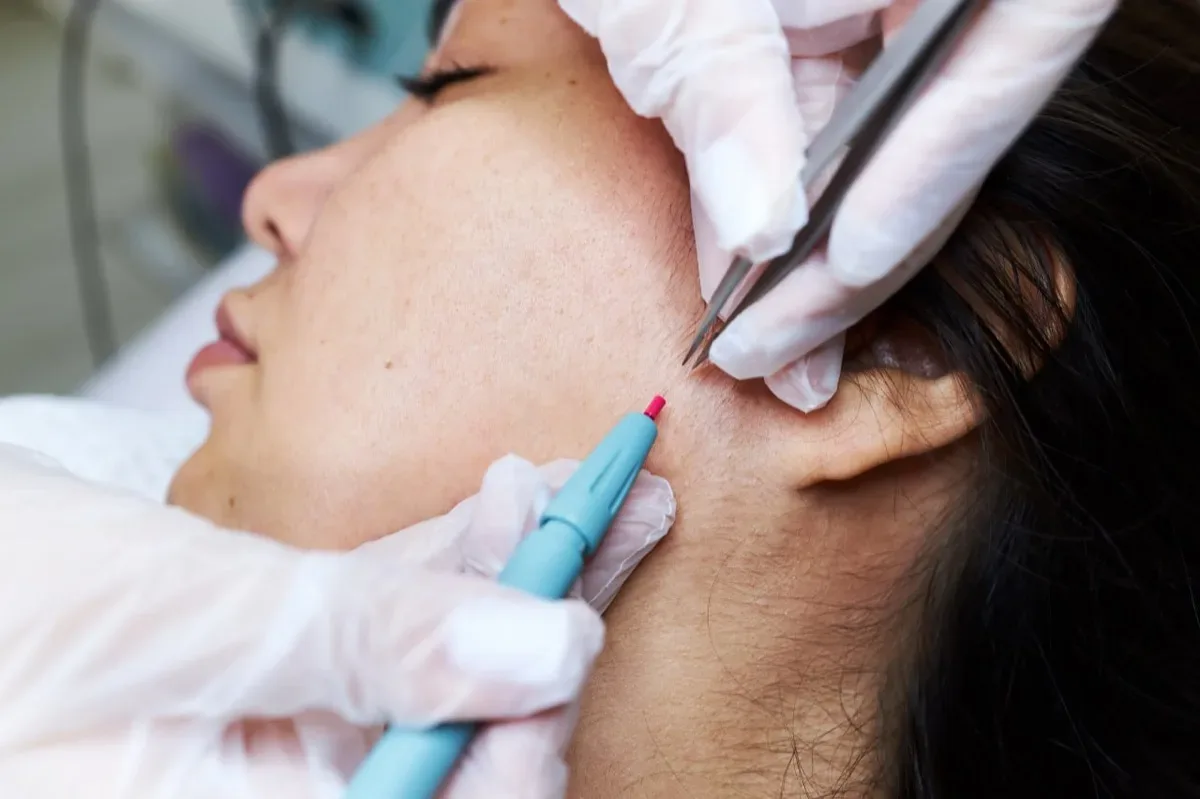
Whatever the cause of the growth, electrolysis removes the hair itself permanently.
Does the Cause Change Your Hair Removal Options?
Patients frequently ask me whether they need to know the cause of their hair growth before starting electrolysis. The short, practical answer is no. Electrolysis works by destroying individual follicles through electrical current. Whether a follicle was activated by PCOS, genetics, menopause, a medication, or idiopathic receptor sensitivity, the deactivation process at the papilla level is identical. Knowing the cause does not change the procedure.
Where the cause does matter is in treatment planning and timeline estimation:
Active PCOS with ongoing androgen elevation: new follicles may continue to be recruited during treatment, which means the total number of follicles requiring treatment can increase over the treatment period. Timelines tend to be longer and require more flexibility.
PCOS managed with hormonal medication: spironolactone, metformin, or appropriate contraceptives slow new follicle activation. Treatment timelines improve significantly with medical management in place.
Genetic or idiopathic hirsutism: the follicle population is more stable. New activation is less aggressive than in active PCOS. Timelines are often more predictable.
Medication-driven hair growth: if the causative medication can be changed, new follicle activation during treatment reduces. If not, the situation is more similar to active PCOS in terms of ongoing stimulation.
Menopausal hirsutism, stabilized: once the hormonal transition completes and stabilizes (typically several years post-menopause), new follicle activation slows significantly. HRT further moderates this.
From a laser standpoint, the cause matters more than it does for electrolysis, because laser's dependency on melanin means mixed-pigmentation hair (common in PCOS and menopause) limits its effectiveness. Electrolysis is not restricted by pigmentation at all.
My practical summary: whatever the cause, electrolysis is effective and appropriate. The cause shapes how I estimate your total treatment time and what expectations I set around new hair appearing during treatment. It does not change whether the treatment will work.
Starting Treatment Before Receiving a Diagnosis
PCOS diagnosis in particular can be a prolonged process. Studies show that the average time from first symptoms to PCOS diagnosis is over two years. During that time, the follicles that are already producing coarse hair continue to become more established, and potentially new ones are recruited. Waiting for a perfect diagnosis before starting electrolysis is almost never the right approach.
You can begin electrolysis immediately to permanently remove existing hairs while pursuing a diagnosis in parallel. The two processes do not interfere with each other. Every follicle treated during the diagnostic period is permanently gone. Those follicles do not need to be "redone" once you receive a diagnosis. The work is cumulative and real from the very first session.
What I recommend doing before starting electrolysis if you suspect PCOS or another hormonal cause:
Tell your electrologist about your symptoms and concerns at the first consultation. This allows for more accurate timeline planning and appropriate expectations about potential new follicle activation during treatment.
Begin the diagnostic process with your physician concurrently, not after your first electrolysis appointment. The two tracks run in parallel most efficiently.
If you receive a diagnosis and start hormonal management during your electrolysis course, inform your electrologist so they can adjust your timeline estimates accordingly. Hormonal management that reduces new follicle activation will accelerate your results.
One practical thing to avoid in the period before starting electrolysis: extensive tweezing or waxing in the 2 to 3 weeks before your first sessions can make some follicles temporarily harder to treat, because the hair shaft is in telogen (resting) and the probe's access to the papilla is less direct. If you are managing hair in the meantime, shaving (which does not affect the follicle) is preferable to tweezing or waxing in the final weeks before your first electrolysis appointment.
Clients who come to me for an initial consultation before they have a definitive diagnosis are not in the wrong place. Understanding your options and getting a clinical assessment of what you are dealing with is exactly what the consultation is for. We can build a realistic treatment plan based on what I observe clinically, and adjust that plan as your medical picture clarifies over the following months. For PCOS-specific treatment information, the PCOS electrolysis page covers the full approach. To book a free consultation at Real Skin Beauty, visit the booking page. If you have questions before your appointment, the FAQ page covers the most common ones in detail.
You Do Not Need a Diagnosis to Start
Electrolysis permanently removes every follicle it treats regardless of what caused that follicle to activate. Starting treatment while your diagnostic workup is in progress does not waste sessions or require repeating work later. The diagnosis helps set timeline expectations. It does not have to precede treatment.
Frequently Asked Questions
What is the main difference between PCOS hair and normal hair? +
PCOS-related hair growth is coarse, dark, and terminal, structurally the same as male beard hair. It appears in androgen-sensitive areas: chin, jaw, upper lip, chest, abdomen, and inner thighs. Normal female hair in these areas is typically fine and vellus, barely visible at a glance. The combination of hair type (coarse, dark, terminal) and location in androgen-sensitive zones is more diagnostically meaningful than either factor on its own.
I only have chin hair. Could it still be PCOS? +
Possibly, but isolated chin hair can also result from normal hormonal variation, genetics, or perimenopause without PCOS. A blood panel measuring free and total testosterone, SHBG, DHEA-S, LH, and FSH, along with a pelvic ultrasound, are the standard diagnostic tools. The presence of other PCOS features (irregular periods, chin acne, scalp thinning) alongside chin hair raises the likelihood of a PCOS diagnosis significantly.
Can you have PCOS without other symptoms except hair growth? +
Yes. Some women have elevated androgens and polycystic ovarian morphology on ultrasound without classic symptoms like irregular periods or weight changes. This is sometimes called lean PCOS or silent PCOS. Coarse facial hair that is progressively worsening is a completely valid and sufficient reason to seek a full hormonal evaluation, regardless of whether any other PCOS symptoms are present.
Does PCOS hair grow in a specific pattern? +
Yes. The Ferriman-Gallwey scale assesses hair growth across 9 androgen-sensitive body areas. A score above 8 in Caucasian women, adjusted for ethnicity, generally indicates clinical hirsutism worth investigating. The chin, jaw, upper lip, chest, and upper abdomen are the most diagnostically significant areas for androgen-driven hair growth in women, and coarseness in these zones is more significant than fine hair coverage elsewhere.
If I have PCOS, will electrolysis still work for me? +
Absolutely. Electrolysis permanently removes each follicle it treats regardless of ongoing hormonal activity. PCOS means you may see additional follicles activated during the treatment period, which extends the total treatment duration compared to clients without a hormonal driver. But every follicle that is properly treated will never regrow hair, regardless of PCOS status. The progress is cumulative and real from the first session.
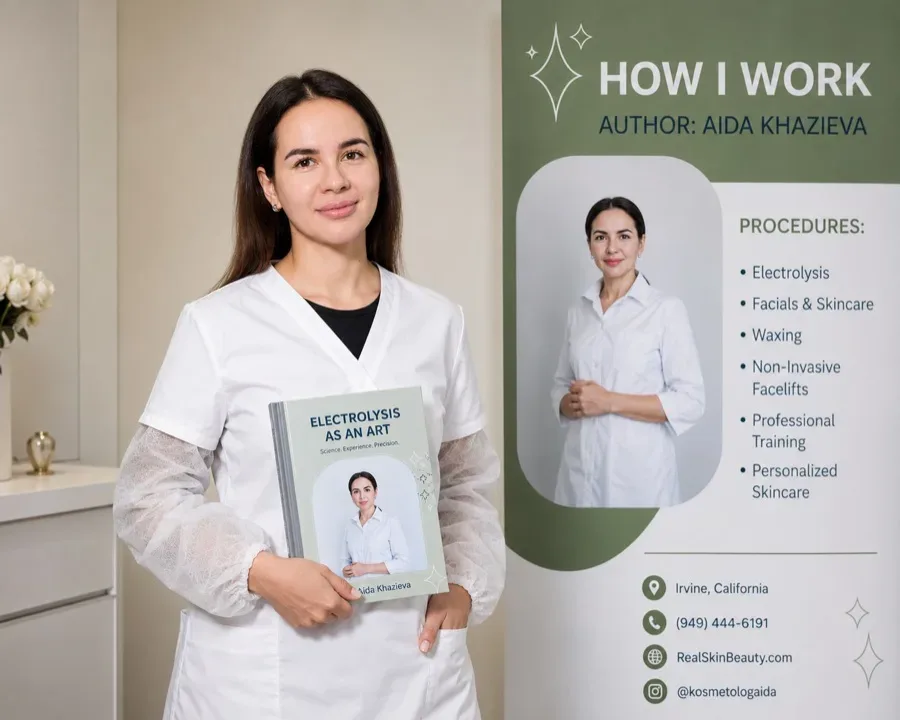
Licensed electrologist and cosmetologist with 20+ years of experience. Aida sees clients at Real Skin Beauty, 18021 Sky Park Circle, Suite N, Irvine, CA 92614.
Book a free consultation with Aida Khazieva at Real Skin Beauty in Irvine, CA. Get clarity on your specific situation, a realistic treatment plan, and honest answers about what to expect.
This article is for informational purposes and reflects Aida Khazieva's clinical experience. It does not replace a personalized medical consultation. Individual results vary.