Red vs Blue LED Light Therapy: What Each Color Does for Skin
By Aida Khazieva·Facials and Skin Care·9 min read·Real Skin Beauty, Irvine CA·Updated October 16, 2026
Red LED light (about 630 to 660 nm) goes deeper into the skin to calm inflammation and support collagen, so it suits redness, fine lines and recovery. Blue LED light (about 415 nm) works at the surface and in the follicle to reduce acne-causing bacteria, so it suits active breakouts and oily skin. Neither uses UV or causes downtime. Here is how I choose between them in the studio.
Quick Answer
Red LED: calming, collagen support, recovery, redness. Blue LED: active breakouts and oily skin. Both are UV-free with no downtime, and both are usually added to a facial. Ask your doctor first if you take light-sensitizing medication.
How LED Light Therapy Works
LED stands for light-emitting diode. An LED panel shines a specific wavelength of visible light on the skin. Unlike a tanning bed or sunlight, it contains no UV radiation, and it does not produce the heat of a laser. Skin cells absorb the light and respond in different ways depending on the wavelength.
Wavelength is measured in nanometers (nm). A longer wavelength travels deeper, so red light reaches further into the skin than blue light does. That single fact explains most of the differences between the two colors. The treatment itself is simple: you lie back, I cover your eyes with protective goggles, and the panel does its work in the studio for around 20 to 30 minutes without pain or recovery time.
At my studio I use red and blue LED. Other colors such as green, yellow and near-infrared exist at some clinics and in home devices, but I do not make claims about them here. The LED therapy page lists what is offered.
Why Light Can Change How Skin Behaves
Skin cells contain components that absorb light of certain wavelengths. When they do, researchers believe it can affect cell activity, including energy production and inflammation signals. That is the idea behind LED treatment. The research is still developing, studies use different devices and settings, and results are not identical for everyone, so I describe the benefits as supportive rather than dramatic.
What is well understood is the safety profile compared with other light sources. Sunlight and tanning beds contain ultraviolet radiation, which damages skin. LED panels used for skin care are designed to avoid UV, which is why the treatment does not burn or tan. That is a different category from a laser, and it is why the treatment can be offered as a gentle add-on.
Red vs Blue LED Side by Side
Red LED (about 630 to 660 nm)
Blue LED (about 415 nm)
Depth
Reaches the dermis, the deeper skin layer
Works at the skin surface and in the follicle
Main purpose
Calm inflammation, support collagen, help recovery
Reduce acne-causing bacteria and calm breakouts
Best for
Redness, fine lines, dull or tired skin, post-treatment skin
Active breakouts, oily skin, recurring acne
Feels like
Gentle warmth or nothing
Nothing, a bright light
Downtime
None
None
Usual series
Often 8 to 10 sessions for anti-aging, then monthly care
Often 6 to 8 sessions, 1 to 2 weeks apart
Studio price
$65 for 30 minutes
$65 for 30 minutes
The session counts above are typical suggestions on my LED page, not guarantees. Skin, goals and the underlying cause of the concern all change them.
What Red Light Does for Skin
Red light is the one I recommend most for tired, inflamed or recovering skin. Skin cells called fibroblasts make collagen and elastin, and red wavelengths are thought to stimulate them. Research on red light and skin is still developing, and findings differ between studies, so I describe the effects as modest and cumulative rather than dramatic.
Here is where I find it useful:
Calming redness and irritation. A red LED session after a facial or peel can help skin feel calmer. For rosacea-prone skin, red is the color I consider, see my rosacea skin care guide for the full picture.
Supporting collagen over time. Regular sessions are part of a plan for fine lines and skin firmness. It works alongside, not instead of, sunscreen and a good routine. Compare options in the collagen-boosting treatments guide.
Post-treatment comfort. After dermaplaning, peels or other exfoliating treatments, red light is a gentle finishing step.
General skin health. Dull, stressed skin often looks fresher after a series of sessions, though results vary.
What red light does not do: remove deep wrinkles, replace microcurrent or injectables, or fix pigment. If you want to lift and tone, the microcurrent facial guide explains a different approach. For age-related changes after 50, see anti-aging facials after 50.
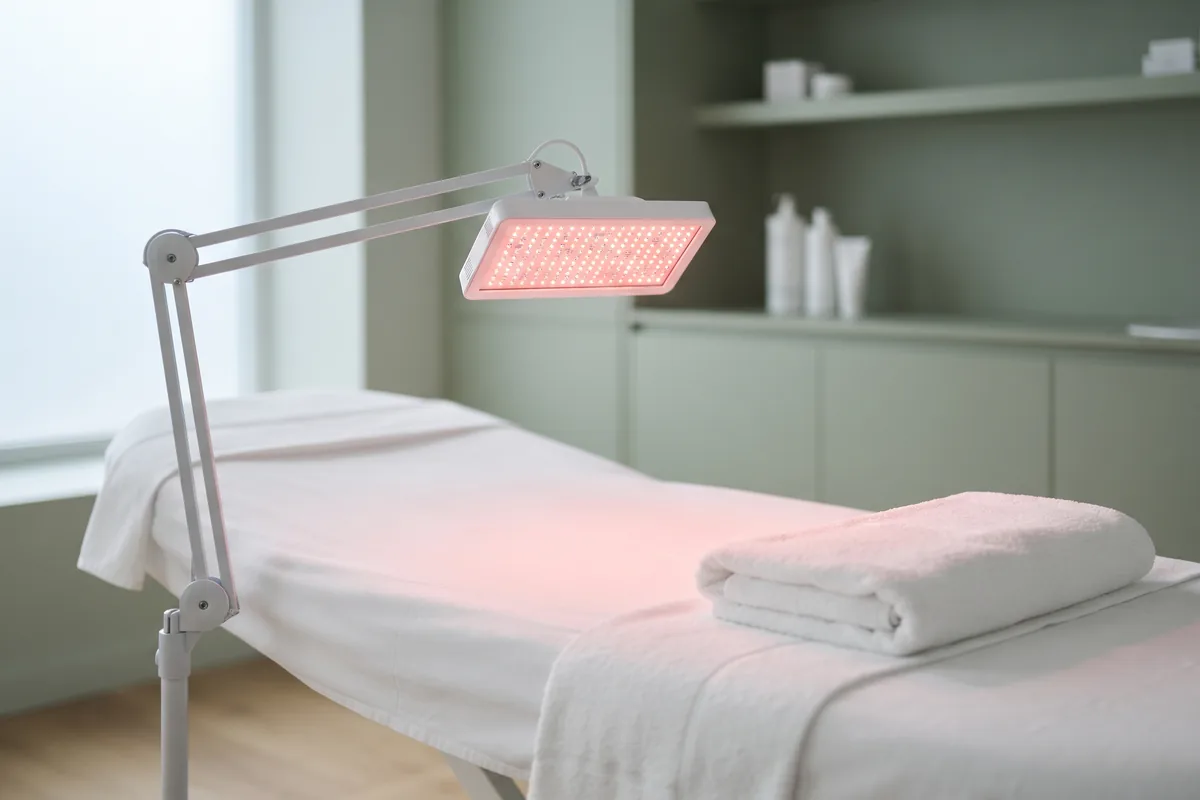
A red LED panel delivers visible light to the face without heat, UV or downtime.
How Long Red Light Takes to Show Anything
Clients usually ask how many sessions before they see a change. The honest answer is that the first few visits often feel like nothing more than a calm half hour, and the benefits show up gradually.
After one session: skin often feels calmer and a bit softer, especially when LED follows a facial or peel. Do not expect a visible change in lines or firmness.
After four to six sessions: some clients notice a fresher, more even look, and redness may seem less reactive. Compare photos in the same light.
After eight to ten sessions: this is the point at which I suggest a review for anti-aging goals, and often a move to monthly maintenance.
Photos matter more than memory. Take one in daylight by a window, without makeup, before you start and again every few sessions. If nothing has changed after a fair trial, I will say so, and we will change the plan.
What Blue Light Does for Skin
Blue light at around 415 nm targets Cutibacterium acnes (formerly called P. acnes), the bacteria involved in many breakouts. It also appears to calm oil gland activity in some people. Blue works at the surface and inside the follicle, which is why it is aimed at active, mild to moderate inflammatory breakouts.
Active breakouts. Blue LED can be added to an acne facial ($115) for supportive treatment.
Oily, congested skin. It is usually combined with cleansing and a home plan.
Recurring blemishes. A regular series may help keep breakouts down, though outcomes vary.
Blue light is not a cure for acne, and it does not remove existing scars or dark marks. Hormonal and cystic acne often need a doctor's input too. If your breakouts follow your cycle, my hormonal acne guide explains the pattern, and facials for acne-prone skin shows how LED fits into a wider plan.
One clarification that comes up often: the blue light used in therapy is a controlled, low-intensity treatment delivered with eye protection. It is not the same as the blue light from your phone or computer screen.
Which Color Should You Choose
Use this as a starting point. In person I look at your skin and often use both.
Active pimples and shiny skin: blue first.
Redness, sensitivity or recovery from a peel: red.
Fine lines and dull skin: red.
Breakouts plus marks and redness left behind: blue to settle active spots, red to calm and support healing. These are often done in the same visit.
The fact that LED has no downtime makes it an easy add-on. Light works better on clean, exfoliated skin because nothing blocks it, so it is usually done after a facial. Results build slowly, so give a series time before judging it, and keep your home routine steady while you do. Picking at spots works against any light treatment, and LED does not replace a prescription from your doctor if you have been given one for acne or rosacea. Tell me about every product and medication you use so the plan fits together. A $65 LED session as an add-on costs less than most standalone treatments, and it is a good fit if you already visit for a facial. Frequency guidance for the facials themselves is in how often to get a facial.
Mistakes That Waste LED Sessions
Booking one session and expecting a result. LED works by repetition. A single visit is a pleasant start, not a test.
Wearing sunscreen or heavy makeup under the light. Product on the skin can block part of the light. Cleansing first is part of the visit.
Choosing the color by marketing, not by skin. Blue on a dry, irritated face does not help. Red on oily, actively breaking out skin may not be the main need.
Picking at spots between sessions. It undoes what the light is supporting.
Stopping the home routine. Cleanser, moisturizer and sunscreen still do most of the daily work.
Skipping the medication conversation. Some prescriptions make skin more sensitive to light, and I would rather know before the panel turns on.
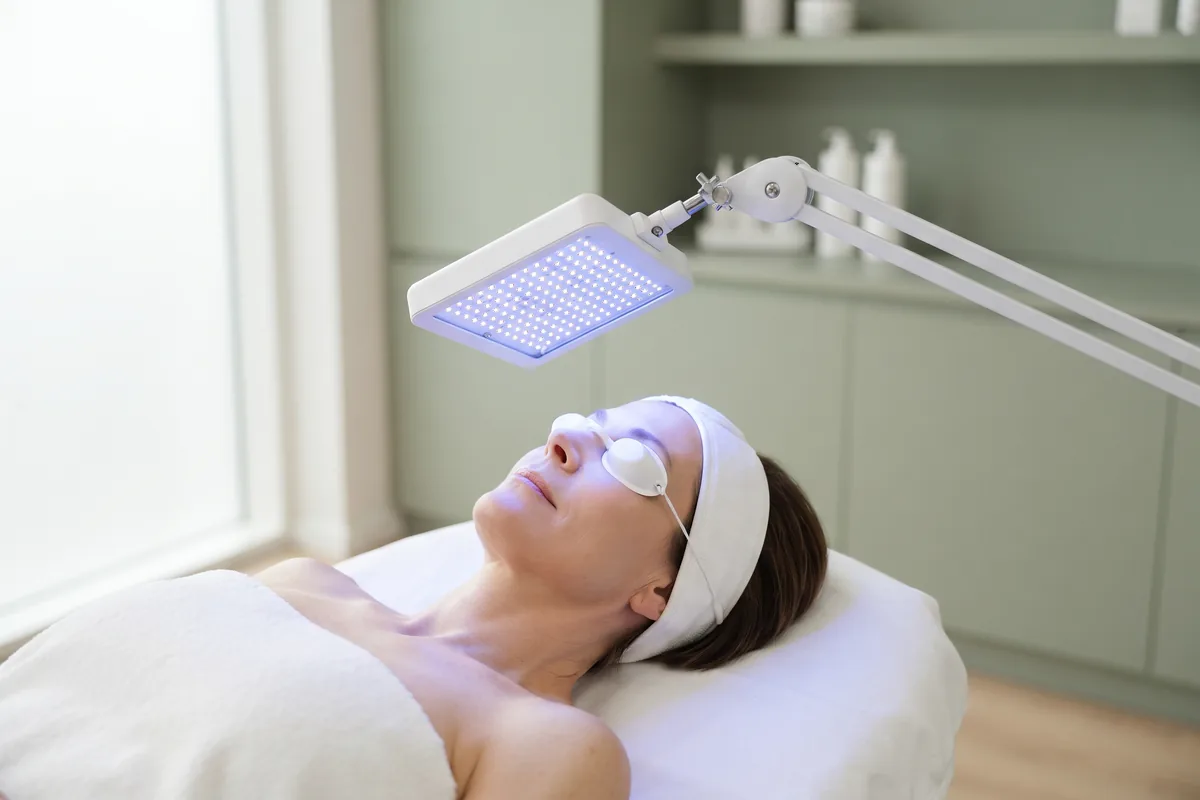
A blue LED panel is used for active breakouts, with protective eyewear worn by the client.
Myths About LED Light Therapy
Myth: LED is the same as a tanning bed. Tanning beds use UV. LED panels for skin care use visible light without UV.
Myth: more minutes always means better results. Devices are designed for set exposure times. Longer is not stronger.
Myth: red light removes wrinkles. It may support collagen over time, but it will not erase deep lines.
Myth: blue light cures acne. It can help reduce acne-causing bacteria as part of a plan, and stubborn acne often needs medical care.
Myth: your phone screen has the same effect. Therapeutic light is delivered at a controlled intensity and distance for a set time. Screen light is not a treatment.
Myth: LED replaces sunscreen or a good routine. It does neither.
Who Should Skip LED or Ask Their Doctor First
LED is gentle and low-risk, but not for everyone.
Medications that increase light sensitivity. Some antibiotics, retinoids and other prescriptions can make skin more reactive. Isotretinoin users should ask their prescriber first.
Conditions made worse by light. If you have a photosensitivity disorder, lupus or a history of light-triggered reactions, get medical approval.
Pregnancy. There is limited data, so check with your doctor.
Open wounds, active infections or a recent skin cancer diagnosis. Do not book until a physician clears you.
Eye problems. Protective eyewear is always used, and anyone with eye conditions should ask their ophthalmologist.
If you take any medication for your skin, bring the list to your consultation.
What a Studio LED Session Looks Like
A typical LED visit at my Irvine studio starts with a cleanse so that makeup, sunscreen and oil are not blocking the light. When LED is an add-on, it follows the facial or peel, since freshly cleansed skin lets more light through. I review your medication list, place opaque goggles over your eyes and position the panel at the right distance from your face.
The light stays on for roughly 20 to 30 minutes. Most people feel mild warmth from red light and nothing from blue light. Many clients doze off. When the timer ends, you can go back to your day. Skin may look a little calmer, but you should not expect a dramatic change after one session. LED works through repetition, and the series matters more than any single visit.
I recommend a sunscreen step before leaving, as with any skin treatment. If you are also using retinoids or exfoliating acids at home, I will explain whether to pause them around your visits. Keep a short note of how your skin looks before you start, such as how many active breakouts you have or how red your cheeks look by midday. After four or five sessions, that note tells you far more than memory does about whether the treatment is worth continuing.
LED Combined With Other Treatments
LED has no downtime, so it pairs easily with other services. These are the combinations I use most. Whether to combine depends on your skin on the day.
The pattern is the same each time: clean skin first, light second, protection last.
Blue Light for Breakouts, Week by Week
This is how a typical blue LED series might run for mild to moderate breakouts. Your plan may differ, and I will not promise a number of clear days.
Weeks 1 to 2: baseline. A skin consultation, a simple home routine and a first blue session after an acne facial. I note the number of active spots.
Weeks 3 to 6: blue sessions one to two weeks apart. Many people notice fewer new spots appearing, and the skin may feel less oily. Some still have breakouts, which is normal at this stage.
Weeks 7 to 8: review with photos. If breakouts have settled, we space visits out. If not, I may suggest a medical opinion, since hormones, medications and genetics play a role that light cannot change.
After the series: a maintenance visit every month or two, combined with a facial if useful, while the home plan keeps doing its work.
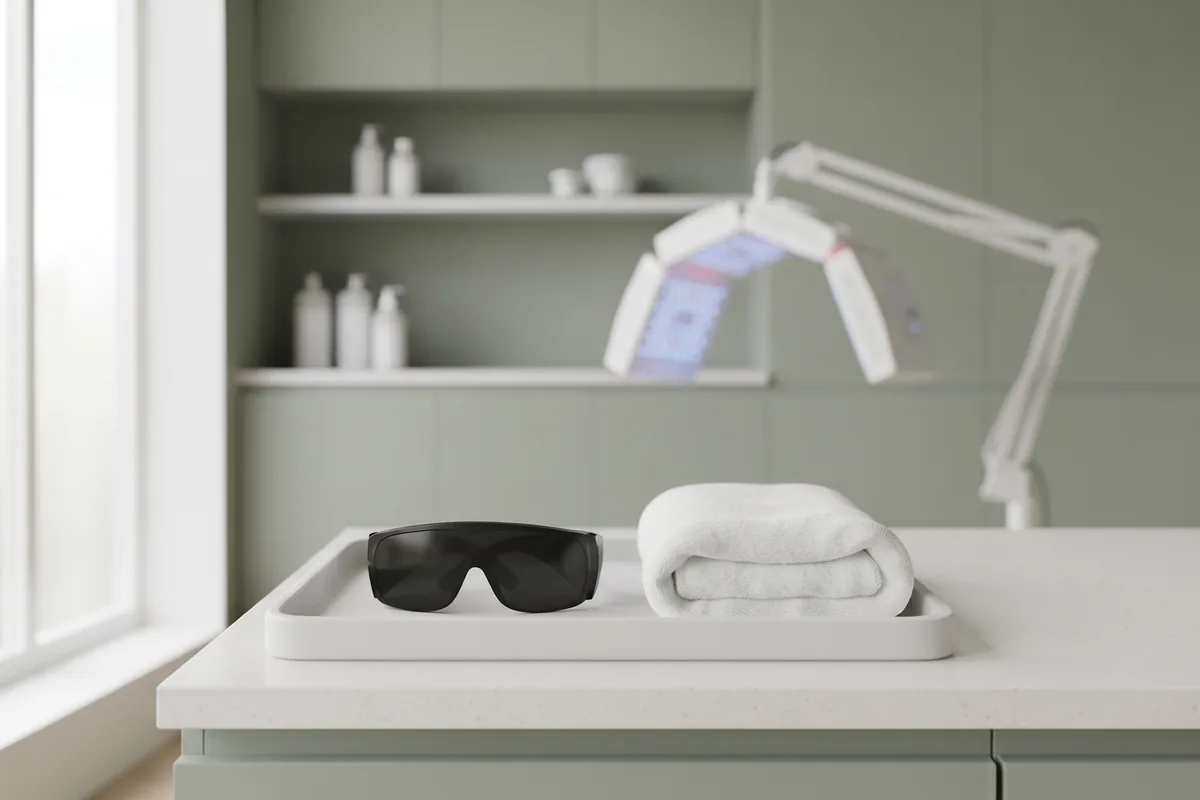
Opaque goggles are part of every LED session, whichever color is used.
Who Tends to Like LED, and Who Notices Little
Clients who enjoy LED tend to want something gentle with no downtime, or a calming finish after a facial or peel. They often have mild breakouts, tired skin or reactive skin that dislikes stronger treatments.
People who notice little are usually expecting a lift, deep wrinkle reduction, removal of deep pigment or a cure for severe acne. Light is a supporting tool. Because LED contains no UV and does not heat the skin, it is used on a range of skin tones, but I still ask about medications and any history of light-triggered reactions before I start. I would rather tell you that LED is the wrong tool than sell you a series.
Studio LED vs At-Home Masks, and How to Start
LED masks and wands are popular at home. I do not tell clients they are useless, but the picture is more mixed than the marketing. Home devices vary widely in wavelength accuracy and power, and many are lower in strength than professional-grade equipment, which means results are usually slower and subtler. Consistency matters, so a device you use three times a week for months can still help some people.
What home devices cannot do is assess your skin, pair the light with a cleansing facial or peel, or tell you that what you think is acne is actually rosacea. If you already own one, bring it to your visit and I will tell you how to fit it into your plan. For most clients, a studio series of sessions combined with a consistent home routine gives the best return.
LED is the easiest treatment to add on to something you already do. A 30-minute session costs $65, and a free skin consultation will tell you whether red, blue or both fit your goals. Clients visit from Irvine, Tustin, Costa Mesa and across Orange County. You can also pair it with an acne facial or an anti-aging facial. Ready to try? Book your appointment.
Questions to Ask Before You Buy a Series
Which wavelength will you use for my concern, and why?
How many sessions do you expect, and when do we review?
Do I need to stop any medication or product around my visits?
Will I wear eye protection, and what kind?
Can I pay session by session before committing to a package?
After the Series: Maintenance and Home Habits
When a series ends, benefits fade if you stop everything. A common plan is one visit every month or two, often added to a facial, plus a stable home routine. Wear sunscreen daily, since sun damage undoes collagen support, and keep your cleanser and moisturizer simple. If breakouts return, book a blue session sooner, and if redness flares, a red one. Skip a visit if your skin is irritated or sunburned, and rebook when it has healed. Re-check your medication list at each visit, because new prescriptions change what is suitable.
Frequently Asked Questions
+ What is the difference between red and blue LED light therapy?
Red light (about 630 to 660 nm) penetrates deeper and is used for calming inflammation and supporting collagen. Blue light (about 415 nm) works at the surface and in the follicle and is used for acne-causing bacteria and oily skin.
+ Is LED light therapy safe for all skin tones?
LED contains no UV and does not heat the skin, so it is considered low-risk for most skin tones. People who take light-sensitizing medications or have light-triggered conditions should ask their doctor first.
+ How many LED sessions do I need?
On my LED page, I suggest about 6 to 8 sessions spaced 1 to 2 weeks apart for breakouts, and 8 to 10 sessions then monthly care for anti-aging. Individual results vary and I do not guarantee outcomes.
+ Can I use both red and blue light in one visit?
Yes. Blue can be used for active breakouts and red for calming and healing. The two are often combined, and I choose the order after looking at your skin.
+ How much does LED light therapy cost at Real Skin Beauty?
LED light therapy is $65 for a 30-minute session. It is often added to a facial. Skin consultations in the studio are free.
+ Does LED light therapy hurt or feel hot?
No. Blue light feels like nothing, and red light may feel like gentle warmth. You wear protective goggles, lie back and relax for about 20 to 30 minutes. There is no downtime.
+ Can I do LED light therapy every day?
I do not suggest daily professional sessions. Studio series are usually spaced one to two weeks apart. At-home devices have their own instructions, and you should follow the manufacturer and ask your doctor if you have a skin condition or take medication.
+ Can I have LED light therapy if I am pregnant?
There is limited information, so ask your doctor before booking. I will not treat you without your physician's approval if you are pregnant or breastfeeding.
Licensed electrologist and cosmetologist with 20+ years of experience. Aida sees clients at Real Skin Beauty, 18021 Sky Park Circle, Suite N, Irvine, CA 92614.
Curious which color your skin needs? Book a free consultation with Aida Khazieva at Real Skin Beauty in Irvine, CA. She will look at your skin in person and suggest LED only if it fits your goals.
This article is for informational purposes and reflects Aida Khazieva's professional experience. It does not replace a personalized medical consultation. Individual results vary.
Questions? Aida Answers Them All.
Visit our FAQ or book a free consultation to discuss your specific skin and hair concerns.