Collagen-Boosting Treatments: What the Science Actually Supports
By Aida Khazieva·Anti-Aging·13 min read·Real Skin Beauty, Irvine CA·Updated July 27, 2026
Collagen is the most misused word in skincare marketing. Products labeled "collagen" line store shelves from Irvine to every corner of Orange County. Supplements promise skin benefits in bold print. Treatments promise collagen stimulation without distinguishing between those with real evidence and those without any. My job is to give clients accurate information about what actually changes collagen density and quality in living skin, not what sounds compelling in a product description. After 20 years of practice I have a clear picture of which approaches work and which are primarily marketing. This guide covers both sides honestly.
Quick answer: You cannot restore the collagen of your 20s, but some treatments do promote new collagen. Red LED at 630 to 670 nm has the strongest non-invasive research base, and prescription tretinoin has extensive evidence. Chemical peels and microcurrent also help. Collagen supplements show promise in small studies, but the evidence is limited.
What Collagen Actually Is and Why It Declines With Age
Collagen is the most abundant protein in the human body. In the skin, it is the primary structural protein of the dermis, the layer between the epidermis at the surface and the subcutaneous tissue below. Dermal collagen provides tensile strength, the property that allows skin to resist stretching and return to its original shape. It also contributes directly to skin thickness, firmness and the smooth, plump texture associated with youthful skin.
The relevant collagen types for skin are Type I and Type III. Type I collagen makes up approximately 80 percent of dermal collagen and provides the primary structural tensile strength. Type III collagen, comprising about 15 percent, contributes flexibility and is particularly active during wound healing and skin repair. Both are produced by fibroblasts, the specialized cells of the dermis that are responsible for synthesizing and maintaining the extracellular matrix.
Collagen production begins declining at approximately age 25, at a rate of roughly 1 percent per year. By age 40, a person has lost approximately 15 percent of their peak dermal collagen density. By age 50, that number approaches 25 percent. After menopause in women, the rate of collagen decline accelerates: studies have documented a loss of approximately 30 percent of dermal collagen in the first 5 years following menopause. This acceleration is linked directly to the loss of estrogen, which actively stimulates collagen production through its receptor activity in fibroblasts.
Beyond natural aging, external factors accelerate collagen breakdown significantly. UV radiation from sun exposure is the most damaging. UV light activates matrix metalloproteinases (MMPs), enzymes that actively break down collagen, while simultaneously inhibiting new collagen synthesis. This is why sun-damaged skin ages faster at the structural level than chronologically matched skin that has been consistently protected. Smoking, chronic high blood sugar, poor sleep and chronic stress all also accelerate collagen breakdown through various oxidative and inflammatory mechanisms.
Collagen synthesis requires specific cofactors to proceed. Vitamin C is essential for hydroxylation of proline and lysine, the amino acid modifications required to form stable collagen triple helixes. Without adequate vitamin C, fibroblasts cannot complete the collagen assembly process. This is why vitamin C both in the diet and in topical application is meaningfully relevant to collagen production, not just as an antioxidant but as a direct enzymatic cofactor.
Understanding what collagen is, where it is located, what produces it and what breaks it down creates the framework for evaluating any claimed collagen-boosting treatment. If a treatment cannot plausibly reach the dermis where fibroblasts are located, or stimulate fibroblast activity through a demonstrated mechanism, the collagen claim is marketing rather than biology.
Why Most Products Labeled Collagen Cannot Deliver What They Promise
The core problem with topical collagen products is molecular size. Collagen molecules are very large, with a molecular weight between 285,000 and 300,000 daltons. The stratum corneum, the outermost layer of the skin, is permeable to molecules up to approximately 500 daltons. A collagen molecule is 570 to 600 times too large to penetrate intact skin.
When you apply a product containing collagen to your face, the collagen molecules sit on the surface. They do not penetrate. They do not reach the dermis. They do not reach fibroblasts. They cannot stimulate new collagen synthesis because they cannot get to where fibroblasts are located. They may contribute some surface-level moisturizing effect as occlusive molecules on the skin surface, and that can temporarily improve the appearance of skin, but the mechanism is hydration, not collagen stimulation.
This is not a fringe opinion. It is the established position of dermatology. The molecular weight limitation is a fundamental fact of skin biology that no topical collagen product overcomes without using delivery technologies that physically disrupt the skin barrier, which topical collagen products are not designed to do.
Hydrolyzed collagen in topical products is different from intact collagen molecules in that it has been broken into smaller peptide fragments, some of which may penetrate to a shallow depth in the epidermis. Whether these penetrating fragments then signal fibroblasts in the dermis in any meaningful way is not clearly established. The honest assessment of topical collagen is that it provides surface hydration and may have some minor peptide-signaling effect, but it does not deliver the collagen-rebuilding outcome that the labeling implies.
The products with the strongest evidence for actually stimulating fibroblast collagen production in living skin are not labeled "collagen." They are retinoids, which work through nuclear receptor pathways. They are vitamin C serums, which provide the essential cofactor for collagen synthesis. And they are delivered through treatments that reach the dermis through energy, controlled injury or pharmaceutical penetration enhancers, none of which are present in over-the-counter collagen creams.
The Molecular Size Problem
Collagen molecules weigh 285,000 to 300,000 daltons. The skin's outer layer permits absorption of molecules up to approximately 500 daltons. Topical collagen cannot penetrate intact skin. It moisturizes the surface. It does not reach fibroblasts. It does not stimulate new collagen production. This is basic skin biology, not brand-bashing. Products that actually stimulate collagen work through completely different mechanisms.
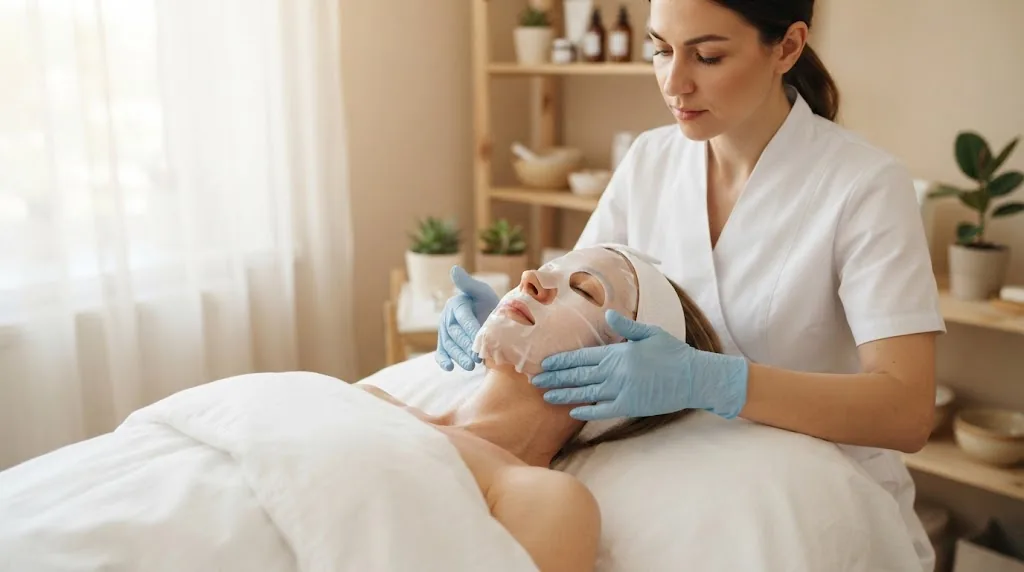
A collagen mask is pressed onto the skin to keep it hydrated and plump while the active ingredients work.
LED Red Light Therapy: The Strongest Research Evidence
Red LED light therapy at 630 to 670 nanometer wavelength has the strongest and most consistent research evidence of any non-invasive, non-pharmaceutical collagen-stimulating treatment currently available. This claim is not based on brand studies or anecdotal client reports. It is based on the mechanism of action and a body of peer-reviewed clinical research accumulated over more than 20 years.
The mechanism is called photobiomodulation. Light at specific wavelengths is absorbed by chromophores in cells, the photosensitive molecules that capture photon energy and convert it to cellular activity. In skin, the primary chromophore relevant to red LED is cytochrome c oxidase, a component of the mitochondrial electron transport chain. When cytochrome c oxidase absorbs red light photons, the efficiency of ATP production in the mitochondria increases. More ATP means more cellular fuel for fibroblast activity, including more collagen synthesis.
Near-infrared light at 830 to 850 nanometers penetrates deeper than red light and reaches the subcutaneous tissue. At this depth it stimulates the same chromophore pathway but can also affect tissue at a level closer to bone and muscle. For facial anti-aging, red LED alone or combined with near-infrared produces the most clinically documented results for collagen density improvement.
Published clinical findings on red LED for skin collagen include a 2014 study in Photomedicine and Laser Surgery showing that 91 percent of participants experienced improvement in skin complexion after LED treatment, with measurable increases in collagen content confirmed by histological analysis in participants who underwent biopsy. A 2005 study in the Journal of Cosmetic and Laser Therapy showed increased Type I collagen expression in fibroblasts following red LED exposure. These are peer-reviewed findings in indexed medical journals, not product studies funded by LED device manufacturers.
In my Irvine studio I use red LED as both a standalone treatment and as a finishing step following other modalities. As a standalone treatment for clients who cannot tolerate more active procedures, it provides genuine collagen stimulation with zero side effects, zero recovery time and no barrier disruption. Following a chemical peel, it accelerates the repair and remodeling phase. Following microcurrent, it adds fibroblast stimulation to complement the muscle conditioning. Its versatility and complete safety profile make it one of the most practical tools in a professional anti-aging protocol.
A standard LED series for collagen stimulation is 8 to 12 sessions over 4 to 6 weeks, followed by monthly maintenance. Visible improvement in skin firmness and texture develops gradually over the series and continues improving for several weeks after the series ends as the new collagen that was synthesized during the treatment period matures. Clients who expect immediate dramatic results after their first LED session will be disappointed. Clients who understand they are investing in a biological process with a 6 to 12 week response timeline see consistent satisfaction with the cumulative outcome.
Microcurrent: Collagen Stimulation Through ATP Production
Microcurrent's collagen stimulation mechanism is related to, but distinct from, LED's. Both increase ATP production in fibroblasts. LED does it through light absorption by mitochondrial chromophores. Microcurrent does it through direct electrical stimulation of cellular metabolic processes. The research on microcurrent ATP production, specifically studies documenting increases of up to 500 percent in cellular ATP in treated tissue, was discussed extensively in the dedicated microcurrent guide. The collagen synthesis implication of that ATP increase is the focus here.
Fibroblasts are highly active cells that require significant metabolic energy to synthesize and secrete collagen, elastin and the other components of the extracellular matrix. When ATP production in fibroblasts increases, the rate and quantity of collagen they produce increases accordingly. This is not a hypothetical mechanism. It is direct biochemistry: more cellular fuel produces more cellular output, including more collagen.
The collagen benefit from microcurrent is a secondary benefit alongside its primary effect of muscle re-education and tissue repositioning. A client doing a microcurrent series for brow lifting and jawline definition is simultaneously receiving the collagen stimulation that comes from the ATP increase in every fibroblast in the treated zone. Both results accumulate across the treatment series and both contribute to improved skin quality over time.
What microcurrent collagen stimulation looks like clinically: improved skin density and firmness, a more plump and resilient skin quality, reduced apparent fine line depth as the dermal collagen provides more support to the overlying epidermis. These changes develop gradually over a consistent treatment series and are most clearly visible in comparison photography at 60 to 90 days.
For clients specifically focused on collagen rebuilding as their primary goal, I often recommend combining microcurrent with red LED in the same session to maximize the ATP-driven fibroblast stimulation from two complementary mechanisms. The combination is safe, involves no increased recovery time and produces stronger cumulative results than either treatment alone. The full microcurrent facial guide covers the treatment protocol in detail. For the broader range of facial treatment options and how they are combined, the facials page provides a complete overview.
Chemical Peels That Trigger Real Collagen Remodeling
Chemical peels stimulate collagen through a different mechanism than LED or microcurrent. Where LED and microcurrent increase fibroblast ATP and signal the cells to produce more collagen as part of their normal metabolic function, chemical peels create a controlled injury that triggers the skin's wound-healing response. Collagen synthesis is a central component of wound healing. When the skin is injured, fibroblasts are recruited to produce new collagen to repair and remodel the damaged tissue. The right chemical peel at the right concentration creates this signal without creating damage that exceeds the skin's capacity to repair it cleanly.
The depth of a chemical peel determines the significance of the collagen response it triggers. Superficial peels affecting only the epidermis (the top skin layer above the dermis where fibroblasts live) produce minimal direct collagen stimulation. They improve texture, remove dead cells and can brighten the skin, but their collagen impact is limited. Medium-depth peels that reach the papillary dermis, the upper portion of the dermis where fibroblasts are located, trigger a more significant collagen remodeling response that produces visible improvement in skin density and fine line reduction.
Peels with significant collagen-stimulating potential
TCA (trichloroacetic acid) at 20 to 35 percent is the most clinically documented medium-depth peel for collagen stimulation. At concentrations that reach the papillary dermis, TCA triggers a wound-healing cascade that produces measurable new Type I collagen synthesis over the subsequent 3 to 6 months. Histological studies have confirmed collagen density increases following TCA peels. The tradeoff is that TCA at effective collagen-stimulating concentrations requires significant downtime, typically 7 to 14 days, and carries higher risk of complications in darker skin tones or when applied by inexperienced practitioners.
Glycolic acid at 50 to 70 percent can reach the upper dermis when applied to appropriately prepared skin with an adequate contact time. This produces a degree of dermal collagen stimulation greater than superficial peels, though typically less impactful than TCA at equivalent depth. The advantage over TCA is faster recovery and a better established safety profile in experienced hands.
Jessner's solution followed by TCA, the classic Monheit peel combination, produces more consistent medium-depth penetration than TCA alone because the Jessner's solution disrupts the stratum corneum barrier and allows more uniform TCA penetration. This combination has a long track record for collagen remodeling with predictable results in appropriate candidates.
For the collagen-focused clients in my Irvine practice who want the resurfacing and remodeling benefits of a deeper peel, I assess their Fitzpatrick type, current skin barrier condition, and lifestyle (specifically recovery time available) before recommending TCA versus glycolic versus a peel series approach. A series of 4 to 6 medium-superficial glycolic peels over 3 months can produce cumulative collagen remodeling comparable to a single TCA peel with less downtime per treatment and lower barrier risk. You can review the peels available at Real Skin Beauty for the specific options I offer.
Retinol: The Proven Topical Collagen Stimulator
Retinol is the most evidence-backed over-the-counter topical collagen stimulator available. It occupies a unique position in the skincare landscape because, unlike topical collagen products that cannot penetrate the skin, retinol does penetrate the epidermis and is converted in the dermis to retinoic acid, which binds to nuclear retinoic acid receptors (RARs) inside fibroblasts and directly influences which genes those fibroblasts activate.
Two collagen-specific mechanisms are well-documented for retinoids. First, retinoic acid increases the expression of genes involved in collagen synthesis, including the genes that encode for Type I procollagen. Fibroblasts exposed to retinoic acid produce measurably more collagen than untreated fibroblasts. Second, retinoic acid inhibits matrix metalloproteinases (MMPs), the enzymes that break down existing collagen. By simultaneously increasing collagen synthesis and reducing collagen breakdown, retinoids address both sides of the collagen balance equation.
Prescription tretinoin (all-trans-retinoic acid, brand names Retin-A, Tretin-X) is the most potent topical retinoid and has the most clinical evidence. Studies using tretinoin at 0.1 percent applied consistently for 12 months have documented measurable increases in dermal collagen density and improvements in fine lines, skin roughness and skin thickness confirmed by histological analysis and optical coherence tomography. These are not subjective patient-satisfaction findings. They are objective tissue measurements.
Over-the-counter retinol requires conversion to retinoic acid in the skin, which means it is less potent than prescription tretinoin but still produces measurable collagen stimulation with regular use. The effective concentration range for OTC retinol is 0.025 to 1.0 percent. The correct starting approach is to begin at the low end, 0.025 or 0.05 percent, applied 1 to 2 nights per week, and gradually increase both concentration and frequency as the skin builds tolerance. Retinol used incorrectly at too high a concentration too frequently produces the characteristic retinol irritation (redness, peeling, sensitivity) that leads clients to abandon it before seeing results. Used correctly at a pace the skin can accommodate, it is one of the few at-home products with genuine clinical evidence for collagen stimulation.
Important practical notes for retinol use that I discuss with every client in my Orange County practice:
Apply retinol to fully dry skin. Damp skin increases penetration and increases irritation risk simultaneously.
Apply only at night. Retinol degrades in UV light and increases photosensitivity.
Always follow with a moisturizer. The "sandwich method," moisturizer, retinol, moisturizer, significantly reduces irritation while maintaining efficacy for sensitive skin.
Do not combine retinol with benzoyl peroxide, which oxidizes and deactivates it, or with AHA/BHA exfoliants on the same night.
Daily SPF 50 is non-negotiable while using retinol, because increased photosensitivity and the skin thinning effects of retinoid use require UV protection to avoid offsetting the benefits.
Retinol vs. Tretinoin: Understanding the Difference
Retinol (over-the-counter) must be converted to retinoic acid in the skin before it can bind to receptors in fibroblasts. This conversion means it is weaker than prescription tretinoin but still produces real collagen stimulation with consistent use. Tretinoin is retinoic acid already, so it acts directly with no conversion step. It is more potent, more likely to cause initial irritation, and has more clinical evidence. Both work. Tretinoin works faster.
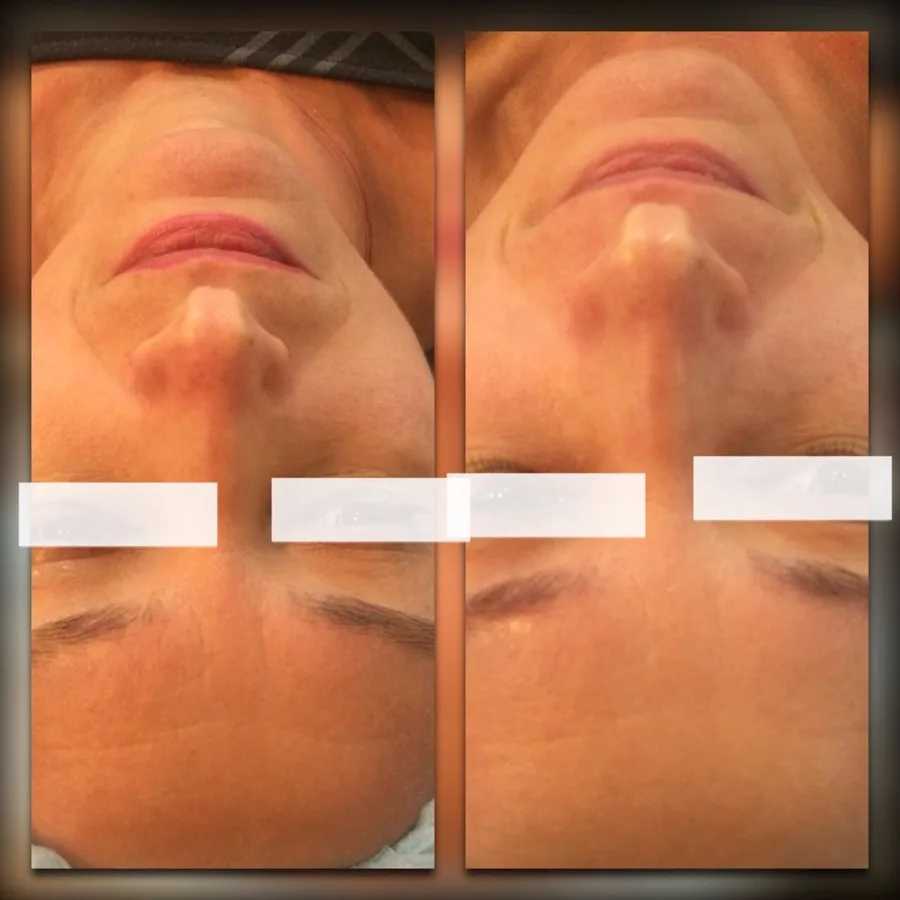
Lower face before and after a lifting treatment series at Real Skin Beauty. Individual results vary.
Collagen Supplements: What the Evidence Actually Shows
Collagen supplements, primarily sold as hydrolyzed collagen peptides in powder or capsule form, have become one of the most popular wellness categories in the past decade. The clinical evidence for them is more nuanced than either the marketing claims or the skeptical dismissals suggest.
The skeptical argument runs as follows: collagen is a protein. When you eat protein, your digestive system breaks it into amino acids. Those amino acids enter the bloodstream and the body uses them wherever it needs to, not specifically in your skin. Therefore collagen supplements are just expensive amino acid sources, no better than eating a chicken breast. This argument is biologically accurate as far as it goes, but the picture is slightly more complicated.
Hydrolyzed collagen supplements are pre-broken into peptide fragments before you consume them, specifically into fragments small enough to be absorbed through the gut wall without complete digestion. Some of these peptides, particularly hydroxyproline-containing dipeptides, appear to reach the bloodstream intact in detectable quantities and have been shown in some studies to stimulate collagen synthesis in fibroblasts. The specific peptides from hydrolyzed collagen may carry a signal that generic amino acid mixtures do not, which is the theoretical basis for why collagen supplements might do something that simply eating more protein does not.
The clinical evidence: a 2019 systematic review in the Journal of Drugs in Dermatology analyzed 11 randomized controlled trials of oral collagen supplementation. The studies found statistically significant improvements in skin elasticity and hydration, and some studies also found improvements in collagen density. The effect sizes were modest and the studies were generally small, with most running 8 to 12 weeks. The honest assessment is that the evidence is promising, more than zero, but not definitively established at the level of confidence we have for topical retinoids or red LED.
What I tell clients who ask about collagen supplements: if you are already doing the foundational things well (consistent SPF, retinol, vitamin C, adequate protein intake, professional treatments) and you want to add collagen supplements to see if they make a noticeable difference for you, the risk is low and the potential benefit is real, though likely modest. If you are not yet doing the foundational things and you are taking collagen supplements instead of or before those, you are prioritizing the less-established intervention over the better-established ones. Get the foundation right first.
Building a Collagen-First Treatment Strategy That Works
A collagen-first treatment strategy works by simultaneously addressing the three variables in the collagen equation: increase synthesis, reduce breakdown, and maintain the biological conditions that support both. Every element in an effective protocol maps to one of these three goals.
The collagen-first home routine
The home routine that best supports collagen from the at-home level:
Morning: vitamin C serum (10 to 20 percent L-ascorbic acid or stable derivative). Provides the essential cofactor for collagen synthesis. Also inhibits matrix metalloproteinases and neutralizes UV-generated free radicals that break down collagen.
Morning: SPF 50 daily without exception. UV radiation is the primary driver of accelerated collagen breakdown. Sun protection is the most impactful single anti-aging action available at any age.
Evening 2 to 3 nights per week: retinol at a concentration your skin tolerates. Increases collagen gene expression. Inhibits MMPs. Builds tolerance gradually over the first 3 months.
Evening: ceramide moisturizer every night. Maintains barrier integrity so active ingredients stay where they are needed and transepidermal water loss does not trigger chronic low-grade inflammation that upregulates MMP activity.
The collagen-first professional protocol
The professional treatment schedule that produces the most consistent collagen improvement in the clients I work with in Orange County:
Monthly microcurrent maintenance following the initial series. Sustains fibroblast stimulation through ongoing ATP amplification. Also maintains muscle tone that supports tissue architecture.
8 to 12 LED sessions as an initial series, followed by monthly maintenance. Consistent photobiomodulation collagen stimulation with no recovery burden.
Quarterly medium-superficial chemical peel to trigger the wound-healing collagen remodeling cascade. 4 peels per year at appropriate intervals provide ongoing collagen remodeling stimulus without over-treating the skin.
Annual assessment comparing current photographs to baseline to evaluate progress and adjust the protocol for what the skin needs in the next treatment year.
Realistic timeline for collagen improvement
Clients in my Irvine studio who begin a comprehensive collagen-first protocol need to understand the timeline before they start:
Weeks 1 to 4: Skin quality improvements from surface exfoliation and hydration optimization. No significant collagen changes yet. This is establishing the conditions for the changes that follow.
Weeks 4 to 8: Fibroblast stimulation from LED and microcurrent begins producing early new collagen. Skin starts to feel firmer and more resilient. Not yet visible in photographs in most cases.
Weeks 8 to 16: Cumulative collagen production from consistent treatment becomes visible. Skin photographed at 90 days shows measurable difference from baseline in texture, firmness and plumpness.
3 to 6 months: Full results from the initial treatment series become visible as newly synthesized collagen matures and reorganizes in the dermis. Retinol's collagen stimulation also reaches its full visible effect in this timeframe.
Anyone who promises dramatic collagen results in 2 weeks from any non-invasive treatment is selling marketing, not biology. Collagen synthesis and remodeling are slow processes that respond to consistent, appropriate stimulation over months. The good news is that the results are real, cumulative and visible when the right treatments are applied consistently. Book a free consultation to discuss a collagen-first treatment plan specific to your skin. The about page describes my background and approach to evidence-based treatment recommendations.
Frequently Asked Questions
Can you actually rebuild lost collagen?
Yes. While you cannot restore the collagen density of your 20s, treatments that use energy to stimulate fibroblast activity, such as red LED and microcurrent, and treatments that trigger a wound-healing collagen cascade, such as chemical peels, do produce measurable new collagen synthesis in living tissue. The key is consistency over a meaningful time period. Three to six months of consistent treatment is the minimum for evaluating genuine collagen improvement.
Do collagen supplements work for skin?
The evidence is more promising than pure skeptics claim but less definitive than manufacturers suggest. Hydrolyzed collagen peptides have shown statistically significant improvements in skin elasticity and hydration in multiple randomized controlled trials. The effect sizes are modest. Consumed collagen is largely broken into amino acids during digestion and does not directly deposit in skin. Any benefit is indirect, possibly through specific peptide signaling that reaches the dermis. It is a reasonable addition to a complete protocol, not a replacement for better-established treatments.
What is the most evidence-backed collagen-stimulating treatment?
Red LED light at 630 to 670 nanometer wavelength and prescription tretinoin (retinoic acid) both have strong, independently replicated clinical evidence for non-invasive collagen stimulation. Histological studies have confirmed actual collagen density increases in treated skin for both. Medium-depth chemical peels have equally strong evidence but involve meaningful downtime. For accessible, no-downtime collagen stimulation, red LED has the best evidence base of the non-pharmaceutical professional treatment options.
Is microneedling or microcurrent better for collagen?
They target collagen through different mechanisms and are better suited to different concerns. Microneedling creates controlled micro-injuries that trigger a wound-healing collagen cascade similar to a chemical peel, producing meaningful collagen remodeling in the dermis. Microcurrent increases fibroblast ATP to fuel collagen synthesis without creating injury, and simultaneously addresses muscle atrophy and tissue descent that microneedling does not affect. For pure collagen density improvement, microneedling is generally more impactful. For muscle-related sagging, microcurrent is the appropriate choice.
How long does it take to see results from collagen-boosting treatments?
Collagen synthesis and maturation are slow biological processes. Most non-invasive collagen treatments require 4 to 8 weeks before any visible improvement appears in the skin. Full results from a consistent treatment series develop at 3 to 6 months as the new collagen fibers mature and reorganize within the dermis. This is not a treatment failure. It is the timeline of actual collagen biology. Before-and-after photographs at 90 days make the progress visible in a way that day-to-day observation misses.
Licensed electrologist and cosmetologist with 20+ years of experience. Aida sees clients at Real Skin Beauty, 18021 Sky Park Circle, Suite N, Irvine, CA 92614.
Book a free consultation at Real Skin Beauty in Irvine, CA. I will assess your skin, explain which collagen-boosting treatments are appropriate for your specific situation and build a realistic protocol.
This article is for informational purposes and reflects Aida Khazieva's clinical experience. It does not replace a personalized medical consultation. Individual results vary.