Electrolysis for Transgender Clients: A Full Body Guide
By Aida Khazieva·Electrolysis·14 min read·Real Skin Beauty, Irvine CA·Updated July 27, 2026
Electrolysis is central to many transgender women's transition in a way that it simply is not for most cisgender clients. The scale of treatment is larger, the emotional stakes are different, and the technical demands of working with developed beard follicles and genital skin require specific experience and careful planning. I have been providing electrolysis to transgender and non-binary clients at my Irvine studio for many years, and this guide covers what you actually need to know: why electrolysis is the right tool, how HRT affects your treatment, what genital preparation for surgery involves, and what a safe and affirming experience should look like.
Quick answer: Electrolysis is the foundation of transgender hair removal because it is permanent and works on every hair color, including the blonde, gray and red beard hairs laser misses. Full beard clearance typically takes 100 to 400 or more hours over one to three years. Most surgeons also require permanent hair removal before SRS.
Why Electrolysis Is the Gold Standard for Transgender Hair Removal
The two requirements that matter most for transgender hair removal are permanence and complete hair-color coverage. No other available method satisfies both simultaneously. Electrolysis does, and that is why it is the foundation of any complete transgender hair removal plan rather than an optional upgrade.
Laser hair removal requires melanin (pigment) in the hair shaft to work. It targets this pigment with light energy, converting it to heat that damages the follicle. For clients with exclusively dark hair and light skin, laser can achieve excellent and lasting reduction. Beard hair, however, is frequently mixed in pigmentation. Fair-skinned clients often have substantial proportions of blonde, light brown, or even red beard hairs that laser cannot address. Any client who has any gray or white beard hairs, whether due to age, genetics, or the natural variation that occurs during HRT, will find that a portion of their beard is permanently outside laser's effective range.
Electrolysis works through electrical current delivered directly to the follicle. The follicle's dermal papilla is deactivated through a combination of chemical and thermal action, with no involvement of melanin. Black hairs, gray hairs, blonde hairs, and white hairs all respond identically. For transgender clients who need to address the complete population of beard follicles, there is no substitute for this capability.
Electrolysis also holds the FDA's recognition as the only method for permanent hair removal. This recognition matters practically for one specific application that affects many transgender clients: pre-surgical genital hair removal. Most surgeons performing vaginoplasty or other genital reconstruction surgeries require documentation of permanent hair removal from the donor skin area. Electrolysis is the accepted standard for this requirement. Laser may be accepted as a supplement in some programs, but electrolysis is the verification baseline.
For transgender women, beard electrolysis is not a convenience or a cosmetic nicety. Visible beard hair, even the shadow of follicles beneath the skin, is one of the most persistent sources of dysphoria that persists after other aspects of transition have progressed. Early, consistent electrolysis makes a meaningful difference in daily life well before complete clearance is reached.
Why Laser Alone Is Not Enough
Beard hair is often mixed in pigmentation: dark, light brown, blonde, red, gray, or white hairs in the same area. Laser cannot address any hair without sufficient melanin. Electrolysis treats every hair color with equal effectiveness, making it the only method capable of complete permanent beard removal.
Facial Feminization: Beard Area Electrolysis
Beard area electrolysis is technically among the most demanding work in the field. Beard follicles develop under years of testosterone exposure and become some of the deepest, most coarse, and most densely populated follicles on the human body. Working through them requires patience, precision, and significant cumulative time. Understanding the technical reality from the beginning allows for realistic planning and appropriate expectations.
The beard area encompasses several zones with differing characteristics:
Upper lip: extremely high density, often the area clients are most eager to clear, requires thorough sequential treatment across multiple sessions
Chin: high density, deep follicles, often the coarsest hair in the beard area
Jaw and lower cheeks: high density, large surface area, often the longest total treatment zone by area
Sideburns: moderate density, often clears more quickly than central beard zones, producing early visible improvement
Neck: variable density, often clears in the mid-phase of treatment, can involve ingrown hairs from prior shaving that require careful probe insertion
I use the blend modality for beard area electrolysis in most cases. The blend combines galvanic current (which produces a sodium hydroxide reaction at the papilla) with thermolysis (high-frequency heat). Beard follicles are deep, well-vascularized, and firmly anchored. The blend's dual mechanism achieves more thorough deactivation in these robust follicles than either modality alone.
The most important thing I tell new beard-area clients is that the clearing process is not linear. The sideburns and neck often show dramatic improvement relatively early, which is encouraging. The upper lip and chin, with their highest density and deepest follicles, require the most cumulative treatment time. Clients sometimes describe a period midway through treatment where they feel the chin is not improving fast enough relative to other areas. This is normal. It reflects the density reality, not a failure of the treatment. Consistent appointments in this period are what move things forward.
Progressive reduction during treatment is also genuinely meaningful, not just a way of framing things positively. When beard density drops by 50 percent, the daily shaving time and shadow both decrease substantially. When it drops by 80 percent, many clients no longer need to shave daily. The psychological relief of these milestones, well before complete clearance, is real and significant.
Treatment starts with a private consultation to map the areas, timeline and session schedule.
How HRT Affects Hair Growth and Electrolysis Outcomes
Hormone replacement therapy for transgender women typically involves estrogen supplementation (oral, patch, gel, or injection) combined with an anti-androgen such as spironolactone or, in some cases, gonadotropin-releasing hormone analogues. Together, these medications reduce circulating testosterone and, over time, change the hormonal environment in which beard follicles exist.
The effect on beard hair is real but gradual, and it is important to understand both what HRT changes and what it does not.
What HRT does change over time:
New beard hair growth slows. Follicles that were producing hair rapidly under high testosterone may cycle more slowly on HRT.
Hair characteristics shift gradually. After 12 to 24 months of HRT, many clients find that beard hairs are somewhat finer and lighter in color than they were pre-HRT. The follicle structure remains, but the hair it produces is less maximally developed.
Electrolysis sessions become progressively more efficient. Finer, less deeply anchored hairs require less current per follicle to deactivate, which can mean faster sessions and reduced discomfort over time.
What HRT does not do:
HRT does not eliminate established beard follicles. The follicles that have been producing terminal hair for years are deeply structurally established. Without direct electrolysis treatment, they will continue producing hair indefinitely, even under estrogen therapy.
HRT does not produce visible, dramatic reduction in existing beard hair density within the first several months. The improvement in hair characteristics is gradual. Clients who stop shaving expecting HRT to clear their beard will be disappointed.
My practical recommendation: begin electrolysis as early in your transition as possible, concurrent with starting HRT rather than waiting for HRT to "do something first." The two processes work synergistically over time. Early electrolysis addresses the beard that HRT alone will not remove. As HRT gradually reduces hair coarseness over 12 to 24 months, electrolysis sessions become progressively more efficient, so the later sessions in your course benefit from the HRT changes.
Clients who wait until 18 months into HRT before beginning electrolysis are not wrong to do so; they may find their hair slightly finer when they start. But they have also lost 18 months of cumulative electrolysis progress during that period. The earlier you start, the sooner you reach clearance.
Genital Electrolysis for SRS and GCS Preparation
Pre-surgical genital hair removal is a specific and important application of electrolysis that many transgender women need to address well in advance of their surgical date. I want to provide clear, practical information about this process because it involves significant planning and timelines that affect surgical eligibility.
The reason pre-surgical hair removal is required is anatomical: vaginoplasty and other genital reconstruction surgeries use skin from the genital area (typically penile skin, and in some techniques scrotal skin) to create the vaginal canal. If that skin contains active hair follicles when it is incorporated into the new anatomy, the follicles will continue producing hair internally after surgery. Internal hair growth in a surgical neovagina is a serious complication that can cause infections, granulomas, and significant discomfort. Permanent pre-operative hair removal prevents this entirely.
The specific area that requires treatment depends on the surgical technique and the individual surgeon's requirements. Generally:
Penile inversion vaginoplasty: penile shaft skin is the primary area, sometimes extending to the perineum
Peritoneal pull-through: the donor area requirements differ; surgeon will specify
Some surgeons also require scrotal skin treatment if scrotal grafts will be used for the vaginal vault
I strongly recommend contacting your surgical team before beginning genital electrolysis to get a precise map of the areas they need cleared. Each surgeon and each surgical technique has specific requirements, and treating the wrong area or missing a required area creates problems close to your surgery date. I work directly from the surgical team's specifications whenever possible.
Timeline is the most critical planning element for genital electrolysis. Most surgeons require that treatment be completed and fully healed at least 3 months before the surgical date. Some require 6 months. This accounts for the healing of treated skin and a final verification of clearance. Planning 12 to 18 months before your target surgical date is advisable for most clients, because genital electrolysis requires multiple sessions timed around the hair growth cycles in that specific area, and any scheduling delays compound. Clients who try to complete genital clearance in the final 3 months before their surgery date are taking a significant risk with their surgical eligibility.
Session frequency for genital electrolysis is typically every 4 to 6 weeks, aligned with the hair growth cycles in that area. The genital skin is treated with attention to skin characteristics that differ from facial skin: it is thin and more reactive in some zones, and positioning and draping are managed with full attention to client comfort and dignity throughout every session.
Start Genital Prep Early
Most surgeons require genital electrolysis to be complete at least 3 months before surgery. Planning 12 to 18 months ahead gives you full flexibility and protects your surgical date. Starting this process too late is one of the most common reasons surgery dates are delayed or rescheduled.
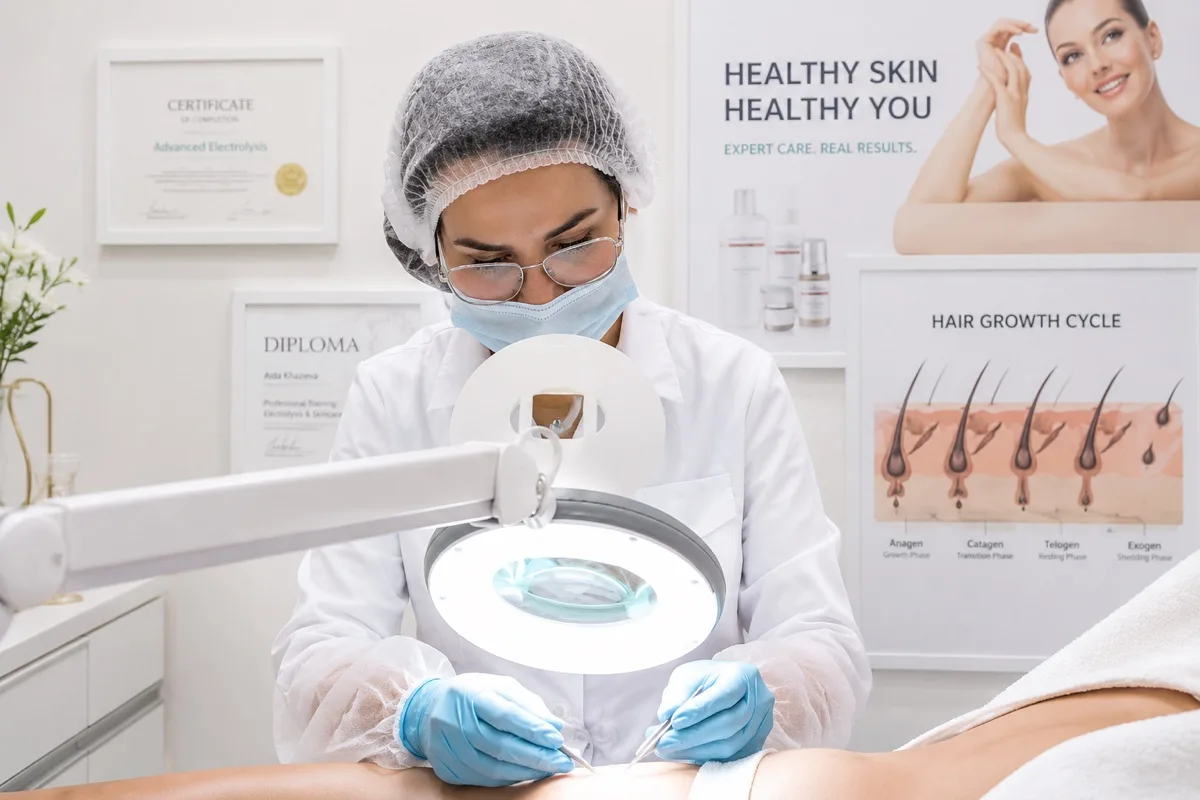
Aida Khazieva during an electrolysis session at her Irvine studio.
Timeline and Sessions for Full Beard Clearance
I am going to give you realistic numbers here because I think the field does clients a disservice when it either overpromises on timeline or is so vague that planning becomes impossible.
Full beard clearance, meaning permanent removal of all beard-area follicles, is one of the most time-intensive electrolysis projects that exists. The total hours required depend primarily on three factors: beard density at the start of treatment, coarseness of individual follicles (which relates directly to how many years of testosterone exposure the follicles had), and HRT duration and effectiveness at the time treatment begins.
Realistic total treatment hour ranges by beard type:
Light beard density, fine to moderate coarseness, HRT 12+ months prior to starting electrolysis: 100 to 150 total treatment hours over 12 to 18 months
Moderate beard density, typical coarseness for a client 2 to 5 years into transition: 150 to 250 total hours over 18 to 30 months
Heavy beard density, coarse follicles, early in transition or pre-HRT: 250 to 400+ total hours over 2 to 3 years
These ranges reflect the full course to clearance, not what is needed to reach a point of comfortable daily management. Many clients reach a degree of reduction where daily shaving is no longer needed, or is only needed for the densest chin and upper lip zones, within the first 12 to 18 months. Reaching that milestone is meaningful even before full clearance.
Session structure typically evolves over the course of treatment:
Early phase: 1.5 to 2 hour sessions weekly or biweekly to build initial momentum across all zones
Mid-phase: 60 to 90 minute sessions every one to two weeks, concentrating on the highest-density remaining areas
Final phase: 30 to 45 minute sessions monthly for touch-ups on stragglers and any new follicles that activated during the course
The clearing is not uniform in pace. Sideburns and neck areas often show rapid improvement early, which is encouraging. The upper lip and chin are typically the last areas to fully clear and require the most concentrated sessions. Clients who maintain consistent appointments through this middle period, even when progress on those zones feels slower than it did initially, are the ones who reach clearance. Gaps in treatment during the high-density work phase are the main reason timelines extend unexpectedly.
What an Affirming, Safe Electrolysis Experience Looks Like
I include this section because the quality of the electrolysis experience varies significantly by provider, and transgender clients deserve a clear picture of what they have a right to expect, not just hope for.
At minimum, an appropriate electrolysis provider should:
Use your correct name and pronouns consistently, at every appointment, without requiring a reminder each time
Maintain complete confidentiality about your treatment and your transition status
Handle scheduling, billing, and any communications with discretion and professionalism
Provide a private, comfortable treatment environment where you do not feel observed or on display
Offer no unsolicited commentary on your body, your transition timeline, your surgical plans, or your personal circumstances
Understand the full treatment picture for transgender clients: how HRT affects hair, what genital preparation involves, how to coordinate with surgical teams
At Real Skin Beauty in Irvine, I provide exactly this for my transgender and non-binary clients. I understand that beard electrolysis and pre-surgical preparation are not routine cosmetic treatments in the way that leg hair removal might be. They are part of a broader transition that carries real weight, and I take that seriously in every session.
I also want to acknowledge something that I observe in practice: the emotional experience of early beard clearance sessions is different from later ones. In the first months, the visible impact of each session is still modest, and the goal feels distant. By the midpoint of treatment, the tangible reduction in visible hair and in daily grooming burden creates a different relationship with the process. Clients who come to me describing significant dysphoria around their beard shadow in the early months often describe the later phases of treatment as a meaningful shift in how they feel in their own skin.
I do not approach this work as a technical procedure with an emotional client in the waiting room. The technical and the personal are both present in every session, and both deserve competent, respectful attention.
What You Should Expect from Any Provider
Correct name and pronouns used consistently. A private treatment space. No commentary on your body or transition. A provider who understands HRT effects, genital prep requirements, and realistic beard timelines. These are professional minimums, not special accommodations. If a provider cannot meet these standards, find one who can.
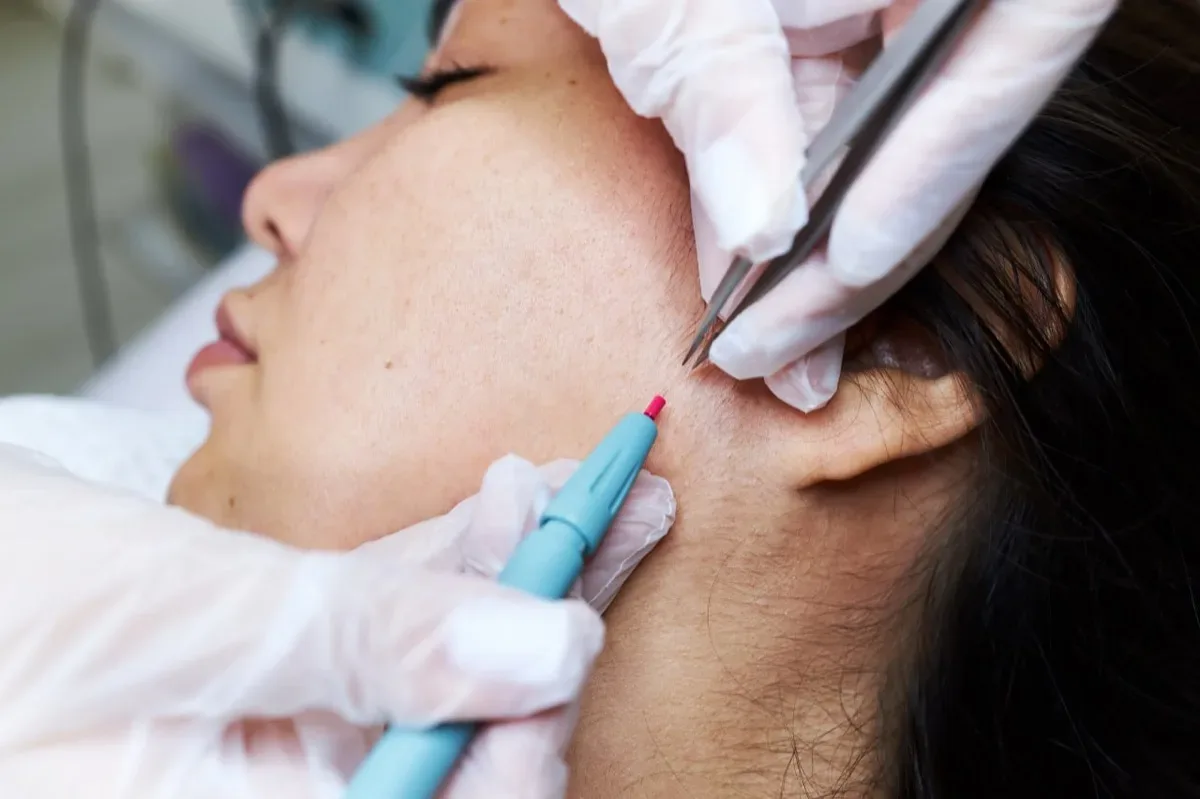
Facial hair is cleared follicle by follicle, with sessions scheduled around the hair growth cycle.
Combining Laser and Electrolysis Strategically
Some transgender clients benefit from using both laser and electrolysis rather than choosing one exclusively. When this combination makes sense, how to sequence it, and when it does not apply are worth understanding clearly before making any treatment decisions.
Laser and electrolysis are not competing methods for the same goal. Laser reduces the volume of dark, pigmented hairs efficiently and at relatively lower per-session cost. Electrolysis permanently removes every hair it treats regardless of color, at a pace limited by the number of follicles that can be individually treated per session. For clients with very dense, predominantly dark beards, using laser to reduce initial density can lower the total electrolysis hours required to achieve final clearance.
A typical combined approach for eligible clients looks like this:
Four to eight laser sessions on the highest-density zones (typically jaw, lower cheeks, and neck) to reduce overall follicle volume in these areas
Parallel electrolysis on the upper lip, chin, and sideburns, which often have mixed pigmentation that makes them poor laser candidates from the start
Electrolysis-only for all remaining hair after laser has reached its effective endpoint, treating the complete remaining population across all areas regardless of color
This approach is not appropriate for every client. Candidates who benefit most from a combined approach have:
Predominantly dark beard hair (at least 70 to 80 percent dark pigmented hairs)
Skin tone light enough for safe laser treatment on the beard area
High beard density where the volume reduction from laser meaningfully affects total electrolysis time
Clients who may not benefit significantly from laser first include those with predominantly light, gray, or mixed pigmentation in the beard; darker skin tones where facial laser carries more risk; or moderate beard density where the volume reduction from laser is marginal relative to the cost of the laser sessions themselves.
I discuss this individually at consultation rather than recommending one approach universally, because the right decision depends on your specific hair characteristics, skin type, HRT duration, and budget. Some clients prefer electrolysis exclusively for simplicity. Both paths reach the same destination.
Questions to Ask Any Electrologist Before Starting
Not all electrologists have experience with transgender clients, and not all have experience with full beard clearance or pre-surgical genital preparation. These are specialized applications that require specific knowledge. Here are the questions I recommend asking at any initial consultation, along with what good answers look like.
How much of your practice involves transgender clients? A provider who sees transgender clients regularly will have experience with the specific characteristics of testosterone-developed beard follicles, the effects of HRT on hair over time, and the emotional context of this work. A provider who rarely sees trans clients may be technically competent but may not understand the full picture.
What modality do you use for dense beard hair? The blend method is the most appropriate for the deep, coarse follicles of a developed beard. A provider who uses thermolysis only for all clients may not be calibrating their technique specifically for beard characteristics.
Can you give me a realistic total hour estimate for my beard? A provider who answers with a specific range (100 to 300 hours depending on density) is more credible than one who gives you a very short timeline that sounds optimistic. Full beard clearance on a developed beard takes significant hours. Anyone promising clearance in 20 to 30 hours is not giving you an accurate picture.
For genital preparation: what is your protocol for coordinating with surgical teams? A provider experienced in pre-surgical preparation will know to ask for your surgeon's specific clearance map, will understand the healing timelines surgeons require, and will be comfortable discussing this aspect of care without awkwardness or hesitation.
How do you handle scheduling and communication for clients who need discretion? A professional provider will have clear answers. Appointment reminders can use initials or a preferred name. Billing descriptions can be kept appropriately vague. These accommodations should not require special requests.
For clients in Southern California, I welcome consultations at Real Skin Beauty in Irvine and provide care for transgender clients from across Orange County and beyond. Book a free consultation here, or visit the FAQ page for additional background on the electrolysis process and what to expect at your first appointment.
Frequently Asked Questions
Can electrolysis remove a full beard for transgender women? +
Yes. Electrolysis is the only method that permanently removes all beard hairs regardless of color. Full beard clearance typically requires 100 to 400 or more hours of treatment depending on beard density, coarseness, and how long HRT has been in effect. This is planned over one to three years with regular appointments. Every session makes permanent, cumulative progress toward a clean result.
How does HRT affect electrolysis for transgender clients? +
Estrogen therapy reduces circulating androgen levels, which causes beard hairs to gradually become finer and slower-growing over time. This makes electrolysis progressively more efficient as treatment continues. Many trans clients find that sessions become faster and more comfortable after 12 or more months of HRT, as the hair characteristics shift in response to the new hormonal environment. Starting electrolysis concurrent with HRT rather than waiting produces the best combined outcomes.
Do I need genital hair removal before SRS or GCS? +
Most surgeons require pre-operative permanent hair removal from the donor skin area used in vaginoplasty. Hair follicles left active in skin incorporated into the vaginal canal will continue producing hair internally after surgery, causing significant complications. Electrolysis is the required and accepted method, and some surgeons accept laser as a supplement for areas with dark hair. Confirm the specific requirements with your surgical team before beginning.
Is Aida experienced with transgender clients? +
Yes. I provide affirming, discreet care for transgender and non-binary clients at Real Skin Beauty in Irvine. I understand both the physical and emotional dimensions of beard electrolysis and pre-surgical preparation, and I maintain a respectful, professional environment at every appointment. Correct name and pronouns are used consistently without needing a reminder.
How soon before SRS should genital electrolysis begin? +
Most surgeons require that genital electrolysis be complete and the skin fully healed at least 3 to 6 months before surgery. Planning 12 to 18 months ahead is advisable for most clients, as this gives the most scheduling flexibility and allows for additional sessions if any areas need further treatment. Starting too late is the most common reason surgical dates are delayed by an otherwise ready client.
Licensed electrologist and cosmetologist with 20+ years of experience. Aida sees clients at Real Skin Beauty, 18021 Sky Park Circle, Suite N, Irvine, CA 92614.
Book a free consultation with Aida Khazieva at Real Skin Beauty in Irvine, CA. Private, affirming, and focused on your specific treatment needs and timeline.
This article is for informational purposes and reflects Aida Khazieva's clinical experience. It does not replace a personalized medical consultation. Individual results vary.